Blog

Theorizing Modernities article

God’s Plan, Or Institutional Violence? Congolese Refugees in Kampala between Hope And Disillusionment

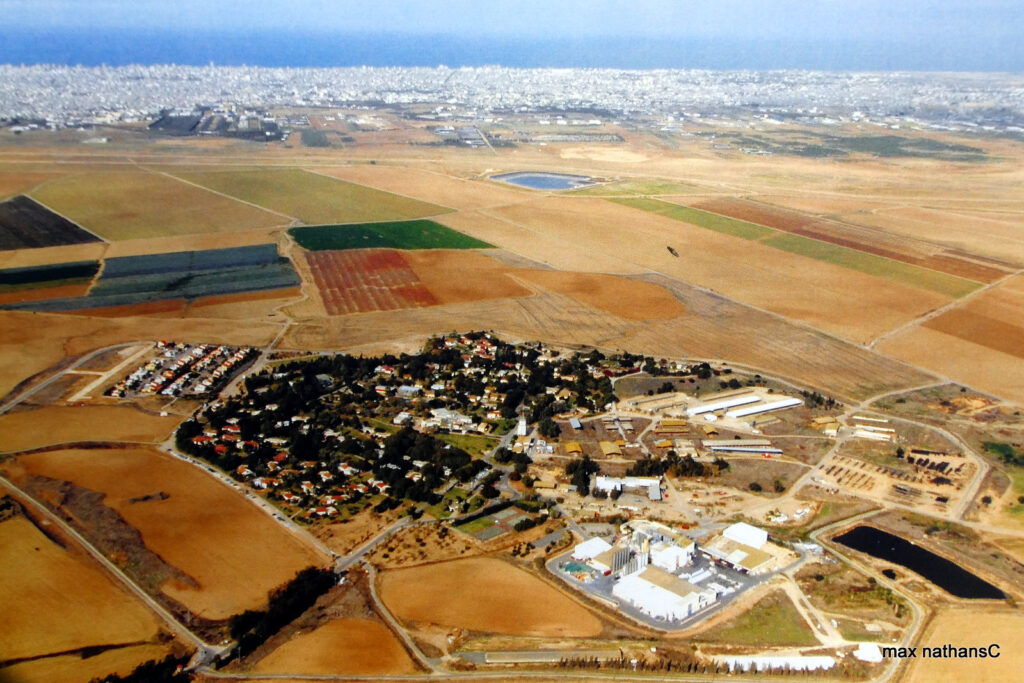
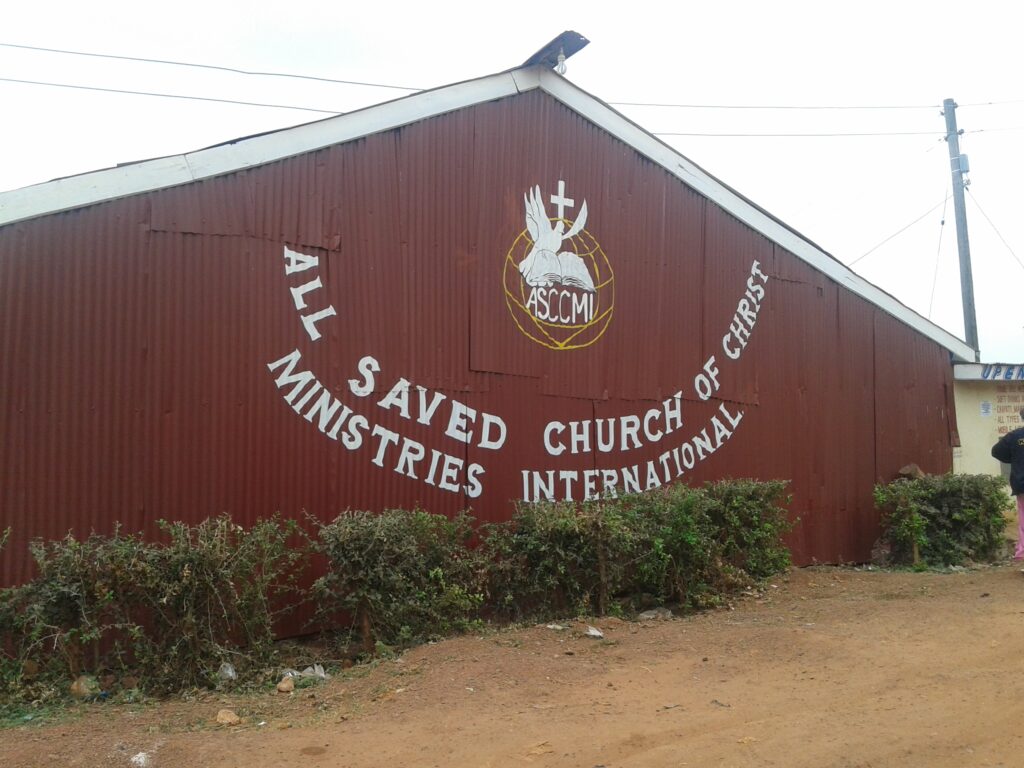
All Saved Church of Christ. One of the 15 Congolese “Églises de Réveil” in the neighborhood of Katwe. These churches are usually built in cheap and perishable materials. October 2015. Photo courtesy of Alessandro Gusman.

God has a plan for you; never forget this truth: God has a plan for you. Even if you are a refugee and you can’t see where your future will be, God has a plan for you; even if you are suffering here in Kampala, God has a plan for you; even if you have been here in Uganda for 5 years, or for 10 years, don’t forget, God has a plan for you. This is not something you can know in advance, you just have to put faith on him, because he has a plan for you.

This excerpt from a sermon delivered by a Pentecostal pastor echoes a commonly heard theme one hears in the many Congolese Pentecostal churches around Kampala, the capital city of Uganda: never lose faith in God and his plan, mysterious to humans, but clear in his mind. According to this narrative, the suffering of today and of the past should be interpreted as part of a divine plan that is beyond humans’ comprehension; there is nothing one can do but trust in God, knowing that sooner or later this plan will be accomplished. This theme projects into the future a resolution to the current suffering one faces, maintaining expectations beyond the situation experienced in the present. Briefly, it creates a hope for the future in a situation of extreme existential and legal uncertainty, as is the case for the majority of the more than forty thousand Congolese refugees currently living in Kampala (out of almost half a million who live in Uganda as a whole). They arrived in Uganda in different periods of time through the last three decades, fleeing the conflicts and protracted violence in the Kivu region (Eastern Congo). Many of them live in the settlements in the West and South-West of Uganda. Yet, an increasing number choose to leave the settlements and move to urban centers, where they aim to find better opportunities in terms of education, work, and physical safety.

The reference to trust in a divine plan is identified as a coping strategy by refugees, who listed it as the main mediator of the significant stress that they face in light of their economic and social insecurity and isolation. In conducting my own research in Kampala, I have seen it also operate as a tool to counter the chaotic experience of refugee life, the sense of anxiety and despair generated by the protracted refugee status, and the difficult living conditions of urban refugees. Becoming part of a congregation is also seen as part of this divine plan, as is meeting people in church who provide financial support, help rebuild social networks, and aid refugees in confronting the many other challenges that they face. In short, talking about God’s plan helps Congolese refugees find an order in life, and to project onto a different dimension, that of the divine, their expectations, which are often unachievable in the present.

Another narrative of hope frequently adopted in the Congolese churches in Kampala is that of the biblical story of the people of Israel. The long transit through Uganda (many Congolese have now lived in the country for ten or more years) is symbolically likened to the crossing of the Sinai desert narrated in the book of Exodus, with the prospect of reaching—albeit after a long period of suffering—the promised land, identified as the place of resettlement. Hence, on the one hand these refugees experience the anguish that results from living in a prolonged suspension from living a full life. On the other hand, there is hope, which in Christian theology is the expectation that something that is already there (in this case, a solution to the present condition) will be fulfilled, not that something which may not be real or possible will come to pass. This religious affect of hope seems to be particularly active in the case of the refugees I worked with, because it stands in contrast to the realization that the three “durable solutions” (repatriation, local integration, resettlement) proposed by secular international bodies are ineffective; as I will emphasize below, it is against this ineffectiveness of secular narratives that the Congolese refugees in Kampala have developed the idea of being exposed to a fourth solution, that of a “silent death” in the refuge. In this context, religious institutions maintain an important alternative welfare function too, providing shelter and material aid, as well as spiritual support and opportunities to socialize and share painful experiences in DRC Congo and Uganda itself. Moreover, Christian narratives of suffering and redemption help Congolese refugees in Kampala to make their present experience of suffering, marginality, and displacement more understandable and therefore also somewhat more tolerable. Religious language is crucial in the way Congolese refugees describe their life in Kampala and make sense of it. In light of the fact that states of insecurity and fear mark their everyday reality, they translate these realities into a different affective realm, one in which faith in God and in his plans provides room for narratives of hope.
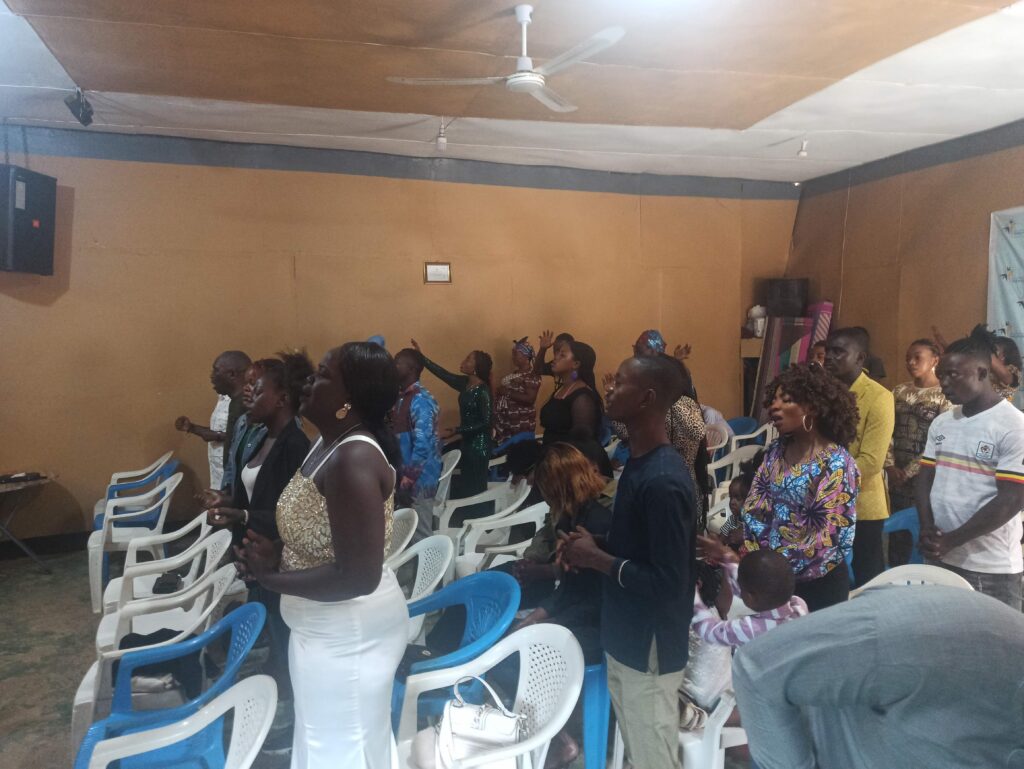
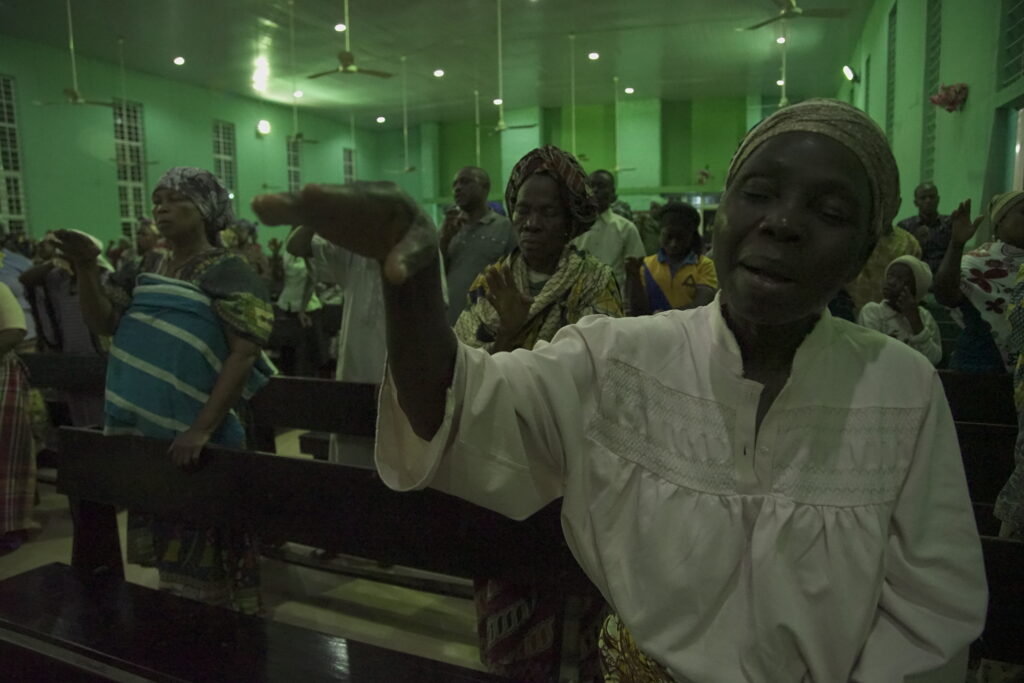
Église Gloire de Dieu. Congolese congregations in Kampala include 50 to 200 members. They regularly meet on Sunday and on 2–3 other days in the week for prayer and worship. May 2022. Photo Courtesey of Alessandro Gusman.

However, as the time living in refuge becomes more and more protracted, this hope begins to give way to disillusionment, especially among the older generations of refugees and those who have been in Uganda for many years. I started conducting research with the Congolese in Kampala in 2013. At that time, resettlement was an extremely popular discourse and a concrete hope for the future for many. This is because a return to Congo was (and continues to be) an unrealistic (and often unwanted) prospect. In the case of Congolese refugees, Congo is often conceived with a nostalgic feeling of a “lost home,” a place to which it is not possible to return. Thus, the idea of Congo as a “nation” to be supported and to which to return one day is not widespread among Congolese in Kampala, nor it is “exile nationalism”; the only well-known case of nationalism in the Congolese diaspora is the one of “Les Combattants”, a network of intellectuals who live in Europe and North-America and who are critical towards the Congolese state. However, most of my interlocutors in Uganda didn’t even know about this group, or had just heard about it but considered it something far from their experience.

The link to Congo is thus mainly an affective one, most of them declare they are “proudly Congolese”; yet, they do not plan, and do not want, to return. In this situation, resettlement is seen as the only possible way out of the refugee condition. My interlocutors were confident that with God’s help they would soon be travelling to the US, Canada, or another of the UN Refugee agency resettlement destinations. They were in Uganda, waiting for the plan God had for them to be realized, and were hearing in sermons that they should wait patiently for their turn to come. No one could know when, but their long transit would eventually come to an end. Almost ten years later, most of those same people who had expressed hope of building a life elsewhere are still stuck in Kampala. In this situation, maintaining a hope in the future becomes increasingly difficult, and many now express feelings of disillusionment and despair. During my most recent periods in Kampala, in June 2022 and in September 2023, it was not uncommon for me to be told, “I no longer know what my future will be,” “I am beginning to feel that I will be trapped here forever,” or “I no longer have any hope of travelling, I no longer have any plans for the future”; for planning implies having a hope in the future, which for many of the Congolese refugees in Kampala is fading away.

In light of the fact that states of insecurity and fear mark their everyday reality, they translate these realities into a different affective realm, one in which faith in God and in his plans provides room for narratives of hope.

Given the extended length of time that they have lived as refugees, the ability for religious narratives to aid refugees in maintaining positive expectations for the future is also fading. If “hope” in God’s plan is still present in the way Congolese pastors frame their preaching during Sunday sermons, outside of churches refugees seem to turn more and more to a different language, one in which the reference to hope leaves room to make political accusations towards the institutions that they believe are responsible for their condition, as these institutions do not provide real “solutions” to the condition of refugee. In the experience of many of the Congolese refugees, return, local integration, and resettlement are all unrealistic options, and they often remark the distance between international policies that remain on paper, and their everyday feeling of being stuck in Uganda. With the concept of “mort silencieuse” (“silent death”), they describe the extreme consequences of a “protracted refuge” when it appears to have rather become a permanent one. When this condition lasts indefinitely and does not allow a way out to be glimpsed, the prevalent feeling is of no longer being able to “hope for” a solution to the present situation, but of being left to die silently in the country that was imagined as a place of transit and from which one can no longer leave. Congolese refugees have thus started calling this condition of despair and disillusionment a “fourth durable solution,” an expression they use as an allegation against the Ugandan government and international bodies, which they consider co-responsible for the prolonged condition of limbo they are experiencing as refugees. Despite the hospitality offered to them, the Ugandan government is reluctant to allow a form of de jure integration by granting citizenship to those refugees who have been in the country for a long period of time. In addition to this, return to the DRC is made impossible by the protracted conflicts in the eastern regions, and resettlement numbers are increasingly low due to the unwillingness of those countries that have been historically more open to receive refugees (mainly North American, Central and Northern European countries, and Australia) to continue to act as resettlement countries. For these reasons, the common condition for Congolese refugees in Uganda is that of a prolonged lack of citizenship rights and recognition of their claims. In the face of this institutional violence, religious narratives are not emphasized, yet they are complemented by a political claim that becomes stronger and that should not be reduced to a passive acknowledgement of an ineluctable fate, but rather recognized as a renewed plea for a possibility to build a future.
Alessandro Gusman
Alessandro Gusman (Ph.D. in Social Anthropology) is Associate Professor of Anthropology at the University of Turin, Italy. His research focuses on the presence of Pentecostalism in Uganda, on Congolese churches in Kampala, and on ageing and end-of-life care in the Italian context. He is the Director of the Italian Ethnological Mission in Equatorial Africa, and of the research center CPS-Africa, which organizes the Summer School TOAfrica. He is the author of the books Pentecostistes en Ouganda. Sida, moralité et conflit générationnel (2018) and Antropologia dell’olfatto (2004), and coeditor of Strings Attached: AIDS and the Rise of Transnational Connections in Africa (2014, with Nadine Beckmann and Catrine Shroff) and Urban Africa (2017, with Cecilia Pennacini).
Theorizing Modernities article

Turning Away: White Nationalism and a Paraphenomenology of Darkness

Zenit ET – Black – v1 camera. Via Wikimedia Commons.

I hate to admit it, but I think about White people damn near all the time. I’m constantly concerned about what they do, about how their words and actions affect me. I wish this weren’t the case. But I cannot help it. 

It is not simply the “conservatives” who occupy my mind, though. All that “anti-woke” foolishness is just that—foolishness. It is idiocy. It is violent. And it has brutal effects. But it’s not just them. It is also the liberals. They irritate me, too. For their hypocrisy is apparent. Everywhere. 

Or maybe it isn’t hypocrisy. Maybe DEI™ is just the latest iteration of an old philosophy. We have been here before. The “Great Chain of Being” called us here. It structured this world. In fact, it structured the very notion of world. (And if you know Hegel, you know a notion is always more than a notion.) According to this chain, we are all branches from the same Adamic tree. The chain was hierarchical, but it wasn’t exclusive—not in an absolute sense. As Zakiyyah Jackson and Sylvia Wynter remind us, it wasn’t that Africans-turned-negroes were left out. The “negro” might have been an invention, but even it had its place in the great schema (or scheme?) of philosophical and theological anthropology. They were—we are—included. Still. 

I therefore live according to their rules. Those rules govern my life. They shape my perception. They form my horizons. They dominate my attention. 

And, sadly, they control my thoughts. 

And that is the violence. I know we are here to talk about “White nationalism.” This term allegedly conjures up image of tiki torches and white hoods; it is meant to invoke fights over statues and “Moms for Liberty.” But if you look deeper, you recognize: White liberals are White nationalists, too. As they reach for reform at every turn, as they embrace a crass pragmatism disguised as “being realistic,” they name themselves as invested in the same project as their conservative counterparts. To miss this is to be foolish.

To speak of White nationalism, then, is to recognize White supremacy as a common project. A common project of whiteness. Which is to say, a common project of antiblack violence, of antiblackness. We are made to conclude that the source of this violence is found in the mass shootings and the book bans. We are supposed to conclude that the “southern” states are off their rocker, that they are the site and source of our national ills. 

White liberals are White nationalists, too. As they reach for reform at every turn, as they embrace a crass pragmatism disguised as “being realistic,” they name themselves as invested in the same project as their conservative counterparts.

But this is not the case. The source of White nationalist violence is not found in the physical and legislative brutality enacted in public spaces and proclaimed in state and federal legislatures. The violence is not simply in the people themselves. It is also in the institutions and structures that are built upon and sourced from that common antiblack white supremacist project. This project might be socially constructed, but it is not a fiction. It is real. It structures our social reality. To borrow from Wynter again, if we only think of the actors, if we only think of White supremacy in terms of those who say and do disgusting things, then mistake the map for the territory; for the real source of the violence is in its capacity to dominate our attention and occupy our headspace. Whiteness, White supremacy, White nationalism—call it whatever you like—shapes the horizon of what we can and should see. White people are beneficiaries of these horizons and this shaping. Arguing about monuments, getting riled up about White people enacting insurrectionist violence—hell, even getting caught up in Donald Trump’s latest legal fiascos—all of this is meant to distract, to turn our attention toward them and away from ourselves.

Steve Biko once said that “the greatest weapon in the hands of the oppressor is the mind of the oppressed.” I agree. But I must admit: my mind still needs work. Because they dominate my attention. Long ago, a philosopher—well, his translators—used the term “they” to discuss normative (read: White) actions, presumptions, and perspectives.  A “normal” person does what they do. One sees as they see; one attends to what they attend to. 

This philosopher said he was doing mere description. He claimed he was simply articulating the state of affairs. And maybe he was. I can’t call it. But I know that this philosopher was a White supremacist. Which means that his “description” wasn’t neutral. It was steeped in power relations. The “normal,” the they, isn’t neutral. There is power attached to normality. We call it normativity. And normativity structures what should be attended to and what shouldn’t. When they dominate my perceptions, it isn’t innocuous. In fact, as Frantz Fanon once claimed, they are the ones who tell me that I am nothing more than an “object among other objects,” that whatever I see (or want to see) is structured by what they see (89). 

When I speak of they, then, I am speaking of the various structures and embodiments of White supremacist anti-Black normativity. For, even when I might not want them to, they structure my perception and determine what I have come to understand as knowledge. What I see, what I am made to see, is dominated by them. 

Call me weak. Call me foolish. But I cannot help it. Not unless I focus. Not unless I turn my attention away from them, away from what they do. I cannot do my work so long as I am focused on them. For as long as I am preoccupied with them, I am not engaged with us. 

To turn our attention away: that is the move. I believe that the radicality of Black study is not simply found in its philosophical criticisms of White supremacist anti-Blackness—though there is something to be said for this, to be sure—but instead is sourced from a different kind of attention. And this different attention would entail a different kind of experience—a different structure of experience. Phenomenology wouldn’t hold here; as Derrida once told us, phenomenology is, always, a phenomenology of light. Phenomenological experience is about what can be brought to the light—to the White light of epistemological transparency. 

The radicality of Black study is not simply found in its philosophical criticisms of White supremacist anti-Blackness, but instead is sourced from a different kind of attention.

Visibility, then, is a tool of Whiteness and White supremacy. As Lewis Gordon once put it, Whiteness determines what appears—what is deemed a “licit” or “illicit” appearance. And as I’ll show later, Sara Ahmed makes it clear that a phenomenology of Whiteness is about who and what fits and how—which is to say, who and what is rendered visible, and for what reasons. 

But I come from the dark. And because I come from the dark, my appearance, my presence, my visibility—even my own perceptions—are rendered subject to the phenomenology of White experience that dominates this world. I am not always invisible, but my appearance is illicit. And that illicit appearance renders my perceptions invalid. Hence, my focus on them. 

And yet, I still come from darkness. My birthright is the darkness of night, the depths of the sea. And there is something about the darkness that opens possibilities. There is something powerful about darkness, something generative. And that’s what I want to think with. How might we think with the dark? How might we engage in a paraphenomenology of darkness, a description of what cannot be seen? 

Here’s what I have to offer.

***

For some time now, I have been mesmerized by a passage from Toni Morrison’s Beloved. It comes in Beloved’s chapter, where she begins to speak. In speaking, she leaves grammar and punctuation behind. Perhaps she leaves it behind because she is trying to leave her body behind.

we cannot make sweat or morning water so the men without skin bring us theirs one time they bring us sweet rocks to suck we are all trying to leave our bodies behind the man on my face has done it it is hard to make yourself die forever you sleep short and then return

Even if you have not read Beloved, the only context you need for this passage is that Beloved is in the hold. She is in Middle Passage. And being in Middle Passage takes away the sense, the meaning of this passage. This passage in and from the Middle Passage doesn’t make sense. In philosophical terms, it does not give itself. It is not given. It is not an object of perception, of meaning; it leaves the question of significance behind. Understanding is impossible here. All we have are fleeting observations, called and culled from the violence of being too close, of being in such frottage that even the very capacity to move is stunted: “someone is thrashing,” Beloved tells us, “but there is no room to do it in.” Fuck a body schema—the body is a trap. 

First paraphenomenological insight: the Black body is not a site of freedom.

There is more. Read the passage again. And now, pay attention to the “men without skin.” These figures are not beautiful. Their morning water, their piss, is not a gift. These men are ugly—physically and ethically. But pay close attention to Beloved’s method. She is describing the conditions of her experience, the structure of a lifeworld to which she does not have access. She is engaging in paraphenomenology here, and what we see, what we are enabled to see, is nothing less than the ghastly grotesqueness of White aesthetics. Whiteness is not beautiful. It is hideous. It has no skin. It is burned by the sun and changes color in the breeze. What is given in the light of whiteness is nothing more than the blinding luminescence of violence. 

Second paraphenomenological insight: White aesthetics are not to be embraced, let alone attended to.

There is one last paraphenomenological insight that I think we need to underscore: Blackness is to be loved. Though I didn’t record the whole speech here, there is a moment when Beloved says the following: 

if I had the teeth of the man who died on my face I would bite the circle around her neck bite it away I know she does not like it now there is room to crouch and to watch the crouching others

In “Blackness and Nothingness (Mysticism in the Flesh),” Fred Moten calls our attention to the possibility that the hold was a “language lab,” a space where care and love were possible in the midst of degradation. I no longer hold a rosy idea of this picture. But I do think there is something to be said for Beloved’s desire, for the way that she holds care for the woman who has her face. Blackness is to be loved. Blackness is beloved. Why? Because, at some point, there will be “room to crouch.” There will be room. Room will be made. Not because we want it, but because they will make it. Blackness is to be loved. Blackness is beloved. That is the last paraphenomenological insight. For now, anyway. 

***

You might be wondering what that detour into Beloved has to do with the idea of White nationalism. And I’ll be honest with you: it has nothing to do with it. Nothing at all. What this brief literary and paraphenomenological detour exposes is the sheer terror of Whiteness, the utter violence of White nationalism. How? Because it exposes how White nationalism seeks to dominate our attention. If phenomenology is about anything, it is about where and how we pay attention. It is about what constitutes “experience.” But, as Sara Ahmed intimates, the very terms under which “experience” is constituted is always White. Always steeped in philosophical and theological logics that posit transcendence and light as good things. But in that light, we are blinded. In that light, we are made to pay attention to the heinousness of White people—a heinousness with which we are already too familiar, a heinousness about which we do not need to be constantly reminded. 

This is not to say that there is no place for criticisms of White supremacy. In fact, a turning away from White aesthetics is itself a critique of their logics, their actions. And their history. In fact, a paraphenomenology of darkness allows us to see the brutality of history, the violence not simply of statues, but of the fight over statues. It allows us to the see the disgusting condescension of White liberals who, as Steve Biko reminded us, seek to tell us how and what to think. It allows us to see how this condescension is enacted in the name of goodness. Liberal condescension is their morning water; DEI™ is nothing less than the institutionalization of White people pissing on us and telling us it’s gold

At the beginning of this essay, I spoke of them. I consistently put it into italics because I wanted to underscore who and what they are. They aren’t (simply) individuals. They are the institutionalization of White normativity, the enactment and enforcement of a brutal social ontology that determines who and what we should attend to. They therefore names both the agents of White normativity and the normativity of Whiteness itself; they names the ways that normativity seeps into our everyday lives, structuring our perceptions, calling our attention toward Whiteness (and white people) and away from ourselves. They are White, and Whiteness is them. The “are” and the “is” in the previous sentence are meant to convey the reality of the they—a social reality, to be sure, but a reality nonetheless. And because it is a reality (though perhaps not the only one) DEI™ is yet another ontological tool they use to reinforce their continued dominance and normativity, to determine who is or isn’t eligible for resources, benefits, and healthy life options. 

Liberal condescension is their morning water; DEI™ is nothing less than the institutionalization of White people pissing on us and telling us it’s gold

Which means that DEI™ is also a nationalist project. It serves the project of U.S. imperial interests here and abroad. It functions to justify a nation steeped in White interests and White perspectives. We must not forget that anti-Black chattel slavery operated along the lines of a doctrine of inclusion; Black people were included—just not as beneficiaries of the country they were tasked with building. Even if they weren’t equitable, slave plantations were both diverse and inclusive; they were pictures of White people and Black people being in the same place. 

And what of equity? Equity is structured by them. So to speak of equity in this country is to always measure oneself “against the tape of a world that looks on with amused contempt and pity.” DEI™ is a White nationalist project, steeped in their interests and marked by their desires.  In fact, it has been the nationalist project since we hit these shores.  

But Beloved is not concerned about their morning water. She has turned away. 

She is trying to free the woman who has her face. 

I know she doesn’t like it.

Biko Gray
Biko Mandela Gray is an Associate Professor of Religion at Syracuse University. He writes, teaches, and thinks about the relationship between blackness, ethics, philosophy, and religion—with a particular emphasis on questions of subjectivity. His first monograph, Black Life Matter (Duke, 2022) sits with four lives as a mode of philosophical eulogy and criticism of religious and philosophical logics of subject-formation. He's also co-author (with Ryan Johnson) of Phenomenology of Black Spirit (Edinburgh, 2022) and co-editor (with Stephen Finley and Lori Martin) of The Religion of White Rage (Edinburgh, 2020). He is currently working on a monograph that explores Sojourner Truth's life as a way of thinking about black ethics. 
Theorizing Modernities article

Affective Un/Belonging: The Coptic Diaspora and Imperial Geographies of Islam

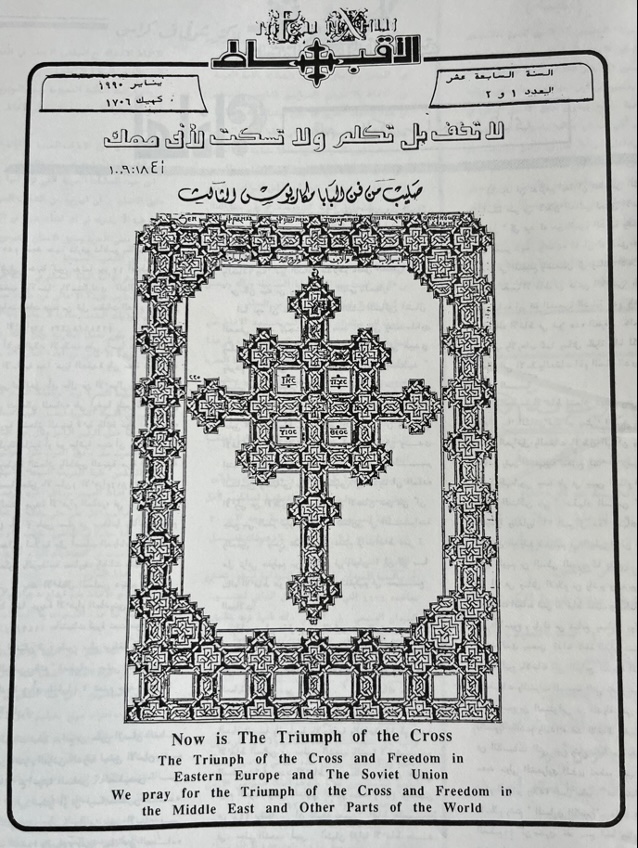
“Triumph of the Cross.” The Copts newsletter cover. January 1990. Photo courtesey of Candace Lukasik.

One evening before a Bible study, I met with Father (Abouna) James, a Coptic priest in a rural area of middle New Jersey. We sat in what appeared to be the old office of a two-story home, used temporarily as the liturgical space. Abouna James was quite active on Facebook and had recently shared articles on then President Trump’s comments that Haiti and African nations (including Egypt) were “shithole” countries. Looking through the comments on the shared article, I noticed that many Copts voiced their support for Trump’s perspective. I asked the priest why many Copts in diaspora expressed such views on Egypt, despite their Egyptian origins and transnational kin relations. “They support those comments,” he explained, “because when they support them, they are essentially saying ‘shithole’ refers to Islam, not to them.”

While translating “colonial trauma” as well as collective memory of sectarian violence in Egypt, the work of religious differentiation done by some Copts, like those in these comments, gestures toward what I have discussed elsewhere as the ordinary affects of U.S. empire—as a power structure of assimilation to mold sensibilities, relationships, and practices and avoid the gaze of racialized and civilizational suspicion. Both communal and scaled transtemporal affects can be held in tension. These ordinary affects of empire unfold in how Copts have adapted to and have been shaped by visions of Islamic geographies that have kept them in an affective paradox of racial-religious un/belonging. In thinking with the longue durée of geographic and religious difference under colonization, Coptic Christians have more recently integrated into the shifting gaze of racecraft in the United States. The racialization of Coptic Christians in American society can be thought of as pieced together in the ordinary and extraordinary course of everyday doing—mediated through discursive forces of terrorist threat and suspicion of the Middle Eastern other, racial infrastructures of securitization (through profiling programs), as well as the cultural logics that proliferate after the event. The dominance of racial difference—a difference that makes one recognized as a dangerous other—lies in the dense set of prior representations and practices on which they build in U.S. empire—the undocumented, the immigrant, the Jew, Black—the histories of these threats to American freedom and democratic stability interweave with one another. Coptic Christians integrate into the shifting gaze of racecraft in the United States in the way their visibility—as martyrs—is veiled by their positionality as non-White migrants from the Middle East—a politicized place and geography racialized as Muslim and therefore incommensurable with western and specifically American values.

“The Descendent of Islam Princes”

While Coptic immigration from Egypt to the United States began in earnest in the 1970s after the 1965 Immigration and Nationality Act, Egyptian Coptic Olympic diver and Hollywood socialite, Farid Simaika was already in the center of a battle of racial belonging in 1935. At the time, he was engaged to Betty J. Wilson, University of California, Los Angeles co-ed and daughter of William G. Wilson, steel manufacturer from Youngstown, Ohio. When Simaika and Wilson filed an intention to wed notice, the marriage license bureau initially refused to grant them a marriage license because of doubt as to whether Simaika was “an Egyptian or a Caucasian.” The determination of Simaika’s Whiteness was front page news of the Hollywood elite. In pre-Perez v. Sharp (1948) California, existing laws prevented the intermarriage between Whites and “those of another race.” After consulting ethnologists, the county counsel’s office in Los Angeles ruled on April 26, 1935 that “an Egyptian is of the Caucasian race” and that “Egyptians were of the Hamitic and Semitic branch of the Caucasian race,” thereby removing the racial barrier to their marriage. 

Coptic Egyptian Olympic Diver Farid Simaika prepares for a swim. Wikimedia Commons.

In her May 1935 article, journalist Adelaide Fielding rhetorically questioned the appeal of Simaika—“Was he [Simaika] not the descendant of Islam princes?” This question is certainly a prime example of Orientalism, (of the amalgamation of different Middle Eastern communities into the figure of “Islam”). Yet, it also connects national imaginaries of racial imperialism to their very real colonial contexts during this time period—when American Christian missionaries and travel writers were plentiful in Egypt and transnationally circulated tropes on Islam and Muslims. 

Amid contesting visions of Middle Eastern Christianity and its distance and proximity to Islam at the time, Copts and others had to varyingly contend with European colonial knowledge production on their racial composition and religious kinship with western Christendom. Egyptologists of the late 19th and early 20th century argued that Egyptian Copts were the “descendants of the Pharaohs” and most importantly, that they were “racially pure.” A continual theme was that of the “racial” link between the Copts and the Ancient Egyptians, which sought to distance Copts from their Egyptian Muslims co-religionists. This complex structure of proximity and difference is linked to how Coptic-Egyptians were racialized in the early 20th century United States, and layers of racialization continue to frame the ambiguous character of transnational Coptic life today as well. 

While such citizenship strategies in appeals to Whiteness (like that of Simaika) are plentiful in the early 20th century United States out of legal necessity, the affective conviction of difference among Middle Eastern Christian diasporas like the Copts draws from collective memory of sectarian violence in Egypt and upends those contexts translated through a new imperial key. The allure of Trump among the Coptic diaspora in the United States did not start and end with him but exemplifies a long history of paradoxical dissimilarity from and similitude within the global geography of Islam that has bound Christians in/from the Middle East to strategies of distinction as a means of assimilation into Whiteness.

Affective Geographies of Islamic Persecution

Over the past several decades, these colonial binds have been reconfigured into a new kind of American persecution politics that has translated earlier conceptualizations on Islam within it and bound the Coptic diaspora into conservative political orientations. During the Cold War, evangelical narratives of persecution were centered on the suffering of Christians under communism, especially in the Soviet Union. As the Cold War ended, this global vision began to break down. American evangelical persecution politics of the late 20th century fed into diasporic activism and advocacy among Coptic (or Egyptian) Christians in the United States, and reshaped transnational Coptic identity in the process. In this transnational translation, Coptic injury from Egyptian sectarian contexts also lent itself to burgeoning fields of anti-Muslim public discourse

The affective conviction of difference among Middle Eastern Christian diasporas like the Copts draws from collective memory of sectarian violence in Egypt and upends those contexts translated through a new imperial key.

Along with translating Coptic plight through western vocabularies of legitimacy, Coptic diaspora activists curated an economy of Christian kinship in line with the changing field of the Persecuted Church and evidenced through dissemination of The Copts newsletter (founded by Coptic diaspora activists in the early 1970s). While maintaining Arabic content for the Coptic diaspora that focused more specifically on local contexts in Egypt and their transnational interpretation, the English content of the newsletter evidenced an emerging diasporic Coptic imaginary of persecution politics. In this imaginary, Egypt’s Christians felt the same experiences as other geopolitically important Christian communities, in such places as Sudan and Pakistan, that were also the focus of U.S. foreign policy and evangelical lobbying efforts. 

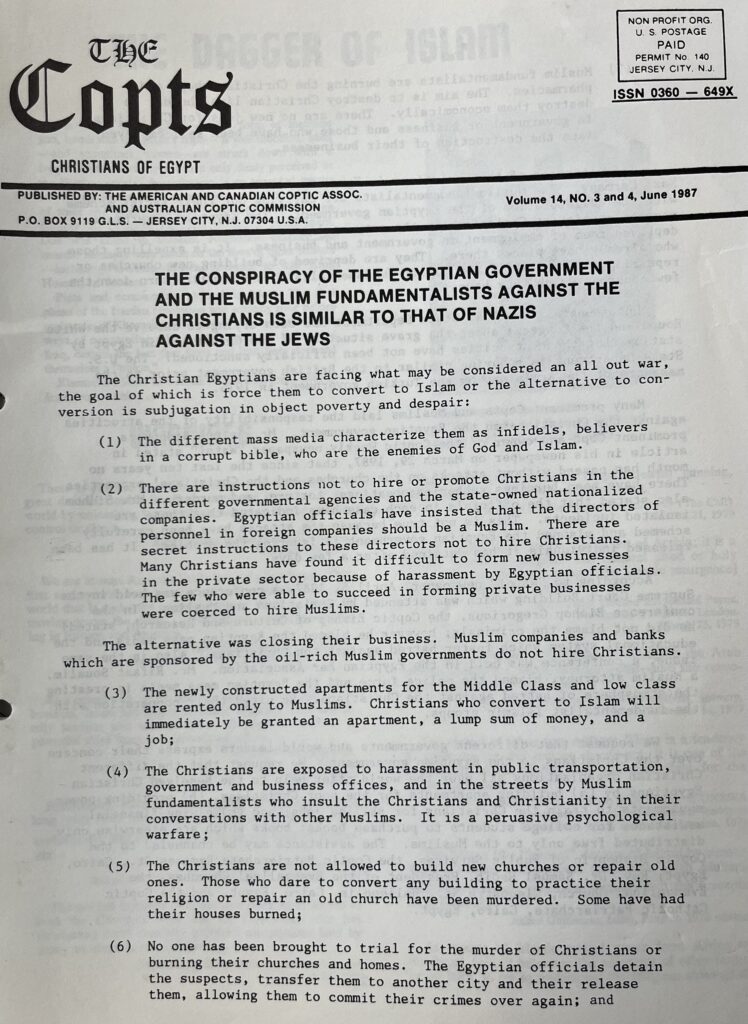
The Copts newsletter cover, June 1987. Comparing Muslim Fundamentalists and Nazis. Photo courtesy of Candace Lukasik.

In an anonymous editorial from 1992 entitled “Wolves in Sheep’s Clothing,” a Coptic editor of the newsletter explicitly details how civilizational language operates on a global Islamic geography and through its political affects. Writing about the differences between Islam in the Middle East and how Muslim activists in the west politically organize around it, the editorial reads, “They brag about being Americans, and have the American flag cover the background of their program set. This is the same flag Muslims burn in their daily rituals in Iran, calling America ‘The great Satan.’” In other newsletters throughout the 1990s, the juxtaposition between Islam and America became even greater. In two editorials from 1995 and 1996, a writer by the name of “Victor Mordechai” even describes the Qur’an as an “Islamic Mein Kampf.” 

While clearly the work of The Copts in the 1980s and throughout the 1990s was shaped by several emerging discourses on Islam focused on fundamentalism and terrorism, the curation of a Coptic perspective on minority discrimination was directly shaped by experiences from the homeland. Although the dangerous consequences of diasporic Coptic rhetoric on Islam and Muslims should not be overlooked, Coptic immigrants to the United States also channeled their experiences in Egypt of pervasive discrimination and violence into networks of American empire-building, embracing global Islamic geographies of threat and advancing strategies to combat it, placing them into political tension.  

Right-wing attention to Coptic conditions in Egypt has historically placed diaspora communities in a contradiction-laden position. On the one hand, drawing attention to the Coptic plight inevitably sets them apart from the broader concerns of the Arab American (or Middle Eastern) communities that are split along religious lines (mainly Muslim and Christian). This attention enhances the fractures that are internal to the body politic that seeks redress for the forms of discrimination and racialization in diaspora, and specifically anti-Muslim/anti-Arab racism pervasive in U.S. society. On the other hand, Coptic calls for American protection or advocacy sets up an unstable synergy between the security this affords and the insecurity it engenders. It places Copts in a contested relationship to other racialized Arab American communities—combatting anti-Arab/anti-Muslim racism—as well as to Coptic kin in the homeland who vehemently disagree with their political tactics from the diaspora. Coptic dependence on such organizations that emphasize religious (and particularly Christian) difference and the evils of Islamic governance and Muslim-majority rule amplify Coptic difference for imperial ends. This is a necessary feature of making Coptic discrimination legible in diaspora in terms of international law and U.S. imperial interests. Over the past several decades, how diasporic Copts have relayed their demands to the U.S. government for equal rights in Egypt became increasingly shaped by new vocabularies and enemies, and securitized discourses on Islam that connected with the initiatives and strategies of U.S. empire and evangelical internationalism. Yet, the pain of the persecuted is curated for Western Christian consumption and ultimately political utility with uneven e/affects—that pain does not produce a homogenous group of bodies who are evenly together in their pain.

Candace Lukasik
Candace Lukasik an Assistant Professor of Religion and Anthropology at Mississippi State University, whose research focuses on the intersections of religion, race, migration, and empire. Her first book manuscript, entitled Martyrs and Migrants: Coptic Christians and the Persecution Politics of U.S. Empire, ethnographically examines how American conservative politicization of Middle Eastern Christians has shaped collective memory, patterns of transnational migration, and inter-communal solidarities.
Theorizing Modernities article

Introducing Enlivening the Nation

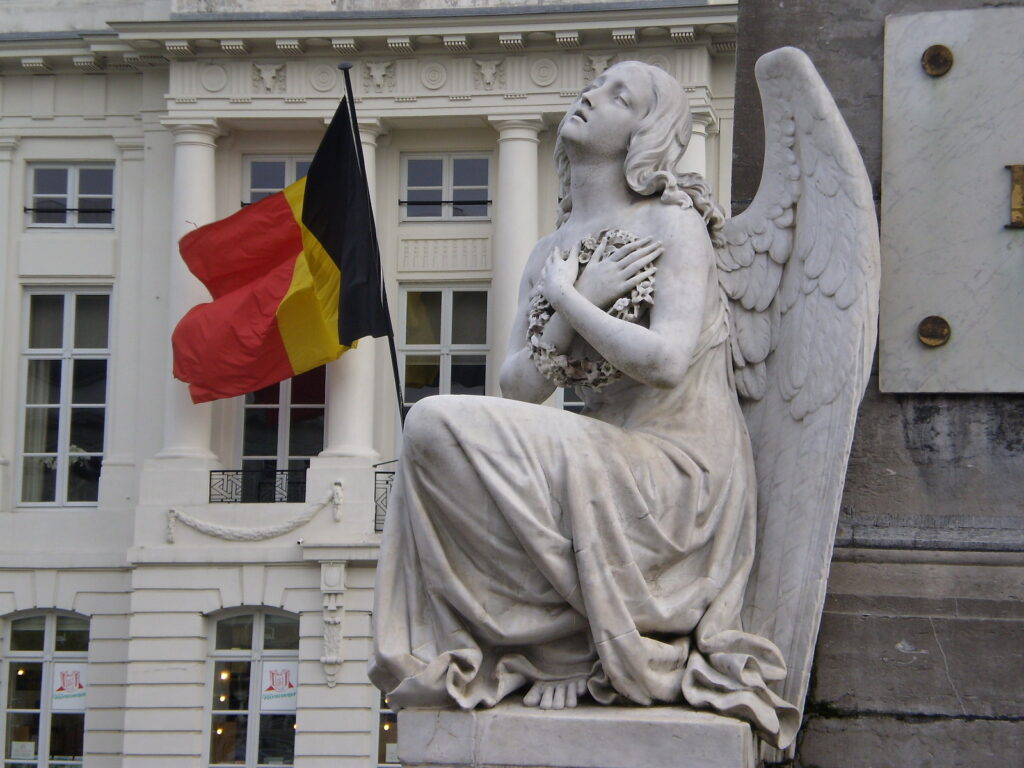
Angel & National Flag of Belgium, Martyrs’ Square – Place des Martyrs – Martelaarsplaats, Brussels, Belgium. Via Flickr User Dr Les Sachs. CC BY 2.0 DEED.

In the wake of the rise of figures such as Victor Orbán, Narendra Modi, Jair Bolsonaro, and Donald Trump, studies of religious nationalism, especially in its more populist registers, are on the rise. Part of the motive for these studies is to better understand why scholars, pundits, pollsters, journalists, and others failed to capture the level of dissatisfaction that has driven some voters in recent years to turn to politicians and causes that are in rhetoric and in practice promoting xenophobia, homophobia, misogyny, and racism. More deeply, scholars are grappling with the resurgence of forces that previous generations of political thinkers believed could be constrained by liberal principles.

Religious nationalism—and more broadly national identity construed in religious terms—has often served as an embodiment of exclusionary ideals. In the US context of White Christian nationalism, for example, the removal of the boundaries between church and State are being supported by public officials who also support ending gay marriage, restricting immigration, and censoring critical discussions of race. Others are calling for “common good constitutionalism” that supports a natural law reading of the constitution and would impose heteronormative laws on all citizens. There are many ways one might approach the examination of this resurgence of religious nationalism, including discursive analysis, ethnographic study, and through the use of critical theory

This blog series builds upon and extends beyond these studies by focusing on the relationship between religion, the nation-state, and affect/emotion broadly construed. Its contributors draw on the resources of affect theory and studies of emotion to better understand the shifting politics of the nation-state in modernity and challenges to its politics. Such an intervention is necessary for understanding the complex ways in which people become attached to particular understandings of the nation (with its ethnic, racial, and linguistic constructions), and the role of religion in either supporting or hindering that attachment. These essays engage the state not at the high levels of political theory but in the felt realities of people living within it. Notably, the contributors here also extend the conversation beyond the Euro- and US-centric analysis by which it is typically constrained. This provides a unique perspective on our current political and social moment. The contributions not only provide a critical genealogical account of the role of affect—that is, the feelings, moods, and/or emotions that shape our individual and collective lives—in the construction of political loyalties and disloyalties, but also help us imagine ways of breaking through them to begin to imagine new affective alternatives.

Beginning in the US, Biko Mandela Gray examines the White nationalism that undergirds the seemingly neutral liberalism in the US. Casting White supremacy as a wider phenomenon than that of “tiki torches and white hoods,” for Gray, requires that we understand the way that White supremacy shapes our political and social horizons in a more deeply entrenched manner than the phrase “White nationalism” signifies. Philosophy, and more specifically phenomenology, has perpetuated a kind of Whiteness through its supposedly color-blind descriptions of how we experience the world. It is only by developing a paraphenomenology that challenges the dominance of this way of mapping the world that alternatives can begin to be imagined. Gray’s piece ends with a reflection on the way that White supremacy, even when it claims to be invested in diversity, equity, and inclusion, shapes policy not only in the US but abroad as well. Affects, as Gray makes clear, spill over borders even as they also reinforce them. 

This is a theme also taken up in Candace Lukasik’s contribution to this series. Lukasik investigates how Coptic Christians who have immigrated to the US translate their experiences of marginalization in Egypt in their new home. In the US, Copts enter into a complex relationship with the racial politics of the US, at times distancing themselves from Muslim Egyptians in an attempt to evade the orientalist gaze of White supremacy. This assimilation into Whiteness has left Copts in an ambiguous position. Of particular note here is how the affect of injury and martyrdom function in some Coptic communities at times to bind them to dominant White evangelical discourse that contributes to White nationalism. Dependence on such discourse, in the end, interpolates Copts into the colonialist discourse on religion that is one of the sources of their marginalization.

Alessandro Gusman is also interested in how migration shapes the affects expressed by religious communities in relation to the nation. His work focuses on the lives of Congolese refugees who are living in Kampala, Uganda. Unlike Copts who have moved to the US, these refugees are unable to integrate into a new society and thus are forced to rely on the more ephemeral affect of trust in God’s plan rather than martyrdom to sustain them in their new home. Gusman describes how this hope that is expressed by Pentecostal pastors on Sunday mornings, sometimes drawing on the story of Exodus, offers a narrative to explain both the current situation of the Congolese, as well as the possibility that their lives might at some point change for the better. It is “God’s plan” that they must trust, not the secular institutions that claim to be acting on their behalf. In recent years, Gusman suggests, it has grown more difficult to sustain this hope and stronger political demands among the Congolese on Uganda and the international community have increased. A feeling of “stuckness” drives this political movement and leads it to imagine a future that lies beyond the current impasse.

If scripture can serve as an outpost of hope for marginalized communities, it can also serve to buttress the standing of the powerful. Hannah Strømmen, in her piece, outlines how the British far-right movement Britain First uses the Bible as a tool to assert a nativist White Christian identity over and against immigrants and Muslims. Its members frequently quote Bible verses in memes alongside expressions of nationalist sentiment in order to perform their British identity. The framing of these posts with seemingly benign imagery like blue skies and clouds, Strømmen contends, only hides the more dangerous message behind them. She ends her piece by suggesting that, despite Britain First’s claims otherwise, the Bible also contains stories of liberation from oppression and siding with the marginalized that are worth reclaiming.

The final contribution to this series focuses more specifically on the way the nation state produces particular affects in order to manage its citizenry. Omar Kasmani examines the way that the management of shrines was taken over by the Pakistani state as a way to establish its custodianship of proper Islam and to reap the financial benefits that would come from donations made at the shrines. In disrupting traditional custodianship rules for the shrines the state has opened them up to queer and trans people as sites where they too can come close to saints. By taking ownership of the shrines, then, new modes of religious intimacy are created across gender, sect, and sexuality.

Together, these essays demonstrate the power of affect to shore up nation state power, to disrupt it, and/or to contest it. One lesson they make clear is that it is not by repressing affect that liberatory aims of marginalized groups will be achieved, as the dream of the Enlightenment and liberal political theory have claimed. Rather, achieving these ends requires harnessing its unwieldy power, a power we ignore at our own peril.

Joshua S. Lupo
Joshua S. Lupo is the Assistant Director of the Contending Modernities research initiative. In this role, he serves as the editor and writer for the Contending Modernities Blog and the classroom coordinator for the Madrasa Discourses program. He has published articles and reviews in Sophia, Soundings, Critical Muslim, Reading Religion, and Religious Studies Review. With CM Co-Director Atalia Omer, he is the co-editor of Broken Solidarities: Feminism, Race, and Transnationalism (Notre Dame Press, 2022) and Religion, Populism, and Modernity: Confronting White Christian Nationalism and Racism  (Notre Dame Press, 2023). His forthcoming book with UND press is titled After Essentialism: A Critical Phenomenology for the Study of Religion.
Theorizing Modernities article

Doubling Down on Anti-anti-Intellectualism

Exterior of Assemblies of God church in Port Harcourt, Nigeria. Image via Wikimedia Commons.

Before my substantive remarks, I should like to put on record my profound gratitude to my distinguished colleagues for their gracious acceptance of the invitation to respond to my work. I am genuinely and utterly grateful. Whatever I may think about their dispositions and disagreements, I am flattered and humbled that they have deemed my work worthy of their investment. If there is a fate worse than being criticized, it is being ignored.  

For the sake of convenience, I will categorize those criticisms into three groups. The first concerns my basic argument on the historicity and meaning of the emergence and influence of clerical authority in Nigeria, the second my perspective on secularity, and the third my ostensible treatment of spirituality and liberalism as antithetical. 

The Meaning of Clerical Authority

When it comes to clerical authority, my critics express reservations regarding my theory of causation (Premawardhana); whether I have “inflated the clerical authority’s ascendancy” while at the same time lessening the power of the intelligentsia (Afolayan, Van Klinken, Premawardhana); my apparent neglect of the nascent resistance to clerical authority, especially in the realm of literary criticism (Van Klinken); and lastly, my apparent insensitivity to the seeming fragility of clerical authority (Adelakun).

Are Pentecostal pastors in Nigeria really on the rise due to the decline of the intelligentsia or have these contrasting phenomena unfolded concurrently with no direct causal link? I continue to see the preponderance of the argument tilting in favor of my original intuition that the devitalization and degradation of the intelligentsia, located primarily but not exclusively within the university system, prepared the ground for the emergence of the pastorate. In other words, the evacuation of the intelligentsia created a vacuum that, I contend, the pastorate, boasting in addition the ballast of spiritual authority, was all too happy to step into. This transition from an authority based broadly on reason to one based on revelation is, I argue, one of the most consequential developments in postcolonial Nigerian history, and insofar as one finds both my account and interpretation of it more or less plausible, it is difficult to “inflate the ascendancy” of the Pentecostal pastor. Even if we can quibble on the meaning of the degradation of the Man of Letters (the term I use, though with some caution, throughout the book to refer to the intelligentsia) or the relative solidity of the clerical regime that I postulate as its aftermath, what cannot be doubted is the effect of the crisis and collapse of the Marxist ideology in the late 1980s and early 1990s on the Nigerian intelligentsia’s ideological identity and amour propre. That it has yet to recover from this calamity and, more to the point, that Pentecostalism filled the space formerly occupied by Marxism in the Nigerian university system, if not in the imagination of the intelligentsia, is precisely my core argument.   

This transition from an authority based broadly on reason to one based on revelation is one of the most consequential developments in postcolonial Nigerian history.

If that is the case, not only can the decline of the Man of Letters not be overdetermined, in fact, the focus on the rise of the contemporary Nigerian Pentecostal pastor would seem totally warranted, if not justified. Whether or not one acknowledges it, the social ubiquity of the Pentecostal pastor is a plain fact. Not only is he, i.e., the pastor, the presiding spirit (pun intended) in what I refer to as an aristocracy of wonderment, such is the vividness of his stamp—on politics, procreation, and social relations more broadly—that one would be remiss in one’s duty as a student of religion and politics not to consider him. I do not dispute that the pastor is, all told, just one element in a “constellation of divines”; nevertheless, his emergent power as a multipurpose cultural broker is such that he has to be taken on his own terms.

Nor am I oblivious to the fact that his “reign” is contested, which is what my analysis of those “useless women” who put up a fight, albeit unsuccessfully, is meant to signal. (In the book, I use the coinage “useless women” to describe women who, refusing to lie down as expected, challenged the masculine authority of various pastors.) On the contrary, while I take this “resistance” for granted and in fact applaud it, I admit to being dubious about its efficacy, at least in the short term. The current order is likely to continue for as long as the sociological conditions that simultaneously froze the development of the university system (and the attendant intellectual culture) and authorized the emergence of what I have termed rule by prodigy are operative. It is not so much a matter of “writing the intelligentsia off” as admitting its relative diminishment. 

Nigeria as Secular State

A second criticism concerns my perspective on secularity (Lauterbach, Afolayan), specifically my assumption that Nigeria is a secular state. I admit the academic value of acknowledging the contestations around the term. However, such are the terms of religio-political engagement in Nigeria that normatively, I don’t see how I could have entertained a different point of departure. It is difficult to think of the Nigerian state as anything other than secular. As a matter of fact, contention over the terms of its taken for granted secularity has long been the defining element in Christian-Muslim political struggles, meaning that insofar as either side is content to have the balance shifted in its favor, it is because it perceives it to be otherwise in a notionally secular arrangement. Paradoxically, in their sworn desire to overturn it, rogue actors like Boko Haram are reminders of Nigeria’s secularity. In saying that Nigeria is a secular state, one is not disputing that religious actors and sentiments continue to exercise an outsize influence; on the contrary, one is acknowledging that, in principle, the Nigerian state is bound to an agnosticism which forbids either having a state religion or the privileging of the interests of one religious community over others. That the state frequently strays from this principle does nothing to nullify its secular status.  

Liberalism and Spirituality

Finally, I have been challenged (Lauterbach) on my ostensible postulation of liberal democracy and spirituality as essentially antithetical. While I concede that the interplay between the two is neither unidimensional nor teleological, and while liberal democracies of course can and do draw sustenance from spiritual resources, what I am anxious to highlight is the danger of civic manipulation under certain conditions by actors invoking spiritual license or authority. By muddying the waters of rational deliberation, something that we have seen in too many cases, such actors provide a justification for rule by prodigy, a state of affairs that is harmful to the growth of liberal democracy.      

Although I have doubled down on my core claims, there is no intention to wave off the earnest corrections and nudges of my colleagues. If anything, not only have I accepted much of their critique as just and taken it on board, they have alerted me to considerations that, in the fog of writing, one is always liable to overlook. None of us, it seems, is spared the fate of seeing through a glass darkly.

Ebenezer Obadare
Ebenezer Obadare is Douglas Dillon Senior Fellow for Africa Studies at the Council on Foreign Relations (CFR), Washington, D.C.; a fellow at the University of South Africa’s Institute of Theology, and contributing editor of Current History. Author and editor of numerous books on religion and politics and state and civil society in Africa, Obadare’s most recent work is Pastoral Power, Clerical State: Pentecostalism, Gender and Sexuality in Nigeria (Notre Dame Press, 2022). He is editor of Journal of Modern African Studies, published by Cambridge University Press.  
Theorizing Modernities article

Anti-anti-Intellectualism in Ebenezer Obadare’s Pastoral Power, Clerical State

Nigerian Women Worshipping. Image via Flickr user SIM USA. CC BY-SA 2.0 DEED.

Ebenezer Obadare’s latest book, Pastoral Power, Clerical State: Pentecostalism, Gender, and Sexuality in Nigeria—his second in a planned trilogy on Pentecostalism and Nigerian politics—is driven unapologetically by normative ends and ethical concerns. Central to the book and subject to critique is the figure of the Pentecostal pastor. Obadare spoke with many pastors, and names and describes specific ones at length. He is less interested in their variability, however, than in their commonality and what they reveal about contemporary Nigerian society. Thus, Obadare writes of these pastors in the abstract manner of an archetype: the “Man of God.” This is the new celebrity, the charismatic authority considered sacrosanct across all strata of society, even by political bigwigs. He (that this figure is a man is relevant) is above reproach or challenge, only to be followed and revered, though not entirely blindly thanks to a few brave Pentecostal laywomen (that these figures are women is also relevant).

What concerns Obadare specifically is Nigeria’s decades-long shift in moral authority from the intellectual class to the clerical class, from the “Man of Letters” to the “Man of God.” The 1980s stands as the fulcrum. That was when Nigeria’s military government gutted and coopted the universities, devaluing the Nigerian intelligentsia and particularly the professoriate. Obadare’s driving argument, to quote his clearest articulation, is as follows: “No one doubts that the Nigerian academy is in stasis or that the pastor is regnant. In Pastoral Power, Clerical State I posit a direct causal relationship between the two” (xx). The greatest strength of this book is the clarity of the case. Obadare openly positions himself in solidarity with his embattled fellow Nigerian intellectuals, especially those still laboring as he once did in Nigerian universities. In this book, he is at times a journalist (reporting from the front lines of the battle for recognition), at times a lawyer (carefully mounting evidence against the malfeasance of Nigeria’s new elites), and always an academic (researching and writing his way to both comprehension and, through it, potential transformation of the empirical facts).

In all this, Obadare is the quintessential Man of Letters. And it is hard not to read this book as a lament of and protest against the systematic weakening of the Nigerian intelligentsia. As an academic myself, I cannot but cheer on Obadare’s efforts to rescue Nigeria’s intellectuals from the displacement they have suffered. Moreover, there is a larger story hinted at in this struggle, one that goes beyond Nigeria. That is the crisis of legitimacy faced by elites and experts of all sorts—felt so acutely in countries like the United States and Brazil in their respective populations’ widespread resistance to public health recommendations during the COVID pandemic, in the increasing vitriol directed toward traditional media and news sources, and in the populist movements capable of ushering in authoritarian leaders like Donald Trump and Jair Bolsonaro (both of them, incidentally, closely aligned with Pentecostal and similarly evangelical forms of Christianity). 

In arguing strenuously against the anti-intellectualism of contemporary Nigeria, as exemplified by the growing clout of unlettered and uncredentialed influencers, Obadare makes no apologies for the book’s evident antipathy toward Pentecostal pastors: “If the reader detects a whiff of an impatient anti-clericalism within these pages, it is at bottom a yearning for some sort of intellectual restoration, which I happily admit is one of the founding impulses behind the book” (5). This candor is to be commended. Scholarship is not neutral, and Obadare makes clear the existential stakes of this book: “I have tried, as much as possible, to bring [my] personal, intellectual, and emotional formation to bear on my analysis” (18). This level of self-awareness and self-reflexivity is a credit to Obadare’s scholarship. Problematic is not the presence of biases,  prejudices, and norms. Problematic is the failure to acknowledge them, the pretense of objectivity that denies how one’s research reflects one’s commitments. 

Obadare is the quintessential Man of Letters. And it is hard not to read this book as a lament of and protest against the systematic weakening of the Nigerian intelligentsia.

There are two points on which I invite Obadare to further clarify his central argument. The first is the basic question asked of any scientific study: Are the two conditions—in this case, the decline of the Nigerian intelligentsia and the rise of the Pentecostal pastorate—connected by causation or correlation? Obadare strongly suggests, as in the quote above, “a direct causal relationship between the two.” Yet, throughout the book, he outlines a series of other originating factors—“a many-threaded social process” (4) as he rightly describes it—that include military misrule, economic collapse, the nascency of Nigerian democracy, the retreat of ideological systems, and the weakening of the state. All of these, and potentially any of these, could be posited as the cause of both the decline of the professoriate and the rise of the pastorate, in which case those two phenomena are related through correlation, not through causation. What would such a concession do to Obadare’s argument? It seems it would require a softening of the denunciatory tone against Pentecostal pastors. Their prominence would have to be seen not as the cause of the decline of the intelligentsia, but as the outgrowth of a deeper malaise.

My second point builds on the first one and centers on the question: Why does Obadare seem so determined to isolate the Pentecostal pastorate as the cause or, at least, the prime example of Nigeria’s problems today? There are other spiritual authorities whom Obadare mentions, but always only in passing: “a constellation of ‘divines,’ ranging from seers to palm readers, mediums, psychics, shamans, Muslim clerics, witch doctors, astrologers, and other spiritual practitioners normally characterized as ‘traditional’” (11). All these appear to contribute in some way or emanate out of Nigeria’s current climate of anti-intellectualism. Especially noteworthy but, for that reason, especially conspicuous in the lack of sustained treatment, are Muslim clerics—also Men of God, of course—who could just as well have received equal coverage to that of the Pentecostal clerics, and perhaps ought to have given the undeniably important role of Islam in setting the course of contemporary Nigerian society. Granted, every book requires focus, and there’s no flaw in delimiting one’s study for the sake of clarity and feasibility. Yet, there is a certain irony in attending almost exclusively to the Pentecostal pastor in a narrative lamenting the outsized prominence of the Pentecostal pastor; the choice of focus ends up reinforcing that which is being lamented. One way to decenter Pentecostal pastors in the society at large may be to decenter Pentecostal pastors in a book like this. But that was not the path taken. Why not? And how does Obadare see other charismatic figures fitting into the story of Nigeria’s shift from reason-based to revelation-based forms of authority?

The book’s second half focuses on gender and sexuality as manifest in the discourse and practices of pastors, and in the responses of the mostly female worshippers in Pentecostal churches. It is a credit to Obadare that he takes on such themes still too often ignored in scholarship on African Pentecostalism. In particular, his argument that the “reformation of machismo,” to use Elizabeth Brusco’s phrase well-known to scholars of Pentecostalism and gender, redounds to the benefit of the male pastor is compelling and original. Pentecostal laymen may be domesticated and tamed, disciplined by their faith to be less philandering and more responsible, but that leaves the pastor “the only man left standing in the church” (91), and from this comes the potential for abuses of power in all ways, not least sexual. 

One way to decenter Pentecostal pastors in the society at large may be to decenter Pentecostal pastors in a book like this. But that was not the path taken. Why not?

In the most moving story of the book, Obadare writes of an anonymous young woman pushing back against one pastor’s aggressive and incendiary witchcraft accusations (99–102). “I am not a witch,” she declares to his face and before all gathered worshippers, in response to which the pastor slaps her. Yet the young woman persists, refuses to back down, and repeats that she is not a witch or, in a variation of her defense, that if she is a witch, she is a witch for Jesus. The pastor eventually leaves her be, but not before hearing the next woman down the line likewise declare, “I am not a witch.” The first woman’s defiance Obadare reads as nothing less than a moment of political insurrection, of rebellion against the Pentecostal pastor’s misogyny and tyranny, but rebellion from within the structure rather than against it. It is far from a final blow, but it is a first act of resistance capable, as it did, of inspiring others. Such defiance may not transform much in the moment, but it may start a chain of events the end of which is a dismantling of the system. As such, Obadare notes, it exemplifies a “hidden transcript” (101), James Scott’s term for unofficial and often undetected acts and gestures by means of which subordinate groups stand up to the powerful.

Although clearly not an insider to the Pentecostal tradition, Obadare as a Nigerian intellectual is an insider to the larger story this book tells. Is Obadare’s book thus also a hidden transcript? It is not so hidden, of course, in that it is published, but it can also be seen as an early, subtle, and indirect act of rebellion on behalf of Nigeria’s intelligentsia. Regarding another woman, a Nigeria-born musical celebrity who filed a lawsuit alleging sexual abuse by a prominent pastor, Obadare writes: “The most important thing for me is that she put everything on the line in challenging someone who she clearly knew was in a far stronger position than she was and who could crush her if he so desired” (103). 

In illustration of both the anti-intellectualism and the asymmetrical power of Nigeria’s Pentecostal pastors, Obadare’s book is likely to be ignored by them. In that, we can also speak of Pastoral Power, Clerical State as a hidden transcript. But it is highly likely to be read by those who may find in it inspiration to continue to resist and thus contribute to the cause of anti-anti-intellectualism. By continuing the chain begun by Pentecostal laywomen like those we learn of in this book—women Obadare presents as worthy of emulation by all of us—Obadare joins them in refusing to let pastors dominate unduly, in forging space for what is increasingly crowded out. In climates indifferent if not hostile to deep learning and credentialed expertise, scholarship of the type Obadare has produced may be (to use another of James Scott’s terms) a “weapon of the weak.” But it is a weapon we have to use in a fight we have to fight.


Devaka Premawardhana
Devaka Premawardhana is Associate Professor in the Department of Religion at Emory University. His first book, Faith in Flux: Pentecostalism and Mobility in Rural Mozambique, received the best book award from the Society for Pentecostal Studies and was a finalist for the best book award of the Journal of Africana Religions. It was also the subject of an earlier Contending Modernities book symposium.
Global Currents article

The Israel/Palestine Escalation: The Current Chapter of a Long History

Image of interlocking chains in a fence in the city of Hebron. Via Wikimedia Commons.

The following statement, originally published on Tikkun, has been signed by Professor Atalia Omer, Co-Director of the Contending Modernities Research Initiative. Below the statement is a summary report of a conversation that took place on Thursday, October 12 at the Kroc Institute for International Peace Studies among experts in peace studies and international law.

Solidarity with Israel/Palestine

This statement is written and signed by Palestinians, Jews, and others who are committed to holding complex truths and striving to overcome polarization. We feel the pain of our people, identify with their pain, and need to work together to uplift our shared humanity.

The unfolding horror in Israel and Gaza is an escalation of decades of state-sanctioned violence by Israel against Palestinians. We condemn the horrific actions of Hamas against Israeli civilians. We likewise condemn Israel’s unbridled bombing and cutting off access to all basic needs, including food, water, electricity, and medical care. Attacks on Palestinian and Israeli civilians are repugnant.

Israeli violence against Palestinians has been intentionally hidden, slow, and steady. Contrary to what the media is reporting, this attack was not unprovoked. The Israeli and American governments have worked together to suppress and deny the inhumane acts against Palestinians that have led to this moment. There are Palestinians and Jews who have been raising red flags and warning about this inevitable outcome for decades, only to be dismissed and ignored.

The world’s failure to challenge Israel’s ongoing occupation, apartheid, and unbridled violence by settlers and soldiers in the West Bank provides the context for what is happening now. The recent Israeli government’s escalation of violence, encroachment of Al Aqsa Mosque, and its 16-year siege of Gaza has led to the current explosion.

We repeat: the brutality of Hamas’ attack on Israeli civilians is unjustified.

As we watch the violent attacks and rallying of xenophobia on both sides, we are brokenhearted. Although it feels like a time to stand with “our people,” we know this is a time to come together. This is a time of great suffering for all; a time of painful emotions. It is only by recognizing our shared fears and our shared tears that we will find our way through this nightmare. It is a struggle we need to undertake jointly.

When we fall back into our separate and distinct identities we risk becoming part of the problem, not the solution. Both peoples suffer from ongoing trauma. We are all on high alert. The fear is palpable. And it is easy for us to objectify the ‘other.’ 

We seek a third path that neither perpetuates a xenophobic response nor sustains an unjust status quo. This moment calls us to slow down, sit with the pain and complexity, and grapple with our discomfort. It is a moment for digging deep, seeing across differences, and remembering our deep yearning for peace and justice. It is only through compassion and empathy that we will find a different way. 

 We recognize and uplift the humanity of all peoples in Israel/Palestine. 

 We call for an immediate ceasefire from Hamas and Israel.

 We demand that basic needs be provided to Gazans. 

 We demand that the United States provide only humanitarian support to Israel and Gaza. 

 We support the creation of a movement that recognizes and affirms the humanity, dignity, and desire of both peoples to live in peace through reconciliation and justice.

****

On Thursday October 12, The Kroc Institute for International Peace Studies held a teach-in with faculty, staff, and students from around the University of Notre Dame community. The panel was moderated by CM Co-Director Ebrahim Moosa and panelists included Notre Dame doctoral candidate in Theology Daniel Bannoura, CM Co-Director Atalia Omer, and Notre Dame Professor of Law and Concurrent Professor of International Peace Studies Mary Ellen O’Connell. Given the mainstream English news media amnesia in covering this event, the aim of this conversation was to provide a broader context for the violence.

Following introductions of the speakers and a reading of the University of Notre Dame’s Land Acknowledgement, Kroc Institute Executive Director Erin Corcoran handed off the discussion to the panel. 

Professor Ebrahim Moosa began by laying out the complex background of Israel/Palestine in light of the current events. He drew particular attention to the different ways that Israelis and Palestinians perceive the political context in which they find themselves. For Palestinians, he noted, the state of Israel is a settler colonial power. For Israelis, on the other hand, Israel is a home that represents an emancipation from centuries of experiencing oppression and violence in Europe and elsewhere.

In her opening remarks, Professor Atalia Omer outlined her personal connections to and scholarly focus on Israel and Palestine, as well as her own Israeli citizenship, roots, and Jewish identity. She urged recognizing the humanity of Palestinians and Israelis and that a failure to mourn victims of horrendous violence, whoever they are, is a failure of one’s humanity. She noted that she herself was hurting because of the loss of friends in Saturday’s atrocious attacks carried out by the Hamas movement. She argued that it is important to contextualize the violence so as to challenge binary and ahistorical narratives and the discourse of genocidal revenge and collective punishment that have been perpetuated in its wake. For her, this means contextualizing 100 years or more of the displacement of Palestinians and the international community’s complicit role in the Israeli occupation. The Gaza Strip, an integral part of the Palestinian landscape, has been fenced in since the Oslo “peace process” in the mid-1990s. During that time, Gaza was fragmented from the rest of Palestine. But Gaza has remained, despite this policy of fragmentation, at the heart of the struggle for Palestinian liberation. The war for Israeli independence in 1948 was the Nakba, or “catastrophe,” for Palestinians who have continued to experience for 75 years a variety of events and mechanisms of control, displacement, restrictions of movement, oppression, and destruction. This includes demolition, dispossession of land, and the denial of the history and experiences of Palestinians often through the weaponization of antisemitism. She noted that the leading human rights groups, including the Israeli B’tselem, have argued that Israel is perpetuating apartheid against the Palestinians through a principle of sovereignty B’tselem terms “Jewish supremacy.” 

She described how she was horrified and in pain on Saturday, but, tragically, not surprised, noting that structural violence has been perpetuated in Palestinian territories for many years. She argued that the story of revenge is not one we should embrace. Redressing the underlying root causes of the escalating violence, Omer underscored, cannot be accomplished by the military through the commitment of war crimes and the violating humanitarian laws, but ought to be attained through diplomatic and political tools. Unfortunately, US Secretary of State Anthony Blinken has said that the US is going to have Israel’s back in its collective punishment of Gazans. But there is a need to recognize everyone’s humanity and pain. We need to understand the history of Palestinian displacement since 1948 (and before, going back to the momentous Balfour Declaration of 1917) and the continued discrepancy in power, which is exemplified in how Israel was able to cut off food, water, and electricity to Gaza. The majority of the residents of Gaza are refugees, uprooted during the Nakba. 

Daniel Bannoura began by sharing his story as a Palestinian who grew up near Bethlehem. The West Bank, he noted, is also a prison in which members of his family still live. So far 1,600 Palestinians, including 450 children and babies, have been killed in Gaza by the Israeli occupation forces [see updated numbers in the editorial introduction]. Half of those who have died are women and children. White phosphorus has been dumped on Gazans in contravention to international law. He noted that around 300 Christian families in Gaza lost their homes and are now without food and sheltering at a church. Rather than a prison, he sees Gaza as a concentration camp because a prison implies that those in it are guilty of committing a crime. The only crime of the people of the Gaza Strip is that they were born there.

He noted that so many are in attendance at the panel today, rather than at past panels, because we don’t think Palestinians are fully human. The difference this time is the number of Israelis who have died. He argued that it was necessary to condemn Hamas, but that it was also necessary to condemn the Israeli government’s actions, the latter of which US citizens are also complicit in because their tax dollars go to support Israel. In our media, he laid out, White supremacy leads us to paint Israelis as White and Palestinians as non-White. He argued that apartheid language is only the beginning of the conversation, and we need to focus on the ramifications and impact of settler colonialism, legal and military procedures, US foreign policy, and the role of religion in whitewashing injustice in the region.

Daniel also noted that we need to recognize the humanity of both peoples. White supremacist ideologies frame Israel and Palestine as well in terms of who is viewed as having humanity and who is not. All of us in the room, he noted, are inheritors of a violence of domination and colonization, whether historical colonization, antisemitism, or the denial of the Palestinian people of the right to exist. Daniel further observed the role of Western Christianity in maintaining the system of oppression against the Palestinians through theological formulations, whether through Protestant zionism or Catholic zionism, that justify the colonization of Palestine and continue to exclude and erase Palestinians from their analysis. He argued that we need to see that the Shoah is tied to the Nakba, that the suffering of innocents in the past is tied to the suffering of innocents now. He ended by noting that he hoped a just peace and human rights would inform how we move ahead from this tragedy.

Professor Ebrahim Moosa recognized that many in the audience were in pain after an interruption from an audience member. He noted that he was South African and that every South African cleric, civil rights activist, and politician who visited Israel/Palestine said that the oppression faced by the Palestinians was far worse than what Blacks faced in South Africa. He suggested that a carnage was about to happen in Gaza, and that because of this he wrote a letter to President Bident and to his Senator, and encouraged others to do the same.

Professor Mary Ellen O’Connell argued that this is a moment to speak with unity. We need to give heart to the amount of suffering. She spoke of a way forward if we use what past generations offered us to unite us and that is our common international law—a concept we around the world built together. She briefly addressed the three categories of law relevant to the crisis: (1) law on resort to armed force; (2) law on the conduct of armed conflict; and (3) human rights law. On initial resort to force she argued that any right of self-defense or to resist occupation that may exist for the Palestinian people (and that is a complicated issue), there is emphatically no justification for the violent measures undertaken by Hamas. Hamas had no hope of removing Israeli authorities from occupied territory by killing civilians. Hamas used violence with only one aim—to intimidate for political ends—that is the definition of terrorism. She explained that even a party with a right to resort to force is restricted from exercising that right where there is no reasonable chance of success.

Concerning law and conduct during armed conflict, she emphasized there is no right to intentionally target civilians or ever take hostages. She said that it is unclear to what extent Israel can lawfully respond to terrorism with war. It is clear that Israel has a duty to withdraw from territory it occupies. Israel’s use of force also violates the principle of necessity. Its interventions in the past have never accomplished a lawful military objective. Further, any resort to armed force must comply with four fundamental principles: distinction, necessity, proportionality, and humanity. Israel is violating all of these right now. Cutting off food, medicine, and water to a civilian population is never acceptable. Hamas must also release hostages and cease violent attacks on Israel. The US has a responsibility to restore international law and reverse its own actions in violation of the prohibition on the use of force. She advocated for the US to lead in international law to aid those suffering in all war-torn nations—Myanmar, in Ethiopia, and in Sudan.

Following these initial remarks, a Q&A period was opened up. One audience member suggested that it would be beneficial for the US and UN to invade Gaza and free the Palestinians from Hamas. Another attendee reflected on the fact that the Israeli occupation had prevented them from returning to their home. Still another wondered what role the UN security council might play in the dispute and what was being said by the Palestinian leadership about the conflict.

Kibbutz Kfar Aza with Gaza seen on the horizon. Image credit: Max Nathans. CC BY-NC-ND 2.0 DEED.

Professor Mary Ellen O’Connell began the panelists’ responses by mentioning, as the other panelists had before their remarks, her own faith, Roman Catholicism, and her Irish heritage. She is the granddaughter of people who fled oppression and genocidal famine. She has devoted her life in line with the great teaching of the Catholic Church to Pacem in Terris. International law offers the most effective tool to work for the goal that she knows of. In response to the question about the UN invading and freeing people from Hamas she argued based on extensive experience and data that the attempt to use military force to create good governance will fail. Classical peacekeeping, which succeeded consistently in ending violence when all parties consented, had been abandoned with the end of the Cold War and the rise of a hegemonic US devoted to realist-militarist policy. The belief in military solutions bred by realism is at the root of conflict today. Yet, military force is no solution to terrorism and other social challenges.

In response to the question about the United Nations Security Council, she dismissed the Council’s relevance today, given the Permanent Members’ disregard for the UN Charter and international law generally. A dynamic UN Secretary General with real leadership potential can do more for peace now as can an immediate shift of US policy from defying international law to compliance—end targeted killing with drones, renounce unlawful military force like the invasion of Iraq 2003, and cease military support of Israel.

Daniel Bannoura noted that the Palestinian president committed himself to nonviolence and condemned the killing of innocent civilians. He also reiterated that we need Israelis to see that their security is connected to Palestinian security. Israel has built a fortress on the lands and bones of Palestinians, he argued. The suffering is connected when we see that a Palestinian cannot return home. Palestinians want a free Palestine from apartheid and oppression so that Hamas and other actors of violence lose their credibility. Hamas has only been around 30 years. Palestinians have been suffering since 1948. 

Professor Atalia Omer argued that it is critical to think of the question of Israeli and Palestinian suffering together. Because of the binary framing, she noted, it is difficult both to mourn the people she lost [in Israel] and recognize the crimes committed against them while also recognizing the Palestinian story and the ongoing violent reality Palestinains have endured, albeit differently in 1948 territories or “Israel proper,” the West Bank, occupied East Jerusalem, and in the Gaza Strip (and various diasporas and refugee camps in the region). This issue did not begin on Saturday, October 7 and it is important to bring the root cause to the foreground in order to de-escalate and redress politically the aspirations of Palestinians for freedom and historical justice. She suggested that the dehumanizing rhetoric from the US President and Secretary of State that claimed that Hamas’ sole purpose for existing is “to kill Jews” collapses the distinction between Israelis and Jews in an unhelpful way. It also abstracts and decontextualizes the realities of prolonged structural violence in Palestine/Israel and the ideology that sustains them as noted in the B’tselem report.

She ended her response by noting that she grew up in Israel, and the first time she heard about the Nakba was when she came to the US. What is at the center of this is the denial of history, the denial of narrative, and the denial of humanity. 

In another round of questions, one audience member asked how they could support Palestinians without being accused of being antisemitic? They also asked how to communicate to the West that Hamas does not represent everyone? Another audience member spoke about their home and neighborhood in Gaza being destroyed, noting that their family is camped in a school and that there was no way out of the city. She argued that Israel is committing war crimes and no one is covering it. Hamas is the only form of resistance that Gazans have, she said. Another audience member asked what duty toward Palestine Jordanians, Iraqis, Lebanese and others have and how the Israelis might be brought to the negotiating table? They also pointedly asked: What do you do when non-violence does not work? 

Daniel Bannoura responded to the question about antisemitism and support for Palestinians. The Palestinian struggle for freedom, he argued, is tied to the struggle against antisemitism. It is the same demand that the struggles are after. Because you are fighting against antisemitism you are fighting for Palestinians. Generally, Western discourse on the situation in Palestine and Israel consistently formulates the Palestinian cause as contingent or insignificant. He suggested that Palestinians are paying for the sins of Christians in Europe and their historic antisemitism. We have to understand that this is a messy conflict, and we have to move away from the colonial framing of it.

A two-state solution will not work, he said. The community’s history and culture are too intertwined. We need to think in new and creative ways that insure the security and freedom of both peoples.

Professor Atalia Omer noted that the two-state framework is based on homogeneous ethnoreligious conceptions of identity that inspire White nationalism in the US and that alternatives are needed. She stressed the need for a political imagination that goes beyond the current framework.

Professor Ebrahim Moosa concluded the panel by suggesting that each side in the conflict is now framing this moment as “a state of exception” from the normal rule of law and that this is an extremely dangerous moment. Indeed, the US claimed a state of exception after 9/11 and dire consequences followed, including years of violence and death in Afghanistan and in other places around the world where the “war on terror” was enacted.

Contending Modernities
Theorizing Modernities article

Liberal Democracy and the Rise of the Pentecostal Pastor

Pastor Ayo ministering at the Warri Miracle Crusade in the Warri City Stadium, December 10, 2015. Via Wikimedia Commons.

In Pastoral Power, Clerical State: Pentecostalism, Gender, and Sexuality in Nigeria, Ebenezer Obadare takes a second step in his bold and original discussion of the nature of Pentecostalism and its influence and role in Nigerian society and in relation to the Nigerian state. The first step was taken in Pentecostal Republic: Religion and the Struggle for State Power (2018) wherein he discussed the role of Pentecostalism and the Pentecostal elite in Nigeria’s fourth republic. In Pastoral Power, Clerical State, the focus is on the pastor as figure and on the power that pastors seek to access, hold, and perform. The work is not bound by conventionalism—disciplinary or other—as it takes the Pentecostal pastors’ spheres of influence to extend across the nation’s “political, sexual, and cultural topography.” This scope allows Obadare to grasp the ultramodern—the merging of entities that were bounded and distinct within a modern framework (religious / secular)—fusion of delusionary ideals of democracy and recourse to religious frames of identity and power. Obadare’s rendering underscores the paradox between spiritual and political power and an ethical ideal of liberal democracy, one that will have impacts on our understanding of these concepts beyond the example of Nigeria. 

At the heart of this book lies a discussion of the factors that contribute to and help us explain the indisputable rise of pastoral power in Nigeria, as well as around the globe. Importantly, he does not operate within the traditional/modern dichotomy that we often see in such works (either explaining the rise of Pentecostalism as a way of going back and drawing on traditional forms of power or seeing Pentecostalism as a modern phenomenon and a reflection of a millennial condition). He wrestles with large and far-reaching processes of change in Nigerian society such as the decline of the salience of the “Man of Letters,” which implies a change in the status of the intellectual, and the ascension of the “Man of God.” This process indicates the replacement of one cognitive framework with another and Obadare is astutely interested in and aware of the consequences of this shift. The central questions of the book come to rest on where power lies, what power is, and who can access and exercise power. 

Pastoral Power opens by turning the question “why are so many young people becoming pastors”? upside down. This question, which has been key in my own work on Pentecostal pastors in Ghana, then becomes: “Why are not all young men becoming pastors” (xix)? This rhetorical maneuver is indicative of what Obadare sees as the prominence of pastoral power in contemporary Nigeria and its consequences on the operations of the Nigerian state. Much of what Obadare describes and observes around the Pentecostal pastor—a calling, eminence, prayers, prophecies, wealth—resonates with my own work on Pentecostal pastors in Ghana. My work has focused on the continuities between how Pentecostal pastors and traditional holders of power, whose authority cut across political and spiritual domains (such as chiefs) achieve, tap into, and hold spiritual power. What fascinates me about Obadare’s work is that he observes very similar processes among Nigerian Pentecostal pastors as Ghanaian ones when it comes to pastoral authority and its mechanisms, but reaches different conclusions and sees the wider future consequences of this change. What Obadare seems to indicate is that these issues should prompt us to ask big questions, such as: What happens to a liberal democracy when the locus of power moves from the institutions of the state to the thrones of Pentecostal pastors? What makes pastors unique and why are they capable of holding the kind of uberauthority that we see? 

Obadare traces a significant shift in the history of power in Nigeria from the Man of Letters to the Man of God. This shift involved the breakdown of “emancipatory ideologies” (referencing Mary Kaldor, 46). Here he describes Major General Vatsa as an example of someone possessing intellectual flair and style. He was a soldier-poet who was defended and liked by people because of his intellectualism. This figure reminded me of Lomba, the prisoner-poet in Helon Habila’s Waiting for an Angel. Lomba is an aspiring intellectual and journalist who, under the military dictatorship of General Abacha, is living with the repercussions of his trade. After participating in an ‘anti-government’ demonstration, Lomba is imprisoned. While in prison, Lomba starts to write, first in secret, but is later discovered by a prison superintendent. After initial punishment, Lomba gets protection by writing ghost love poems for the prison superintendent who offers them to the woman he loves. The woman, it turns out, understands that the superintendent is not the true author of the poetry she has been given. Lomba, on his part, equally reflects upon the messages of the poems not being for her: “But how could I tell her that the message wasn’t really for her, or for anyone else? It was for myself, perhaps, written by me to my own soul, to every other soul, the collective soul of the universe” (28). Habila’s prisoner-poet masters the skills of the letter, but also the skills of performance and the words of love. He speaks to the existential soul of the universe. He is perhaps more than a Man of Letters. 

The central questions of the book come to rest on where power lies, what power is, and who can access and exercise power.

From here we can move to the pastor-poet. What is the pastor doing with words? The Man of God is also a Man of Words,  though perhaps not “of letters” in the sense Obadare describes it. But surely he is a man of words. There is an eroticism to pastoral performativity as Obadare shows, but there is also one of performing knowledge. There is poetry in preaching, in being on stage and addressing an audience, whether that audience is in a church or in the street. We could say that the production and performance of texts (oral or written) conveys a status that stems from the recognition of these skills in society. As Stephanie Newell has shown in her study of Ghanaian popular fiction, the proverb is a way for authors to show that they are able to “quote from ‘outside’ texts in order to generate further text of their own” (11). Is there a way in which we can grasp the power of the Pentecostal pastor through this appropriation and tapping into an intellectual history that might be eroding, yet still holds potential for recognition? 

With this, I return to the question of power raised by Obadare. Naminata Diabate, in her recent work Naked Agency: Genital Cursing and Biopolitics in Africa, discusses naked female protesting across Africa and through a variety of texts. She highlights naked protesting as an act of resistance as well as a site that exposes women to shame, death, and vulnerability. Diabate asks similar yet distinctive questions about the relationship between state power and spirituality as Obadare; they are different because she writes about women who engage in defiant disrobing as being in positions of power and vulnerability simultaneously and thereby points to the ambiguity that lies in holding certain forms of power, yet, similar because Diabate is interested in the relationship between liberal democracies and spirituality. Instead of asking how spiritual causality might undermine the fundamental principles of a liberal democracy, she wonders how the liberal modern state can accommodate the religious practices and traditions of a country. This is fundamentally a question about the “separation of the secular from the religious, which remains an ideal in our world with its promise of secularism-cum-freedom” (144). But what is the liberal democracy of today and in different contexts? This is an open question rather than one whose answer we should take for granted. Liberal democracy is certainly a yardstick and an ideal, but it is entangled with other not-so-liberal forces which cause us to reflect on the contradictions and non-exclusionary co-existence between mystical forces and political power, be it within democratic or other institutions. By defying the boundaries of discipline and genre, Obadare’s book pushes readers to ask this often neglected question about the nature of power in ostensible secular societies in our world today.

Karen Lauterbach
Karen Lauterbach, PhD, is Associate Professor at the Centre of African Studies, University of Copenhagen. Her research focuses on Christianity and histories of social change in Africa. She has written about charismatic Christianity, wealth and power in Ghana as well as Christianity, displacement and moral practices of helping and hosting in Uganda. Her work has focused in particular on the role of pastors including their social status and legitimacy. She has published the monograph Christianity, Wealth and Spiritual Power in Ghana (Palgrave Macmillan, 2017) and co-edited Faith in African Lived Christianity: Bridging Anthropological and Theological Perspectives (Brill 2019) as well as numerous journal articles and book chapters.
Theorizing Modernities article

“Man of Letters” vs “Man of God”: Pentecostal Pastors and Contemporary Nigerian Writers

1986 Nobel Prize winner in Literature Wole Soyinka during a lecture at Stockholm Public Library on October 4, 2018. Image via Wikimedia Commons. CC BY 4.0

The Nigerian writer and public intellectual Wole Soyinka, in his book-length essay Of Africa, refers to new religious movements in Christianity and Islam, including Pentecostalism, when writing that “religion, alas, on the African continent, has moved in recent times beyond the luxury or mere abstraction or academic exercise. It has leapt to the forefront of global concern … [and] it threatens the very fabric of a continent that, only a decade or so ago, considered herself immune from the lunacy of faiths” (131). One can safely assume that Soyinka, who is widely known for his “radical agnosticism” and religious skepticism (see Celucien Joseph’s recent book about Soyinka on religion), would consider the Pentecostal pastor, and the cult around him, as a primary embodiment of the religious fanaticism he is so concerned about. One can also safely assume that Soyinka would sympathize and probably agree with the critical analysis of this phenomenon offered by Ebenezer Obadare in Pastoral Power, Clerical State.

Soyinka himself is mentioned in Obadare’s book as a prominent member of the social class described as “Men of Letters,” which according to Obadare is of “yesterday” because the public status, authority, and influence this intellectual elite once enjoyed in postcolonial Nigeria has been taken over by, indeed, Pentecostal pastors as self-proclaimed “Men of God” (26–27). Although there is a significant element of truth in this account of a passage of authority of ‘“yesterday’s ‘Man of Letters’ to today’s ‘Man of God”’ (4), in the present contribution to the symposium about Pastoral Power, Clerical State I want to complicate this narrative and ask whether Obadare might be writing off the Men of Letters too early. In doing so, I want to foreground the ongoing relevance and significance of literary writing as a site of creative critique and reimagination of Christianity, in particular Pentecostalism. A preliminary note is that although I can’t fully avoid using Obadare’s androcentric language, it’s important to acknowledge that women are an important part of the constituency of Pentecostal pastors as well as of literary writers. 

The “Man of God” as a “Man of Letters”

One complication of Obadare’s framing is that contemporary Pentecostal pastors appear to be rather eager to embody the personae of a “(Wo)man of letters” themselves. As much as Obadare mentions university professors in Nigeria who adopt the title “pastor” in order to regain some of their lost social status, the reverse is also true: many a pastor proudly carries the academic title of Doctor or Professor (honorary or not) in combination with their religious title, indicating that at least the pretension of academic credential and intellectual caliber is vital to their performance as religious, social, and political entrepreneurs. Moreover, pastors frequently cast themselves as Men of Letters in a literal sense, as they boost their public profile with a prolific output of books, usually published by their church-linked publishing houses. To cite only one example, David Oyedepo, the founding pastor and presiding bishop of Living Faith Church International (also known as Winners Chapel), prides himself on having “published over 90 impactful titles most of which have been translated to major languages of the world such as French, Chinese, Spanish etc. with over twenty million copies in circulation.” Most if not all of these titles were published through his own publishing house, Dominion, the mission of which states that “knowledge, which is a product of learning, is a key factor in the liberation of man.” Whatever one thinks of the quality of the writings by Oyedepo and the likes (and I admit to having some reservations about this), one could well argue that Pentecostal pastors have been more successful in promoting a reading culture in Nigeria (and beyond) than the whole class of intellectual Men of Letters before them. The phenomenon of (Wo)men of God casting themselves as (Wo)men of letters raises questions about the boundaries between these two categories, which obviously are blurred unless one adopts an elitist view of what the real (Wo)men of letters are about. 

The Continued Relevance of “Men of Letters”

However, my focus in this contribution to the symposium about Obadare’s book is a different one. Drawing attention to the ways in which Pentecostal pastors have recently been featured in contemporary Nigerian literary texts, I complicate the suggestion that the Men of Letters belong to the past. Instead, I want to highlight their ongoing role in the public critique of Pentecostalism, in particular the figure of the pastor. For the purpose of this discussion, I understand Men of Letters here as referring to literary writers (male or female) who, as Wale Adebanwi has argued, play a vital role as “social thinkers” about contemporary African realities. Obadare, in the introduction to his book, makes brief mention of the writer in their role as social thinkers in relation to Pentecostalism when he quotes the novelist Elnathan John who, in his satirical book Be(com)ing Nigerian: A Guide, observes that “Being a pastor is one of the most rewarding things you can do as a Nigerian.” Needless to say, the rewards of be(com)ing a pastor are well-spelled out in Pastoral Power, Clerical State

John has offered a more expanded satirical critique of the figure of the Pentecostal pastor in his graphic novel On Ajayi Crowther Street (illustrated by Àlàbá Ònájìn). Published by the Abuja-based press Cassava Republic, this novel has been described as a “gossipy, Lagos-set morality tale.” It centers around the lives of Pastor Akpoborie and his family, with the pastor being unfavorably depicted as a moral hypocrite and religious charlatan. In the novel, Akpoborie harasses and rapes the housemaid while subjecting his own son to an aggressive deliverance ritual to cast out the “demon of homosexuality”; he also stages a “night of divine demolition” that promises deliverance and healing, while paying a couple of criminals to help stage the “miracles” in order to deceive the tithing congregation. Building on recent arguments for taking African cartoons seriously for their critical role in public and political culture, I suggest that the cartoons by Àlàbá Ònájìn and the accompanying text by Elnathan John in this graphic novel are an important example of the way in which Pentecostalism, and in particular the figure of the seemingly powerful pastor, is made the subject of satirical criticism. 

One could well argue that Pentecostal pastors have been more successful in promoting a reading culture in Nigeria (and beyond) than the whole class of intellectual Men of Letters before them. 

Another key example of a critical literary representation of Pentecostalism is Okey Ndibe’s novel Foreign Gods, Inc. This book can be seen as a contemporary follow-up to Wole Soyinka’s The Trials of Brother Jero, which offers a mocking depiction of an earlier generation of Nigerian charismatic prophets. What Soyinka’s character of Brother Jero and Ndibe’s character of Pastor Uka have in common is that they have no ethical values, manipulate and delude their followers, and consider pastoring as a business. Pastor Uka is a typical preacher of the neo-Pentecostal prosperity gospel, and the narrative depiction of him in Foreign Gods, Inc. almost neatly mirrors Obadare’s discussion in chapter 3 of the pastor as a “sexual object” and even a “charismatic porn-star.” See, for instance, this paragraph about Uka entering his church:

The congregation shook with excitement. They stampeded to meet the pastor at the entrance. ‘Daddy! Daddy!’ they sang, young and old alike. They massed around the man, enveloped him. They bawled, hands upraised, like fans at a soccer game.… Had God descended through the clouds and into the shaggy church, the frenzy could scarcely have been more delirious. (Ndibe, 146)

This scene illustrates what Obadare describes as the “Pentecostal erotic economy,” with the pastor at the center and using individual aesthetics and charismatic styles to create a “state of arousal” and emerge as an “ecclesiastical stud” (83, 91). Yet, through other characters, Ndibe voices his skepticism about this erotic economy. Faced with Uka’s fashionable appearance, Ike (the novel’s protagonist) silently names him “peacock pastor” (147). Where his mother believes that Uka is “anointed, a real man of God,” Ike refers to him as “an anointed liar” and “a shameless exploiter of people” (134). Uncle Osuakwu, a traditionalist and priest in the local ancestral shrine, too, sees through Pastor Uka, describing him as “a madman” (194) and as an efulefu, that is, a man “blown about by the wind,” without moral principles (205). Thus, Foreign Gods, Inc. depicts Pastor Uka not just as a charismatic performer of religio-erotic spectacle, but as an embodiment of morally corrupt religious leadership. 

Both texts discussed above are literary examples of the tradition of “popular tales of pastors, luxury, frauds and corruption” that abound in Nigeria and beyond. They associate Pentecostalism, and especially the figure of the Pentecostal pastor, with an (im)moral economy of corruption in contemporary Africa.

I don’t have the illusion that writers such as John and Ndibe, or even the giant figure of Soyinka, have an authority in contemporary Nigeria that even comes close to the popularity and influence enjoyed by Pentecostal pastors, so eloquently analyzed by Obadare. In that sense, Obadare is right when he speaks of a “passage of authority” from Men of Letters to Men of God. However, it might be too early to declare the Men of Letters as belonging to yesterday. 

Literary Critique of Pentecostalism

Much scholarly attention is being paid to Pentecostal-Charismatic Christianity as a highly public religion, and as a key driver of socio-cultural change in Africa. However, what is often overlooked is how Pentecostalism itself is also made a subject of critique by a range of socio-cultural actors who are concerned about the impact that this form of religion has on society. Literary writing has recently emerged as a major site of critical engagement, with several writers making Pentecostal beliefs and practices a central concern in their texts. Doing so, they stand in, and invigorate, a well-established tradition of critiques of Christianity in African literature.

In the canonical 20th century texts of African literature, such as Achebe’s Things Fall Apart and Ngugi’s The River Between, Christianity tends to be represented as an agent of colonization and imperial expansion. Yet as Simon Gikandi has pointed out, there is a significant change in post-colonial texts by a new generation of writers: “After independence, Christianity could no longer be represented as a force extraneous to the African experience but a crucial part of the social and cultural fabric of postcolonial society.” This does not necessarily mean that representations of Christianity are more sympathetic, but that a different set of concerns is raised. After all, the face of Christianity on the continent itself has dramatically changed, with the rise of Pentecostalism and its inherent excesses giving contemporary writers new ammunition. 

Although Soyinka’s critique is informed by a fundamental skepticism about religion, this is not necessarily the case with a younger generation of writers. Ndibe, for instance, has confessed to have a “profound respect for Christianity and religious faith.” His concern with Pentecostal pastors such as Uka is that they distort “the true meaning of faith.” And to cite another example, of a Woman of Letters this time, the Nigerian writer Chinelo Okparanta, in her novel Under the Udala Trees, explicitly engages in biblical and theological reflection on the question of sexual diversity. She not merely criticizes Pentecostalism for its tendency to “deliver” the queer body from supposedly “demonic” spirits, but creatively reimagines religious thought, with the conclusion of the novel being that “God, who created you, must have known what He did” (these are the words of an initially homophobic mother to her same-sex loving daughter). As much as Okparanta is critical of the colonial, patriarchal, and queer-phobic nature of Christianity in Nigeria, she states to have made “a conscious decision to continue as a Christian.” The same applies to the internationally renowned writer, Chimamanda Ngozi Adichie, who considers herself a “liberal Catholic.” Thus, what we encounter here is a generation of writers who grew up in the postcolonial era, at a time when Christianity had become very much part of the social milieu, and who combine their criticism of the church with a creative imagination of alternative possibilities of being simultaneously African and Christian. These writers present, not so much a (post)secular critique of religion, but a postcolonial African critical and creative negotiation of religion. 

Obadare concludes his book by suggesting that Pentecostal pastors’ rule by prodigy “is not impregnable” (122). Contemporary men and women of letters may not put the nail in the coffins of today’s men (and women) of God. Yet as long as the latter remain popular and powerful, the former are likely to be a thorn in their side and cause some nuisance.


Adriaan van Klinken
Adriaan van Klinken is Professor of Religion and African Studies at the University of Leeds. He serves as Director of the Leeds University Centre for African Studies and the Centre for Religion and Public Life. He also is Extraordinary Professor in the Desmond Tutu Centre for Religion and Social Justice, University of the Western Cape, South Africa. He holds a PhD in Religious Studies from Utrecht University, the Netherlands (2011). 

Adriaan’s research focuses on religion, gender, and sexuality in contemporary Africa. His books include Transforming Masculinities in African Christianity: Gender Controversies in Times of AIDS (2013) and Kenyan, Christian, Queer: Religion, LGBT Activism and Arts of Resistance in Africa (2019). He recently co-authored with Ezra Chitando,Reimagining Christianity and Sexual Diversity in Africa (2021), and with Johanna Stiebert, Sebyala Brian and Fredrick Hudson, Sacred Queer Stories: Ugandan LGBTQ+ Refugee Lives and the Bible (2021).
Theorizing Modernities article

Pentecostalism, Anti-Clericalism, and Postsecularism in Postcolonial Nigeria

A street preacher in Nigeria with musical accompaniment. Via Wikimedia Commons.

Ebenezer Obadare’s Pastoral Power, Clerical State: Pentecostalism, Gender, and Sexuality in Nigeria vigorously pushes the boundary of the political-theological predicament—the problem of how to figure out and configure the relationship between ecclesia and imperium, or the secular and the sacred—that troubles most societies grappling with the resurgence of the religious and its complicated relationship with the political. The new book, the second installment in a promised trilogy that started with the Pentecostal Republic: Religion and the Struggle for State Power in Nigeria (2018), opens up large theoretical vistas in the relationship between Pentecostalism, secularity, and postsecularism in postcolonial Nigeria. It presses Pentecostal studies into deeper reflection on the role God is supposed to play in world-making, and how that could shape the political future of the postcolonial Nigerian state.

Apart from its deep exploration of the political-theological predicament (which I will explore in this piece), Obadare plunges into the highly sensitive realm of the erotic and eroticism in the relationship between the Pentecostal pastor and gender dynamics. The relationship between religion and gender has remained an ever-contentious one, especially given the patriarchal orientation of pastoral power that defines Pentecostalism. However, projecting the pastor as “a masculine object of erotic fascination able to generate sexual frisson in his female congregants” (xix) not only opens up a dimension of the Pentecostalism-gender discourse that goes beyond the usual masculinist and sexual readings of Pentecostal pastors, it will also outline a discourse that will reel in African feminists and womanists.

Obadare’s book presses Pentecostal studies into deeper reflection on the role God is supposed to play in world-making, and how that could shape the political future of the postcolonial Nigerian state.

Specifically, Pastor Power, Clerical State makes a bold statement that interjects in the powerful contributions to Pentecostal studies, especially by the duo of Ruth Marshall and Nimi Wariboko. Yet Obadare differs from these two in his ability to take the political-theological predicament of the Nigerian state seriously; he combines personal observation, ethnography, and incisive analysis of the political significance, charismatic power, and social relevance of the Pentecostal pastor within Nigeria’s postcolonial milieu. Between them, Marshall and Wariboko expounded on specific issues and how they impinge on Pentecostal political dynamics. Wariboko’s Nigerian Pentecostalism (2014) takes seriously the ideas of epistemology, spirituality, and community as means of political engagement within the Nigerian state. Pentecostal spirituality, for him, is founded on the conviction that spiritual information can be mined to aid the search for meaning by the Pentecostal believers. And it is that epistemological quest that conditions the relationship between the Pentecostals and the Nigerian state. In Political Spiritualities: The Pentecostal Revolution in Nigeria (2009), Marshall also articulates Pentecostalism as a project of rebirth that positions itself in oppositional engagement with the corrupt Nigerian state against which a new mode of government must emerge.

My own research into African Pentecostal political philosophy attempts to excavate the specific African inflection of the politico-theological predicament, especially within the context of postcoloniality. In my reading of Marshall and Wariboko, and in reaction to their arguments, I make the case for what I call the “theology of complicity” that implicates both the Pentecostal ecclesiastical order and the political class in the socioeconomic conditions and predicaments of the postcolonial Nigerian state. I argue specifically that “African Pentecostalism can only be understood as a practice mediated by its leadership and by pastoral power. The leadership’s mediation of political exchanges requires a theology of complicity and duplicity, deriving from the state–society relationship, which determines the Pentecostals’ mode of reacting to political events and dynamics” (224). And this, I further contend, is a justifiable reason for why the vision of a Pentecostal political order—arising from Pentecostalism’s this-worldly political program that seeks to displace the corrupt postcolonial state—is unrealizable. At best, Pentecostalism is possible as politeia; only a certain way of reacting in the political space (237).

Pastoral Power, Clerical State deepens this argument, especially in reading the Pentecostal pastor as a “political entrepreneur”—“someone who reinforces his authority within the religious domain by projecting the same within the political domain—and vice versa” (61). However, it is more bullish in its articulation of the relationship between religion and the state in Nigeria. But while my arguments, as well as Marshall’s, Wariboko’s, and those of many other scholars already participate in Pentecostalism’s inflection of the politico-theological predicament of the Nigerian state, Obadare’s Pastoral Power, Clerical State bluntly overrides my hesitation in conceiving the possibility of a Pentecostal political order. He makes a distinct and provocative contribution to the unraveling of the politico-theological predicament by dubbing Nigeria a “clerical state”—specifically, a Pentecostal republic.

This, all by itself, raises red flags and queries around Nigeria’s hazy secularity. It is hazy because the Nigerian Constitution does not clearly position the Nigerian state as a secular one in ways that distinctly make the secularity discourse, and Pentecostalism’s interjection, clear-cut. And yet, Obadare overrides that haziness by declaring the Nigerian state a clerical one: that argument pushes the Pentecostal-politics conversation in Nigeria along a path that provokes deeper reflections around the depth of Pentecostalism’s influence in shaping postcolonial Nigerian society. In this regard, Obadare forces on Pentecostal studies the question of whether Nigeria is a postsecular state, or Pentecostalism is instigating an awareness of the urgency of secularism. More precisely: can Nigeria be postsecular before it is secular, given Pentecostalism’s attempt at enforcing a postcolonial City of God?

Obadare makes a distinct and provocative contribution to the unraveling of the politico-theological predicament by dubbing Nigeria a ‘clerical state’—specifically, a Pentecostal republic.

The argument for positioning Nigeria as a clerical state is quite brilliant in its simplicity: Pentecostal pastors have stepped into the breach created by the abdication of social responsibility to the Nigerian state by her intellectual class. In his words: “The contemporary Pentecostal pastor is the ultimate beneficiary of the epistemic chasm created by the ideological bereavement of the Nigerian intelligentsia, paralleling the way in which religious forces (Pentecostalism in the Nigerian case) have profited from the collapse of what Mary Kaldor refers to as ‘emancipatory ideologies’” (46).

The argument has two related dimensions—the intelligentsia’s loss of prestige and authority, and the Pentecostal pastor’s emergence as a spiritual and political entrepreneur, with an erotic masculinity to boot! The words that Obadare uses in pushing this position—“surrender,” “delegitimizing,” “transfer of prestige and authority,” “evacuation,” etc.—are too charged and presumptive and thus overlook the continued presence and relevance of the intelligentsia on the Nigerian sociopolitical and cultural scenes. One gets the sense that Obadare overstates not only his arguments about the influence of the Pentecostal pastors but also the vitiation of the intellectual class. He writes, for instance, that given the ascendancy of the pastors, the professor desires to become a pastor “to overcome his comparative social anonymity” (xvii)! The pastoral profession has become so glamorous and fundamental that it has become the number one choice for the unemployed. These are very difficult claims to justify. This is essentially because pastoral power is facing a massive challenge facilitated by a value reorientation, mostly fueled by the celebrity- and crime-induced belief that one can make worldly progress by just being smart (in a negative sense) and artistically creative, rather than being spiritual or hard working. It is thus difficult to see how such an increasingly abnormative context reinscribes pastoral power. Abnormativity pushes the logic of amorality consistently in the negative and immoral direction. If this is correct, then it turns on its head the argument that “it is when this desire for a ‘Me’ does not find an outlet in pastoring that we see the desperation to be ‘worth something’ spill over into an assort­ment of pyramidal ventures: ‘419,’ ‘Yahoo Yahoo,’ ‘MMM,’ and other get-rich-quick schemes” (53). Nigerians dabble in dubious endeavors for so many reasons. I wonder how the failure to become a pastor leads straight to crime! In essence, the devitalization of the Nigerian intelligentsia does not translate into its decapitation.

The issue gets yet more complicated. This is because Obadare’s “impatient anti-clericalism” (5, emphasis added) situates pastoral authority within the “popular economy” in a way that smoothes over its cogent relevance. For him, the waning of the intelligentsia and the weakening of the public space accentuates the “generalized metaphysical bafflement that is the foundation of clerical authority” (47–48). To read Pentecostalism solely in terms of a metaphysical bafflement misses its significance as a cogent re-enchantment of the world; a reading critical to postsecularism. With Pentecostalism, the sacred, to quote Jean Comaroff, “defies the telos of disenchantment” beloved not only by modernization theorists but also all anticlerical scholars (61). Postsecularism reintroduces God back into the process of world-making as a fundamental critique of the modernist project, and this is even more fundamental within the context of the postcolonial societies and their myriad predicaments. Essentially, the existential meaninglessness that lies at the core of postcolonial subjectivity cannot be answered by the modernist project, in the same way, according to Jurgen Habermas, that the internal solidarity of liberal societies cannot be sustained solely on postmetaphysical and nonreligious foundations. Obadare’s impatient anticlericalism prevents a nuanced understanding of how the secular and the sacred implicate each other in the Nigerian postcolony. The postsecular is a critical challenge to secularism’s self-understanding arising from its internal contradictions. The secularist understanding of the world and of religion fails significantly to mediate between the perfectibility and pervertibility of religion; Obadare focuses solely on the latter in a state that is barely secular.

By so doing, his impatient anticlericalism impudently overlooks the possibility of what Nimi Wariboko calls the Pentecostal principle as a framework of new and enchanting beginnings that enable the rethinking of the human future. Pentecostalism represents, for Wariboko, “the capacity of social existence to begin something new” (viii). This understanding of Pentecostalism—as a playful theological framework—opens an alternate interpretation that Obadare’s instrumentalized or zero-sum analysis in Pastoral Power, Clerical State precludes. As a postsecular source of new beginnings, Pentecostalism presents significant potential within the context of reconstructing Nigerian society as (post)secular; a critical attempt to rethink Nigeria with God at the core of postcolonial world-making. What does it imply to rethink he Nigerian society within the rubric of a postsecularity that takes God and the perfectibility of Pentecostalism seriously? Pastoral Power, Clerical State dismisses such a possibility too soon.

Obadare’s impatient anticlericalism prevents a nuanced understanding of how the secular and the sacred implicate each other in the Nigerian postcolony.

The simple lesson here for research in Pentecostalism and Pentecostal studies is not to take Pentecostalism as an undifferentiated monolith, nor to take the heterogeneity of pastoral power for granted. There are so many dimensions to Pentecostalism and even the spiritual influence of the Pentecostal pastor, that defy a one-off negative summation. Pentecostal spirituality can help orient a (post)secular if the perfectibility of religion is factored into the reconstruction of the postcolonial society. But then, the pastors must be properly situated within the Nigerian political and socioeconomic context. Within what we can designate as the space of influence in Nigeria, I doubt that even the pastors achieve the same level of significance that celebrities and criminals now command. Burna Boy, the Afro-pop celebrity, has as much capacity to generate sociocultural and political influence as Pastor Enoch Adeboye. I would populate that space with celebrities, pastors, and the intelligentsia, without inflating the ascendancy of the pastors.

Adeshina Afolayan
Adeshina Afolayan teaches philosophy at the University of Ibadan, Nigeria. His areas of specialization include cultural studies, African political philosophy and philosophy of modernity. He is the editor of Auteuring Nollywood (2014), the author of Philosophy and National Development in Nigeria (2018), a coeditor of the Palgrave Handbook of African Philosophy (2017), Pentecostalism and Politics in Africa (2018), Indigenous Knowledge Systems and Development in Africa (2020), Pathways to Alternative Epistemologies in Africa (2021), and the editor of Identities, Histories and Values in Postcolonial Nigeria (2021), and co-editor of Global Health, Humanity and the COVID-19 Pandemic (2023).