Modernity, it would seem, makes little room for friendship. Its economic logic, which often goes by the moniker neoliberalism, seeks to isolate us as individuals from the wider communal contexts in which we live. The Protestant reformation, as some scholars have contended, played no small part in ushering in modernity’s mechanistic and individualistic ethos and the economic system that accompanied it. The result of this process has been to reduce human beings down to their component parts so that we might be more active consumers and more disciplined workers. In the early part of the twentieth century, this reduction birthed totalitarian and liberal modes of governance alike.
It is this story of modernity and its logics that the figures examined in Brenna Moore’s Kindred Spirits: Friendship and Resistance at the Edges of Modernity seek to push back against. Whether in the close circle of friends formed between Gabriela Mistral and Jacques and Raïssa Maritain, or in the spiritual connection formed between Marie-Magdeleine Davy and Simone Weil, these charismatic and avant garde figures drew on Catholic theologies and cultures that stood against the totalitarian worldview that had come to shape many nations in Europe. Without ignoring the role that Catholicism played historically in the colonization of the world and in promoting fascist politics, Moore shows how these thinkers developed an alternative Catholic modernity to the modern world order. With regard to the latter, Claude McKay, another figure that Moore examines, analyzes the links between racism, Protestantism, secularism, and colonialism in the US. In Catholicism, he saw a spiritual alternative to the dry, Protestant, and racist culture of the U.S. While perhaps naive in his embrace of Catholicism as anti-racist and anti-colonial, his critique nonetheless opened up space for being-with-others that pushed back against the dominant trends of his day. McKay, and the other names mentioned above, are only some of those that appear in Moore’s deeply researched and profound book.
The interlocutors invited to participate in this symposium—Niloofar Haeri, Kathleen Holscher, and Scott Appleby—all bring to bear different disciplinary, tradition-based, and geographical expertise on Moore’s book. The result is a symposium that resembles the form of the book itself. By bringing Moore’s insights to their work, these contributors open up space for thought that break through the modern boundaries of nation, discipline, and thought.
In her response, Niloofar Haeri weaves in her own ethnographic research on women’s prayer in Tehran, Iran, with reflections on the contributions Moore’s book makes to our understanding of religion and modernity. She notes that one of the many lessons of Moore’s book is that doctrine is rarely what attracts people to a religion. Rather, it is more often how a religion speaks to the political and social moment in which people find themselves that brings them to it.
Kathleen Holscher, meanwhile, brings Moore’s account of friendship into her own work on the role of friendship in relations between Catholics and Native peoples in the context of the US settler colonial project. By looking at two examples, one from a Protestant religious organization and one from a Catholic organization, she draws out the differing dynamics of friendships in the traditions as they were practiced at the time—the Protestant idea of friendship in service of the nation-state and the Catholic idea in service of more supernatural ends. While Catholics recognized their responsibility towards the plight of the Native peoples—and ultimately a kind of friendship with them that extended beyond the state—Holscher argues that they nonetheless participated in settler colonial practices that deprived Native peoples of their land and religious practices. Holscher asks us to consider, then, the challenging, and sometimes contradictory, dynamics of friendship among these communities, and others.
Scott Appleby, finally, closely analyzes three key questions that are already marked in the title of the book: (1) What do we mean by modernity? (2) What is the relationship between friendship and political activism? (3) What is modern about modern Catholicism? Appleby contends that there is some terminological instability throughout the text, but that this terminological instability perhaps reflects the shifting grounds of the tradition itself as it has found its way into modernity.
In her response, Moore responds to each of these interlocutors, reflecting in particular on the conceptualization of modernity in Appleby’s essay, the intertwining of her subjects with colonial dynamics in Holscher’s response, and the integrity of the inner spiritual experiences of those she writes about in Haeri’s post. She also looks forward to how the contributors’ responses will impact her future work.
As Appleby notes in his essay, Moore’s book “advances Contending Modernities’ exploration of how ‘identity’ is constructed, contested, policed, and transformed under the shifting conditions of what we loosely refer to as ‘modernity.’” Here, I would add that the contributors, in each of their responses, also further that end by engaging Moore’s insights and taking them beyond the borders of the book and into their own research projects.
Joshua S. Lupo is the Assistant Director of the Contending Modernities research initiative. In this role, he serves as the editor and writer for the Contending Modernities Blog and the classroom coordinator for the Madrasa Discourses program. He has published articles and reviews in Sophia, Soundings, Critical Muslim, Reading Religion, and Religious Studies Review. With CM Co-Director Atalia Omer, he is the co-editor of Broken Solidarities: Feminism, Race, and Transnationalism (Notre Dame Press, 2022) and Religion, Populism, and Modernity: Confronting White Christian Nationalism and Racism (Notre Dame Press, 2023). His forthcoming book with UND press is titled After Essentialism: A Critical Phenomenology for the Study of Religion.
Poster for a presentation titled “Who was Frantz Fanon.” London, May 2017. Via Wikimedia Commons. CC BY-SA 4.0.
Religion remains an underattended area in contemporary study of Frantz Fanon. This is likely due to the misunderstanding informed by the normative secularistepistemic framework that dictates conversations in humanities and social sciences. The prevailing misunderstanding or bias that pits religion against decoloniality often fails to recognize the ideological (that is, colonial) baggage of the secular and its episteme. The rather simplistic, yet widely held view on Fanon’s relationship with religion, overlooks the numerous nuanced references to religion that he makes. In short, Fanon’s relationship with religion is far more complex and complicated. He constantly appeals to religion even as he deliberately turns away from it. The various streams of decolonial struggles he sets his feet in—be that a political movement or an intellectual tradition—are already entangled in a dynamic and complex interaction with religion. Both his critique of the pernicious presence of religion in social-political life and his gesture to repurpose it (as a vessel to resignify Blackness) remain understudied in contemporary Fanonian scholarship.
Beyond the Western-Secularist Framework
Fanon’s work reveals an ambiguous view of religion overall. He seems mostly critical of the role religion plays within the colonial order and often expresses strong repugnance against indigenous religions, identifying them with myth, superstition, and magic. At the same time, Fanon acknowledges religion’s place in culture as a vital ingredient that fosters national identity. As Federico Settler observes, Fanon “recognized the significance of the sacred in cohering social collectivities and in the recovery of the black self” (5). In “Daily Life in the Douars,” Fanon offers a comprehensive report on the general socio-cultural constitution of the Muslim community bound by a unifying religious identity. Here he gives one of his most sympathetic accounts of religion, sketching out the constructive function that religion plays by providing the foundation for community, security, and order (379–81). The ambivalent understanding of religion that fluctuates between two contrasting views reflects perhaps his own ongoing personal anxiety about the subject, an anxiety that often overwhelms the man who inhabits the crossroad of conflicting desires. This is a man who is constantly negotiating the negative colonial affects of denial, refusal, shame, and the desire to restore to wholeness a self split between the two radically contrasting worlds. He was at times critical of the problematic association of native religions with irrationality made by western critics even as he simultaneously reproduced the same questionable associations himself. We can see this in his different treatments of institutional religions (such as Catholicism and Islam) and indigenous religions. The latter is often an object of shame and abhorrence for Fanon. Fanon’s treatment of Islam was different from Christianity as Islam played a significant role in the Algerian revolution. He acknowledged Islam’s contribution to revolution despite his lack of a deep understanding of Islam and the full extent of its connection to the revolution. His limited understanding of the intricate interaction between religion and culture, particularly of Islam, partly overshadows his views. He did not fully understand the degree to which the tradition of anticolonial struggle in modern history of Algeria was deeply Islamic in nature. Fanon praised the self-organization of Algerian peasants in their involvement in the anti-colonial resistance but failed to understand that the origin of these movements was Islam. Fouzi Slisli unpacks the numerous cultural and historical references that Fanon makes to Algeria without acknowledging their connection to Islam.[1] Slisli wonders, “Was he ignorant of this Islamic tradition or did he choose to ignore it?” (97). Whatever the case may be, Fanon’s harsh stance towards Christianity and African (and Afro-diasporic) indigenous religions did not extend to Islam. Still his otherwise ambivalent attitude towards religion also informed his characterization of some Islamic practices. For example, he refers to the mystical Islamic worship of holy men in Algeria as maraboutism and lists it among the list of “old superstitions,” alongside witchcraft and djinn (Arabic spirits).
Fanon’s critique of the pernicious presence of religion in social-political life and his gesture to repurpose it (as a vessel to resignify Blackness) remain understudied in contemporary Fanonian scholarship.
Such a view of religion is not surprising when considering Fanon’s professionalization in western medical practice. A great part of Fanon’s deep immersion in the worldview of North African Muslims came through his clinical observation and study as a psychiatrist. During his time at the Blida-Joinville psychiatric hospital in Algeria, he treated a large group of Muslim patients. There he observed that many of his clinical tools (which came from western science) did not work efficiently on his Muslim male patients. The main reason for this discrepancy was cultural difference. The local population adhered to a completely different worldview informed by religion, which made the seamless application of western methods difficult. A dismaying aspect for him as a clinical practitioner was how often the patients’ religion-based worldview conflicted with the scientific method of the psychiatric approach. The traditional worldview grounded in religion did not help with the procedures as there was a widespread tendency among locals to attribute mental illness to a spiritual problem. Yet Fanon does not let go of his ambivalent position towards religion. Even in his characterization of Islam as rather primitive and traditional, he would not set a strict binary of values that stigmatized Islam in its entirety while uplifting the secular worldview. Discussing the traditional tribal structure of the local Muslim society, Fanon describes the transformation of land ownership implemented by the French. The process of land (wealth) redistribution aggravated the economic condition of the poor. Prior to the privatization of property, there were poor people, but not proletarians. What Fanon implies is that even when certain western innovations reflect advanced (and potentially beneficial) technology, not all such customs and implementations signify a true sense of progress.
Fanon’s views were influenced by western-secularist categories that informed modern science and academic conversations. He insinuates the link between the secular and the colonial ideology of the west, yet he often employed the dominant secularist definition of religion.[2] It is far from difficult to identify the same oversight we find in Fanon across numerous examples in contemporary conversations in critical theory. Many interlocutors in contemporary decolonial theory are critical of the secularist discourse, yet they often overlook the secularist categories that reduce religion to a narrow notion. The compound interaction between religion and power is eclipsed by the reductive concept of religion in their works. For instance, the critical study of the formation of race and (de)coloniality in the Americas is often overshadowed by the erasure of religion, an important constitutive element of (de)coloniality. The secularist epistemic framework at play here consigns knowledge and knowledge production to particular forms and locations. Like the normative ideal of the human (Man), this unmarked normative epistemic framework universalizes a particular mode of knowing as the sole arbiter of knowledge. Forms of knowing that emerge from non-western locales are measured and classified according to these normative principles. These unmarked principles are in fact heavily marked with a western-secularist inflection (rooted in Euro-Christian history), and they underlie the study of religion, particularly of non-western religions. In his latest article on Fanon, Nelson Maldonado-Torres makes an important point on the reception of Fanon’s writings by the contemporary academy. A frequent oversight when approaching Fanon’s work, Maldonado-Torres observes, is to interpret it as a traditional academic text by taking his statements at face value, thus disregarding the complex layers of the clinical and revolutionary context from which he was writing. Religion, be it a conceptual apparatus or a constitutive element of the social fabric, occupies a substantial place in the formation of anticolonial struggles and thoughts of which Fanon was a part. Reading Fanon and religion with these complexities in mind lends an interesting twist and insight: Fanon’s critique of religion (political theology) ends up being a critique of the secular, even when he is not naming it as such. His turn to secularist language as an alternative to religion seems to suggest, in turn, an alternative notion of the sacred. The disavowal of colonial religion need not disclaim the diverse forms of religion-making that take place in and through various forms of decolonial movement and imagination. The sacred molds the spirit and movement of decolonial resistance in the colony. But unlike the institutionalized forms (and understandings) of religion, the diverse registers of the sacred usually take murky shapes. And at times, they are presented as antitheses to the sacred, that is, as a disavowal of the dominant notion of the sacred (and of religion more broadly). Yet even in negation, they are not renounced. Fanon’s critique of religion winds up being a powerful critique of the secular. Contrarily, Fanon seeks refuge in the secular in order to resignify the human but he ends up repurposing religion along the way.
Many interlocutors in contemporary decolonial theory are critical of the secularist discourse, yet they often overlook the secularist categories that reduce religion to a narrow notion. The compound interaction between religion and power is eclipsed by the reductive concept of religion in their works
It is not possible to fully unpack and elaborate on the claim I made above in this limited space. I have elsewhere articulated these ideas partially and I develop them further in my forthcoming book, The Coloniality of the Secular.[3] In what follows, I briefly point to a couple of sites (among others) in Fanon’s work that offer possible directions for advancing meaningful conversations on Fanon’s anticolonial critique and the problem of religion.
Two Possible Readings
(1) Fanon offers an insightful phenomenological analysis of the political by tracing how political life is constituted by the violent sanction of normative universals and the distribution of regulative identities in the colony. A paramount insight Fanon offers here concerns religion’s place as the metaphysical foundation of the political. Fanon continuously insinuates that colonial governance cannot be administered by coercion alone. Its fundamental mechanism requires metaphysics: a theological worldview that makes the colonized accept the colonial structure as the only possible reality. A Manichean worldview of good and evil that requires “a reference to divine right… to justify [the] difference” (Fanon, 1963, 5). This is a theology that legitimates the Manichean dualism dictating colonial reality and its values. It is a theodicean order in which the White/colonizer embodies the Good and the Black/colonized represents absolute evil (50). In other words, Fanon attributes the primary characteristics of colonial violence to theology. As Michael Lackey observes, instead of suggesting that theology benefits from colonization, “Fanon argues colonization is at the service of theology, that theology is the parent and original.” Political life is a theological problem as well as a colonial problem. Fanon brings to light the ways in which the category of secular humanism often overshadows the theology (the colonial theology of Whiteness) that constitutes European humanism and its concomitant colonial vision. The secular dilutes the theological edifice of both modernity and coloniality, thus fostering a notion of modernity that distinguishes itself from normative (dogmatic) values, sectarian positions, and power. The violence of its theology and the theology of its violence are obscured by the nominal framework of the secular. The secular hinges the two ends of modernity/coloniality. Fanon’s piercing analysis of colonial modernity implies, in a way, a nuanced critique of the theological edifice that sustains the necropolitical (Mbembe) management of the colonial world.
Plaque on Frantz Fanon Street in Paris, France. Via Wikimedia Commons. CC BY-SA 4.0.
(2) Much attention has been paid in Fanonian scholarship to the effects of the damage that dehumanization and violence enact on racialized beings, socio-politically and otherwise. Some of these voices also suggest that we pay close attention to the generative ideas that Fanon evokes. They find important constructive ideas in Fanon’s visions such as care, love (Nelson Maldonado-Torres, Houria Bouteldja), fugitivity (Fred Moten), poetics (Sylvia Wynter, Achille Mbembe), and rehumanization (Lewis Gordon), among many others. The bleak outlook we glimpse in Fanon’s penetrating diagnosis does not signal a retreat to resignation, that is, political pessimism. Fanon’s writings and commitment to political struggle consistently demonstrate that the essence of being a human lies in the possibility and capacity of praxis born out of love and solidarity. Building on these insights, we can bring our attention to the sites in Fanon that often go unnoticed, that is, some of the generative ideas that he gestures to in his poetics. Despite his complicated relationship with religion, there are numerous moments in which his appeal to generative concepts and alterity seems to beckon at a certain sense of the sacred, however alternative or unnamed it may be. Joseph Winters has recently suggested that we read the concluding prayers in Fanon’s Black Skin, White Masks as a repurposing of Blackness as sacred, “a sacred gone astray” (258). In the face of suffocating colonial-racial violence, Fanon tenaciously refuses to renounce the possibility of an otherwise. Against the common (mis)perceptions, we can read religion as a reservoir of such possibility for Fanon. His lengthy, pessimistic account concludes with a religious rhetoric that signals hope in which he recreates Blackness as the embodied signifier of the sacred. Put differently, what takes place in Fanon’s phenomenological reflection on his racialized body is a reconstruction of the sacred. The secular humanist’s staunch rejection of western religion and metaphysics unfolds, paradoxically, alongside the unnamed figure or moment that evokes a certain sense of the sacred, a sacred presented as an antithesis to the sacred.
Fanon’s critique of religion winds up being a powerful critique of the secular. Contrarily, Fanon seeks refuge in the secular in order to resignify the human but he ends up repurposing religion along the way.
On the one hand, a closer look at the phenomenological method that Fanon employs opens up the possibility of building on the connection between his repurposing of Blackness and religion. Fanon relies on many of Maurice Merleau-Ponty’s concepts—many of whose ideas were formed in conversation with Catholic theology—in his phenomenological reading of Blackness. On the other hand, we can situate Fanonian poetics within the twentieth century Caribbean tradition of anticolonial poetics. In many ways, Fanon’s poetics are a direct response and a reaction to Aime Cesaire’s anticolonial poetics, which are heavily infused with theological concepts and symbols. In this sense, Fanonian poetics inherit the theological themes and imagery that Cesaire’s poetics inaugurated. It is the Jamaican philosopher and theorist Sylvia Wynter who develops a full-fledged account of political theology by honing the questions and problems that are dormant in Cesaire and Fanon. Poetics disrupts the normative narrative. They seek to (re)create the world by reconceptualizing symbols and meanings. The decolonial refusal in Fanon signals a moment of decolonial poetics. By reconceptualizing theological symbols ingrained in secular registers, Fanon gestures at the possibility of a decolonial otherwise.
What happens when we read religion as a key fabric of social reality that constitutes both the colonial reality and the intellectual traditions that shaped Fanon’s vision, regardless of how much he was aware of it? What are the insights and perspectives we might gain when we view religion as a segue into decolonial resistance for Fanon? Coloniality censors sacrality, as Talal Asad and Peter Van der Veer have shown. That the secular has consistently provided an efficient platform for the articulation of coloniality raises important questions about the relation between decoloniality and the boundaries that segregate the sacred. When the sacred is isolated from the fabric of social relations, it obscures the enduring power of religion that is carved deep in the fabric of political life. It makes us lose sight of the symbolic power that sustains the colonial order which functions as a theological commandment (111).
[1] Much of the anticolonial rebellion in 19th century Algeria was led by Islamic groups and leaders. As Fouzi Slisli points out, the spontaneity of rural-Algerians’ self-organization that Fanon praises was shaped significantly by this historical tradition (Islamic anti-colonial struggle).
[2] While Fanon does not name the link between colonialism and the secular as such, he constantly insinuates that colonialism is founded on a religious (Christian) worldview and metaphysics, one that operates according to a theological mechanism or logic. In other words, Fanon challenges the myth of secular-modernity by calling out the theological logic operative in colonialism (and colonial modernity). See Frantz Fanon, The Wretched of the Earth; An Yountae, “On Violence and Redemption: Fanon and Colonial Theodicy.”
An Yountae is Associate Professor of Religious Studies at California State University, Northridge. He specializes in Religions of the Americas with a particular focus on Latin American/Caribbean religion and philosophy. He is the author of The Decolonial Abyss (Fordham University Press, 2016) as well as the co-editor with Eleanor Craig of Beyond Man: Race, Coloniality, and Philosophy of Religion (Duke University Press, 2021). His new book, The Coloniality of the Secular: Race, Religion, and Poetics of World Making is forthcoming from Duke University Press (2023).
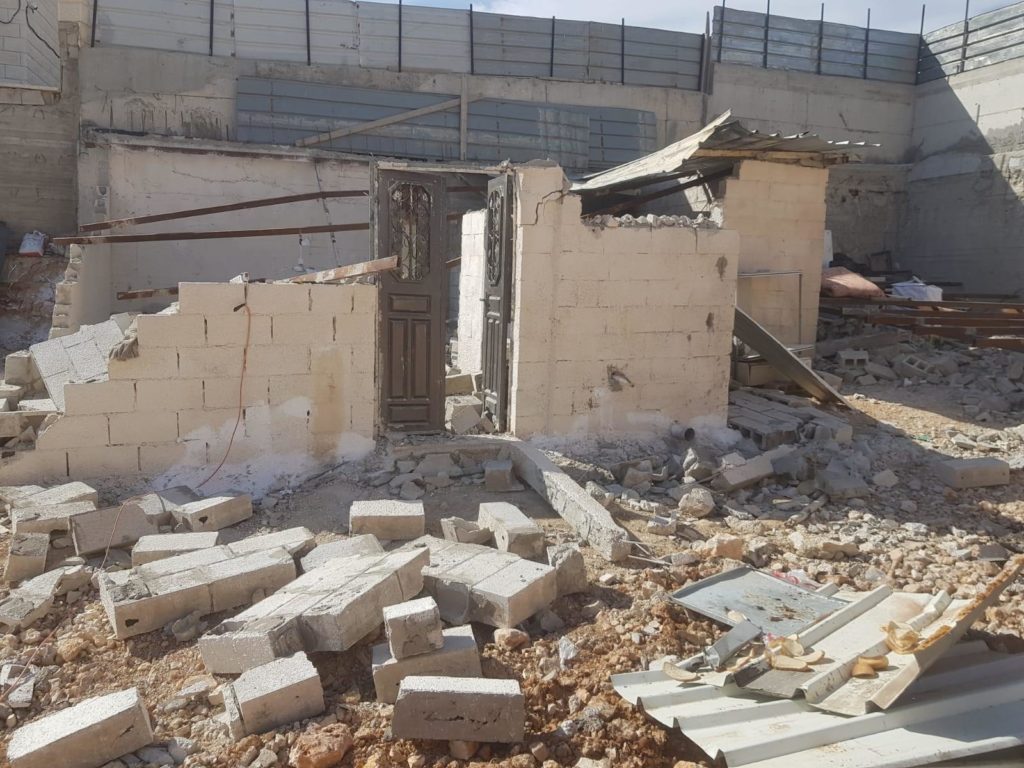
Beit Hanina, East Jerusalem, June 8, 2020. The Jerusalem Municipality offers Palestinian residents of Jerusalem two options: to demolish their own homes or wait for the municipality’s heavy machinery to do it. The latter will force them to pay huge fines. Photo: ‘Amer ‘Aruri, B’Tselem. CC BY-SA 4.0.
Dr. Deborah Lipstadt testified on February 8, 2022 before the Senate Foreign Relations Committee in her confirmation hearing for the role of Special Envoy to Monitor and Combat Antisemitism. In response to a question from Senator Marco Rubio, she criticized Amnesty International’s latest report on Israel, the most recent among similar evidenced-based reports by human rights organizations, including Human Rights Watch and the Israeli B’Tselem, which apply the international legal category of apartheid to describe ongoing Israeli violence against Palestinians since 1948. Amnesty’s report on apartheid in Israel is thorough and well-documented. Still, Lipstadt retorted that it is “unhistorical,” “delegitimizes” Israel, and is somehow threatening for Jewish students on US campuses. This portends a worrying and accelerating trend for an important role in the US State Department, carrying on the Trump Administration’s legacy of attacking human rights organizations and conflating legitimate criticism of Israel with antisemitism.
Dr. Lipstadt is not alone in her harsh condemnation of the Amnesty report, entitled “Israel’s Apartheid Against Palestinians: A Cruel System of Domination and a Crime Against Humanity,” which was published on February 1, 2022. It prompted immediate reactions from the Israeli government and its aligned American Jewish organizations that seek to control a narrative that persistently erases Palestinian experiences, human rights, and political aspirations. Instead of engaging with the evidence presented in the report, they accused Amnesty of antisemitism and of singling out and seeking to destroy Israel. Never mind that Amnesty is a respected human rights organization that has reported extensively on violations of international human rights and humanitarian laws around the world. Amnesty has, for instance, described Myanmar’s system of rule as apartheid in 2017, without anyone understanding this as rooted in anti-Buddhist prejudice. Amnesty is also reporting now on the severe violations of international law in Russia’s war in Ukraine since February 24, 2022, and no one has suggested that Amnesty is biased against Russians. What is singled out in the case of Israel, therefore, is criticism of Israeli policies: those defending such policies distort legitimate criticism of a state and present it, only in the case of Israel, as an attack against a people.
Knee-jerk allegations of antisemitism are meant to marginalize engagement with this reality, as presented in the report. There is indeed much to discuss: the report is the product of four years of research, based also on the work of Palestinian, Israeli, and international human rights organizations, and on a large body of scholarship. It clearly shows that, according to international human rights and humanitarian law, Israel has created and maintains a system of apartheid, consisting of segregation, discrimination, persecution, and violence against Palestinians in all the areas under its control and military occupation. The report therefore calls for dismantling the apartheid system, not the state; for those responsible for apartheid to be held accountable; and for the victims and survivors to receive justice—all according to international law. The report is a critique not of a people, but of a state, though it does not prescribe what the political future of the state should look like following the dismantling of the apartheid system.
Jews who care deeply about Israel have, in fact, described it as an apartheid state, including leading Israeli organizations and politicians, among them former prime ministers.
Those attacking the report present themselves as representatives of all Jews, but Jews hardly agree on anything, including Israel. It is, furthermore, precisely the association of Jews everywhere with Israel that puts them in danger, as it confirms in the eyes of antisemites that Jews do not really belong where they live. This unfortunate meeting point of antisemites and apologists for Israeli state violence stems from a shared segregationist view of the world, which brings us back to the report: the reality of the system of Israeli apartheid.
Those attacking the report present themselves as representatives of all Jews, but Jews hardly agree on anything, including Israel. It is, furthermore, precisely the association of Jews everywhere with Israel that puts them in danger, as it confirms in the eyes of antisemites that Jews do not really belong where they live.
On the day before Dr. Lipstadt’s hearing, February 7, 2022, the Israeli Parliament approved in first reading the proposed Citizenship Law, which denies Palestinians married to Israeli citizens permanent residency in Israel and thus bans Palestinians from the occupied Palestinian territories and Gaza from living in Israel with their Palestinian partners. Israel’s Minister of Health, Nitzan Horowitz, whose party (Meretz) opposes the proposed law, described it as “racist and discriminatory, and there is no place for it in a democratic state.” This failed to prevent the final approval of the law on March 10, 2022. Israeli Interior Minister Ayelet Shaked sees the Citizenship Law as an “important result for the security of the state and its fortification as a Jewish state,” expressing the apartheid rationale that, furthermore, casts Palestinians collectively as a security threat.
Dr. Raz Segal is Associate Professor of Holocaust and Genocide Studies and Endowed Professor in the Study of Modern Genocide at Stockton University in New Jersey. He was a Senior Fellow at the Vienna Wiesenthal Institute for Holocaust Studies (2023) and a recipient of the Baron Velge Award for his work on the history of World War II (2024). His publications include Genocide in the Carpathians: War, Social Breakdown, and Mass Violence, 1914-1945 (Stanford University Press, 2016).
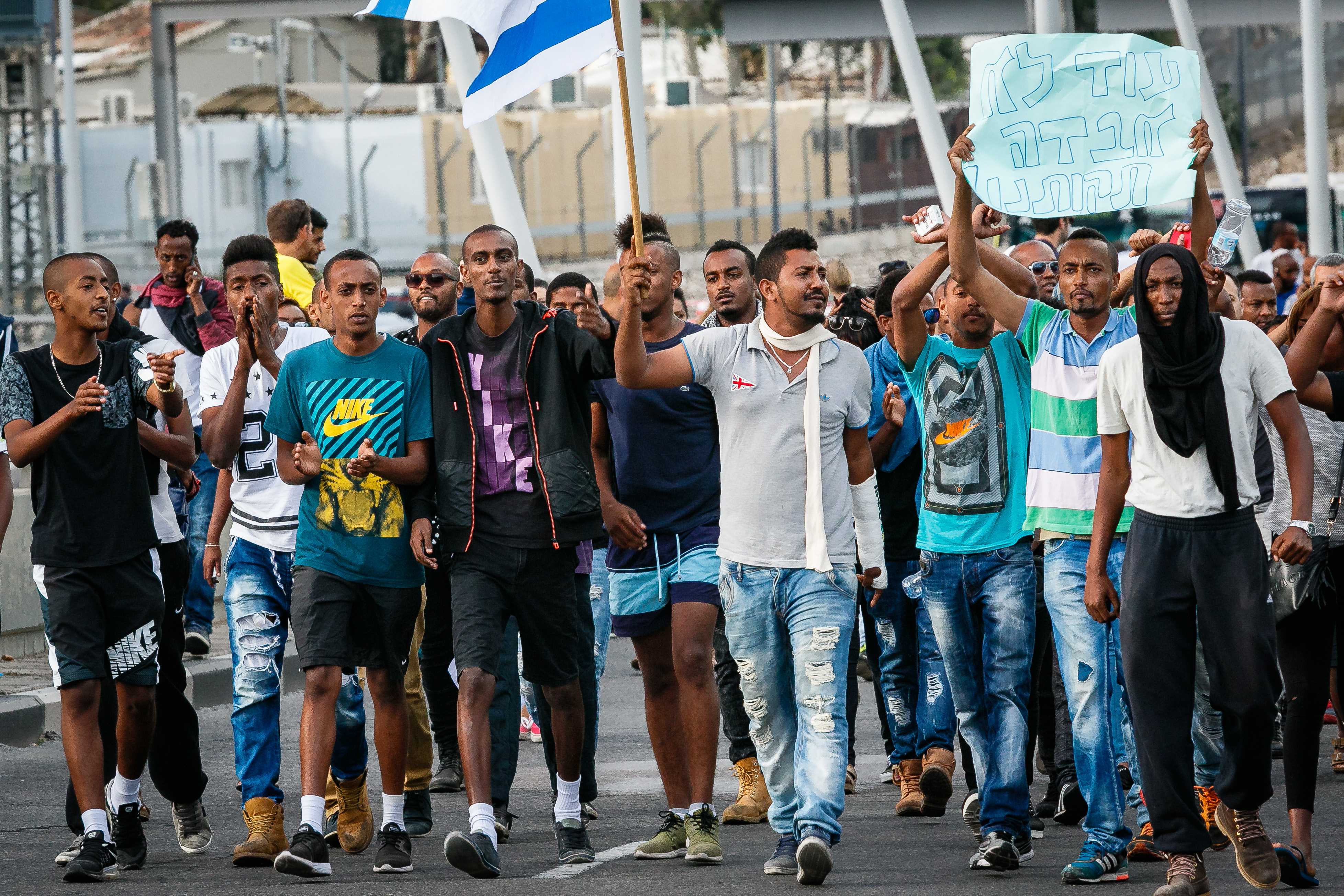
Ethiopian protestors at a rally in Tel Aviv (2015). Public Domain. Via Wikimedia Commons. CC BY-SA 2.0
The summer of 2021 marked the 50th anniversary of the Mizrahi Black Panther movement. Those months in the aftermath of the May events followed a remarkable decade during which Mizrahim succeeded in amplifying their struggle in the Israeli mainstream, even if only for its representatives, and as a kind of lip service and bon ton. Despite this progress, the anger and the pain remained: If previously it was the Mizrahi protesters who were “not nice” (the way they were referred to by American-born Prime Minister Golda Meir), today it is Ethiopians. Like the ultra-Orthodox, the Ethiopians burned tires and blocked roads. However, in frightening similarity to recent events, they also burned and overturned cars, thus becoming the enemies of Israelis that usually perceived the community as unthreatening and docile. The most chilling moment was revealed in a video which captured several Ethiopians at the Kiryat Ata junction chanting cries in Palestinian Arabic from the First Intifada: “Allah akbar”; “Free Palestine!”; “idbah al yahud”; “With blood and spirit we will redeem Palestine”; “Everybody hates you, 5 billion people hate you”; “Only money and greed interest you!” And finally – “You brought us so that we would fight for you, what do you think, that we are like the Moroccan chakh’chakhim (thugs). We are not!”
In this video, the Ethiopians identify with the Muslim population, thereby branding the “Jews” (certainly the new Jews of Zionism and of the luxury towers in Tel Aviv) as a symbol of the Global North. On the one hand, they removed themselves from the imagined collective that tolerates them only when they are “nice,” and at the same time they identified themselves—albeit forming a more radical critique vis-à-vis vis the state—with the Moroccan chakh’chakhim, illustrating their familiarity with the Israeli history of the 1981 election campaign. The demonstrators identified with a critical post- or even anti-Zionist view that rejected the myth of “return to a forgotten homeland” as its purpose was to bolster the Jewish population in the struggle against native Muslim Palestinians. The Ethiopian protesters recalled the Mizrahi struggle of the 1970s rather than trends of Mizrahi domestication into the new Israeli middle class in more recent decades. In their very name, the Israeli Black Panthers defined themselves as part of a globalized solidarity movement (Meir was terrified of any analogy being drawn between them and the American Panthers). They further underscored their global interconnectedness in how they appealed to other Blacks throughout the world, including Palestinians. The Ethiopian video reveals how potentially close the alliance is between suppressed identities in Israel. It creates an almost uncanny effect (in the Freudian sense) in which the warm and the familiar (the Ethiopian) is juxtaposed with the alien and most threatening of all (Palestinian resistance, including Hamas). Recalling this truly remarkable video of 2019 during the May 2021 crisis, I realized that someone was trying to remove it from the web, as I was only able to track it down again in an article by Salmach Salima published in “Siḥa Mekomit” web magazine (the Hebrew version of +972 magazine) in July 2019. There, Salima offers a ground-breaking criticism of the Palestinian struggle’s failure to forge alliances with other suppressed identities:
I nevertheless wish to help the suppressed populations in the society that I aspire to live in. And for me, as the weakest link in this chain of suppression—national, racial, and gender—I have a part to play in the liberation of others, even if these ‘others’ were exploited, willingly or unwillingly, and coerced into suppressing me and my people. This is the strongest position I can take at the moment as a Palestinian.
In the second part of this two-part post, I examine the ongoing ways in which Ashkenazi hegemony is perpetuated in Israel/Palestine and the necessity for the Left to recognize protests against that hegemony as legitimate. Salima’s words above indicate the kind of solidarity between marginalized groups that is necessary in the current moment.
Palestinians, Mizrahim, and…the Israeli (Ashkenazi) Left
The Palestinian struggle is also captive to the equation of “Jews-Arabs.” Recently, Palestinian intellectuals Haneen Maikey and Lana Tatour criticized Israeli human rights organizations for, in effect, preventing the Palestinians from telling their own story. They mocked B’Tselem’s definition of Israel as an apartheid state several decades after it had been so classified in Palestinian historiography. A similar discussion took place recently after editor-in-chief of Haaretz, Aluf Benn, expressed support for the narrative of the Nakba, 73 years after it happened. Maikey and Tatour had no compunction in claiming that “the Ashkenazi-Israeli human rights sector suffers from a problem of supremacy.” During the May crisis, all the organizations who have high visibility in times of Intifada, when the fabric of “co-existing” is jeopardized, speak about symmetry between Arabic and Hebrew and between Jews and Arabs. Not one of them alluded to Jewish-Israeli-Ashkenazi responsibility.
The fact that many people have a keen interest in maintaining the status quo cannot be overstated. In an article which appeared in Haaretz 25 years ago under the heading “The Bond of Silence,” sociologist Yehuda Shenhav-Shahrabani highlighted the Ashkenazi non-recognition of the oppression of Mizrahim. This same silence is passed down through generations and is bound up with Ashkenazi attitudes toward the Palestinian issue. While admitting the injustices done to Mizrahim threatens Ashkenazi hegemony, acknowledging those endured by the Palestinians does not. Furthermore, turning a blind eye to Mizrahim—or in other words, trying to avoid linking the colonialism within Israel with the colonialism in the occupied territories—was always a precondition for the existence of the “Left” (even before the 1967 expansion and occupation beyond the “Green Line”).
At issue here is the European secularization process that was enabled by the negation of religion (the Jewish, the Black, the non-European). Indeed, as Mahmood Mamdani wrote recently, “Zionism is both a product of the oppression of Jews under European modernity and a zealous enactment of European modernity under colonial conditions” (250). The brand of Zionism that Israel markets in North America and in Europe is only the enactment of European modernity. It should therefore come as no surprise that all the liberal media in Israel, as well as the English edition of Haaretz, continue to foster this separation, the significance of which is no less than the denial of the Mizrahi cause, which is what stands behind the false “religious” division between all “Jews” and “Arabs.” The crucial point is that Zionism’s colonization of the Jew himself, a notion at the core of early Zionist discourse, is now enabled by its focus on the distinction between “Jews” and “Arabs,” a binary which makes (Ashkenazi) Jews seem modern and secular. Nonetheless, when the focus turns to Mizrahi Jews, (Ashkenazi) Jews are reminded of their own “non-Europeaness,” and thus their failure to fully assimilate to White European identity.
While admitting the injustices done to Mizrahim threatens Ashkenazi hegemony, acknowledging those endured by the Palestinians does not. Furthermore, turning a blind eye to Mizrahim—or in other words, trying to avoid linking the colonialism within Israel with the colonialism in the occupied territories—was always a precondition for the existence of the “Left” (even before the 1967 expansion and occupation beyond the “Green Line”).
Because Mizrahim are unequivocally Jewish, unaffected by the complex political-theological discourse surrounding immigration from Ethiopia and the former Soviet Union, they serve as a painful reminder that Jews (including those of European descent) are themselves not European. Mizrahim remind Ashkenazim of their own Mizrahiness and that their assimilation into Whiteness and a modernist civilizational discourse came at a price, not just of losing their oriental heritage but in fact of losing their own Jewishness as a socio-political mark. It is interesting to note that since the defeat of the crime families—Alperon, Abergil, but also Rosenstein—the state has “nurtured” the crime scene in Arab towns. The much-discussed documentary series “Jerusalem District” (the Israeli broadcast channel, 2019) follows the capitol’s police force and their interactions with the city’s Palestinian population (like in the case of Sheikh Jarrah). The Jerusalem police often confront drug-related and other socio-economic crimes, those which are not connected to citizens’ ethnic or national identities. Because Mizrahi is not a category recognized by the State of Israel (unlike Ultra-Orthodox, Arabs [recognized as bnei mi’utim, minorities, and not as Palestinians], or Ethiopians), as a people they are often difficult to trace. However, in “Jerusalem District” the policemen’s surnames are so clearly Mizrahi that they border almost on the stereotypical: Obadia, Hazan, Gueta, Ohayon, Amsalem, etc. If the occupier is visualized as a fearless Ashkenazi from the Palmach and afterwards the Israeli Air Force, then policing in Israel is a Mizrahi performance: what was once the Minister of Police and then the Minister of the Public Security is now a job reserved for Mizrahim, starting with the first Minister of Police Bechor Sheetrit (the only indigenous Palestinian-Jew who signed the Declaration of Independence), and going on to Moshe Shahal and then Shlomo Ben-Ami. The picture that emerges is quite damning: the more blatantly evident it is, the greater its invisibility to us. Only this mesmerizing mixture of presence and absence—the entire domain of “internal security” is kept for Mizrahim who only police the Arab population—enables the perpetuation of this project of Jewish-Ashkenazi supremacy (and recall: the Oslo Accords granted Palestinians the right to police themselves; what is the PLO if not a police force?). In Israel, the victims become the executioners, and in this process the Israeli ethos is emptied of all hope for real political protest. It is also clear from this why Mizrahim themselves will go to any lengths to deny this.
In 1996, Amira Hass published her monumental book on Gaza, Drinking the Sea at Gaza, which in my opinion is one of the most important works of Israeli prose. Even during the era of the peace accords and the consolidation of the separation regime, Hass, in her role as a collector of testimonies, understood the legitimate and popular origin of the Hamas movement and recognized it as a multi-faceted and human entity which has both moderate and less moderate streams. The phrase “my friend the Hamas activist” appears many times in the book. The Muslim Brothers, who helped found Hamas, are a popular movement in the Muslim arena. They are “popular” both in the sense of their wide reach and also in their connection to the people, that is, in their stand against the colonial elites and their emissaries from the early twentieth century. In many ways, the Brothers are reminiscent of the consolidation of the steadfast “Jewish bloc” in the Knesset during Netanyahu’s last governments (this bloc, based on the “Likud” party and the two Ultra-Orthodox parties, also presents itself as fighting the elites, which are often perceived to be under Western influence). This movement is conservative in the same way that Germany, for example, has been ruled for many years by a conservative Christian-Democratic-Union movement. Hamas was established in 1987 as a direct result of an earlier period of Israeli violence. In 1948, Israel was responsible for both ethnic cleansing in the south of the country and the bombing of new refugee areas, one which included the hospital in Majdal, now Ashkelon, where many future leaders of Hamas originated.
In an interview following the last war, Tareq Baconi explained that there was no consensus within Hamas regarding the use of violence. During “The March of Return” protests of 2018, for instance, it was apparent that non-violent protest attracts much less attention from the international community and from Israel itself, for which only the firing of rockets represents an act of war. The continuing siege is not perceived as violence that demands a response, and the “right to self-defense” is reserved for Israel alone. Hamas’ use of violence has a long history in the anti-colonial struggle: suffice it to recall the famous scene in Gillo Pontecorvo’s film The Battle of Algiers (1966), in which the native Algerians plant bombs in the fashionable handbags of the ladies of Algiers who innocently place them in the heart of the city’s Parisian cafes. And here, in the same classic book about Gaza, back in the 1990s when the hopes for peace were mixed with the distress surrounding segregation and closures, A’s testimony teaches us something about alienation and closeness in the colonial oppression of the global age:
There is no longer light you know, when I reach the Palestinian front [the checkpoint – OBY], the closest to the Israeli side where they thoroughly check all the documents, sometimes there is some Bedouin black as night posted there, who comes from Egypt or Yemen, so black that I cannot see him in the dark, and he does not know one word of Hebrew and he takes my work permit, shines his torch on it, holds it upside down because he has never seen a Hebrew letter, and he has to decide whether the permit is fake or not. Afterwards we advance with the car and reach the Israeli checkpoint, and we meet there an Israeli soldier, a new immigrant from Ethiopia, black as night and I do not recognize him in the dark, and he looks at the permit and reads it for half an hour, very slowly because he does not yet read Hebrew very well, reads and glances at me and again reads and looks at the photo and again looks at me, and I feel as if I’m the biggest criminal in the world who is about to be caught.
A certain guilt accompanies this blindness towards one another (“I don’t recognize him in the dark”) which is the lot of all subalterns who live under this regime, especially during times of violence. The Left remains indifferent to the state-sanctioned violence practiced by Israel as a matter of course against the large majority of its inhabitants who are not part of the European settlement project in the Middle East. The word “settlement” here is the same as “colonization,” which is used until this day in French, and was previously not differentiated from “settlement” in both German and English. For this “sane majority” (which is not a majority), many of whom are left-wing liberals, Hamas is an extremist movement and not one that raises the flag of protest against a siege that has lasted in various forms since the late 1980s and against many decades of racism and varying degrees of ethnic cleansing.
Hamas shooting missiles can be compared to a child in a refugee camp who throws stones, an expression of rage with which I, as a Queer Mizrahi, and thus as a victim of Israel’s degrading and humiliating system, can identify. A Left that just quells the flames is not Left, but hegemony; a true Left protests injustice. Perhaps a change will signal its coming when the Left will be able to declare, unequivocally: “Palestinian protest is just.”
The author wishes to thank Dr. Sigal Nagar-Ron of Sapir Academic College.
Dr. Hannah (Omri) Ben Yehuda is a scholar of comparative literature in Tel Aviv University. This essay is based on her academic paper “The Flight of a Mother: Rape and National Coercion in David Grossman’s To the End of the Land”, Shofar 42:3, 2024, 155–180.
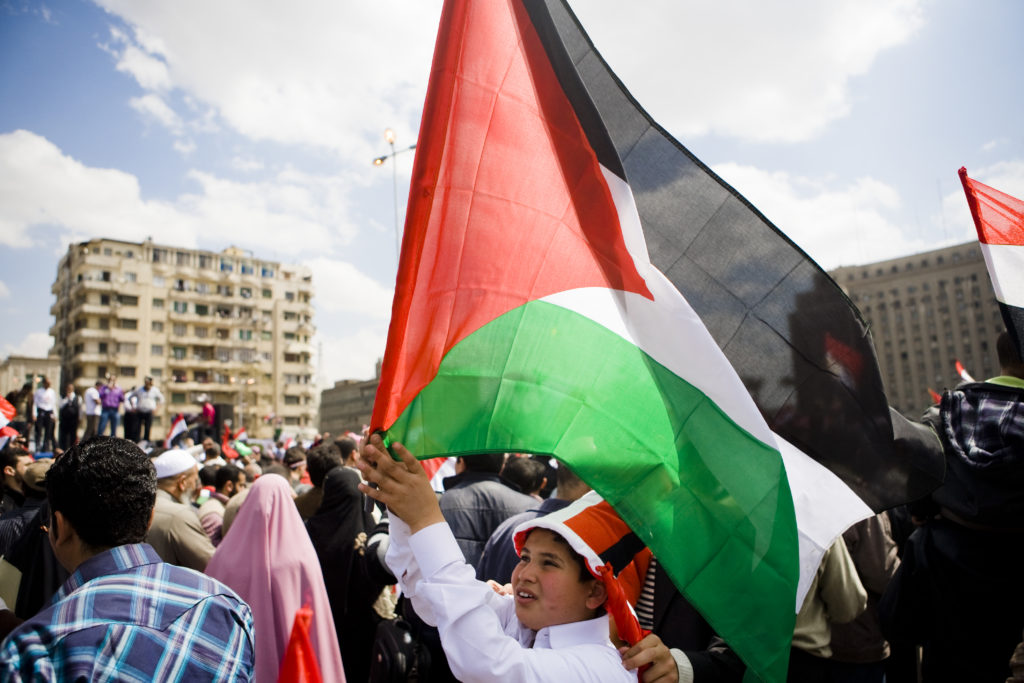
Protest in Tahrir Square (2011). Photo by Flickr User Hossam el-Hamalaway. CC BY-SA 2.0
Jews, Arabs, and… Ashkenzim
One of the most viral videos to emanate from the last Gaza war and the violence within Israel in May 2021 was of Amit Segal, Israel’s most popular political commentator. On May 13, Segal appeared on a prime-time news broadcast on Keshet 12. For several minutes, Segal, acquainted with the Right, laid out his grievances against the media for their symmetrical coverage of the Jewish-Arab violence when, in his opinion, the Jewish side was most often the victim. Close to four minutes into Segal’s monologue, which he subsequently posted on his popular Facebook page, a kind of dialogue began with his interlocutor, one of Israel’s star journalists, the non-partisan (i.e. in today’s Israeli media the Center-Left) Ilana Dayan. Dayan presented the discursive symmetry in Jewish-Arab relations, wherein the “other” is no more than a reflection of the “I” or “we” and its desires (“they are our doctors,” “I have an Arabic teacher,” “we live together”). At the 17:12 mark, Segal—for whom this “other” is an opponent and as such enjoys a modicum of independence from the “I” (always a Jewish “I”)—blurted out a word that was out of place in the context and was probably an unintentional slip of the tongue. When Dayan argued, “We must address the lynching in Bat Yam (where Jews are perpetrators) because we have a role to play here,” Segal asked, “Who is ‘we’? Who is ‘us’? Journalists? the Ashkenazi Jews?” Dayan replied “We the Jews.” Segal branded this “we” as an imaginary and narcissistic collective oblivious to internal pluralities of the Jewish communities in Israel. The Ashkenazim, at the height of the battle and on prime time TV, triggered those sitting around the “tribal bonfire” in the midst of the May 2021 escalation. They suddenly spoke about the “ethnic demon” (ha-shed ha-‘adati), always a Mizrahi demon. Segal made it clear, briefly, that the “we” that bears responsibility and which Dayan presumed so easily is not simply Jewish but unequivocally Ashkenazi. It was a moment, however fleeting, of admitting responsibility for the implications of Ashkenazi hegemony which has targeted Palestinians and Mizrahi differently but in interconnected ways.
Amit Segal (left) and Ilana Dayan (right). CC BY-SA 3.0
This was not the only time during the conversation that Segal took issue with Keshet’s official line, which it has held since its establishment in the 1990s—the prime-days of Israeli neo-liberalism—as the first commercial channel in the country. Unlike his liberal peers, Segal’s overall point of view amalgamates “the Arabs from Gaza and East Jerusalem with the rioters in Lod” (at 18:04), thereby eliminating any distinction between them. In his opinion, they all “do not want us here.” Although, naturally, this extreme point of view is incompatible with the position of any liberal media outlet, Keshet 12 has made every effort to accommodate it. Indeed, Segal subscribes to the pre-state Zionist ethos of victimhood in which the “Arabs” are perceived as an entity hostile to “Jews” (then in a minority)—an entity which was dismantled and fragmented by the liberal Left after the Oslo accords (around the same time as establishment of the commercial channel). Also in the 1990s, acclaimed Haaretz journalist Amira Hass (1996) showed that the Oslo Accords formed a division between “Israeli Arabs” (or Palestinian Israelis) and “Palestinians.” This acknowledgment came, of course, without recognizing the terrible split that the Zionist project has imposed on Palestinians since its very beginnings. This split ruptured ties between Palestinians of 1948 (who possess a blue identity card), Palestinian residents of occupied East Jerusalem, Palestinians in the West Bank, Palestinians in Gaza, Palestinians in the refugee camps in Lebanon, Syria and Jordan, and of course Palestinians in the diaspora around the world. Segal’s words thus carry great subversive potential because he regards the region of historic Palestine/Eretz Yisrael as a single entity. In the first part of this two part post, I will therefore grapple here with the way the liberal Left—for which Dayan serves a prominent example—normally frames Arab-Jewish relations in the region; namely, in a way that erases both the legitimacy of violence by subalterns and the entire Mizrahi question. While the Palestinian question, or case, is somewhat recognized outside the very provincial scope of the Israeli Left, the Mizrahi case has gained currency only recently and among a handful of Palestinian activists who insist on uttering, like Segal, a known harbinger of the Right, the word “Ashkenzim.”
Gaza as an Israeli Space
Much has been said about the suitcases filled with dollars that were transferred from Qatar to Hamas with the approval of former Prime Minister Netanyahu, but no mention has been made of the currency —the Israeli lira and the shekel—used by Gazans to buy vegetables or pay for services, at least since its occupation in 1967. With the changeover to the new banknotes in Israel in 2013, I wrote in Haaretz about the feeling of alienation that a Jewish immigrant from Tunis must feel, never mind a native-born Palestinian, when waiting at the bank where images of statesmen and poets such as Moshe Sharet, Natan Alterman, and Shaul Tchernichowsky gaze out at her from plasma screens.Imagine how the residents of the most bombed buildings of the Gaza War of 2014 (Operation Protective Edge), for example, must feel when, while fleeing for their lives, they hang on to these notes as a kind of security. Of course, Gaza is part of Israel in many other respects, some civil (like area dialing codes and electricity infrastructure) and some under the umbrella known in Israel as “foreign and security affairs.” The latter has been under the control of the Israeli army since the establishment of the Palestinian Authority and certainly since Israel’s disengagement from Gaza in 2005 and the rise of Hamas a decade and a half ago. This reality is in complete contrast to the picture painted in times of war by Keshet 12 and all other mainstream Israeli media outlets. They talk of “Israel under fire” by an external agent with which Israel shares only a border. For this reason, it is legitimate for Israelis to claim that against such incoming fire, Israel, like “every country has the right to defend itself and its citizens.”
However, if Israel has sovereignty in Gaza over all matters relating to foreign affairs and security, is it really under fire from an external force when Hamas fires rockets on its citizens? What protection is being referred to if residents of Gaza, including members of Hamas, and residents of East Jerusalem, resort to violence against citizens of the same sovereign entity? Why do the media, and also a large part of Israeli academia, firmly refuse to refer to Palestinian violence, both internal and external, as a “protest”? As “Palestinian protest”? This protest is linked to the Mizrahi struggle in Israel, the Wadi Salib protest in the fifties, the current protest on the Asi Strem in the Kibbutz of Nir David, the social justice protests of 2011, the recurrent protests of persons with disabilities (who get minimal aid from the government), the Balfour demonstrations during the coronavirus pandemic against Netanyahu’s legal affairs, right-wing protests especially against the disengagement plan from Gaza in 2005, and the Ethiopian protests over the years. The protests of Palestinians with Israeli citizenship in October 2000, which many people called to mind last May, are defined as “events,” in line with pre-state Zionist historiography that defines the Palestinian uprisings against the colonial apparatus (Turkish, British, and particularly Jewish) as events (1921, 1929, and now 2021 as well).
The “Palestinian cause/question” (al qadiyyah) and the “Jewish question” are both expressions of European modernity, whether in the form of their currency of nationalism or genocidal practices, neither of which are acknowledged in Israel.
In Arabic, just as in the context of the Arab Spring, these events are described via the language of revolts/uprisings. In Hebrew, the words meora’ot (events) and meḥaah (protest) are reserved for Jews, while pra’ot (revolts) or meora’ot (events) relate to the Jewish-Arab conflict. Mainstream historiography in Hebrew also uses the word “Palestina,” which was imported from German and Yiddish in order to foster the illusion that Palestina existed only before 1948, while Palestine is something which relates to theory alone. Another striking example of how the Israeli Center Left imagines the country’s reality can be seen in Avi Nesher’s spectacular film Portrait of Victory (Israel, 2021) that depicts the battle over Kibbutz Nitzanim in 1948. Because the narrator is Egyptian, half of the film is in Arabic with Hebrew subtitles, and while Palestinians and Egyptians refer to Nitzanim as a settlement (mustautanah), the translation refers to the foreign word “kolonia” (colony) and not to the Hebrew word hitnaḥalut (settlement). The latter is reserved only for the settlements beyond the green line, thus continuing the false legitimacy of the pre state colonization of the country by dubbing it with a foreign, and hence neutral, word. The “Palestinian cause/question” (al qadiyyah) and the “Jewish question” are both expressions of European modernity, whether in the form of its currency of nationalism or genocidal practices, neither of which are acknowledged in Israel.
This leaves the Israeli Orientalists mainly with Arabs who want to integrate into society or those, like members of the Joint List party, who are “troublemakers” or “terrorists.” It is convenient for Israelis to think that Israeli Arabs are not really interested in “Palestinians,” those on the other side of the “walls” whose protection gave its name to the May assault. The current Israeli discourse refers to “rounds” (sevavim) of violent skirmishes between the Israeli government and Hamas. The last major round was Operation Protective Edge in 2014, during which 70 Israelis—almost all of them soldiers, a terrible loss that is hardly ever mentioned in Israeli media—and more than 2000 Gazans lost their lives. And although Operation Protective Edge hovers in the background together with the endless rounds that prove that the process is at a standstill, there were several unprecedented factors during the 2021 round, most notably Hamas’ response to the events inside Israel and the responsibility it took for the fate of East Jerusalemites that resonated as well in an internal Israeli intifada.
The Protest of the Global South
When the May events began, we—that is, the Israeli media and academics—reignited a dialogue about Hamas itself and about Gaza, consolidating Protective Edge of 2014 as the central point of reference. But then the rebellion broke out within Israel, an uprising (intifada) in Jaffa, Lod, in Jerusalem and the North, as well as other places, which reminded some commentators of the October 2000 protests that ended with the death of 13 Palestinians with Israeli citizenship. I suggest that the rebellion of 2021 and the imaginary “coexistence” that was projected by Israeli liberals, should not be separated from Israel’s war against Hamas. In my historiography of the events last May, there are two points of reference far more pertinent than Operation Protective Edge. First is the Intifada of the Individuals from 2015–2016, which broke out in the aftermath of Protective Edge, and was an assemblage of suicide missions during which Palestinians attacked security personnel with scissors or other ridiculous weapons with the sole purpose of bringing about their own death. Second are the Ethiopian protests in 2019 following the murder of Solomon Tekah. These protests, and not Protective Edge, uncover the seething venom that exists in all areas of the Greater Eretz Yisrael/Palestine, a venom of pain mixed with justified anger rather than the brittle “fragility” of coexistence. They teach us that, unlike what was formulated by Dayan and Keshet 12, the issue is not Jews against Arabs, but rather Israeli-Ashkenazi Jews against the Global South, which in Israel is represented by non-Europeans: Palestinians, Mizrahim, Ethiopians, and migrant laborers (almost all from the Global South).
In a state of emergency, every Mizrahi has to internalize (what Dayan nonchalantly parroted) that she is nothing more than a “Jew,” an imaginative signifier that also represents the adjectives “Israeli,” “liberal,” a “champion of progress.” In one stroke, Mizrahi identity is totally erased: the non-European Israeli Jew is no longer “Black” (whether ultra-Orthodox or Ethiopian), or as liberals in Israel tend to condemn Mizrahim today, a “Bibist” (a follower of Bibi Netanyahu). She has to suspend the knowledge that there is only one Mizrahi party leader in the Knesset, Aryeh Deri (who recently had to resign the Knesset and rule the party from the outside as part of a plea deal related to minor misdemeanours), that Israel has never had a Mizrahi prime minister, and that the new administration (that was inaugurated a month after the May crisis) is almost entirely Ashkenazi. In times of escalation, the Mizrahi will have Dayan and her colleagues to remind them that in the equation of Jews and Arabs, they are definitely not part of the latter. In the Israeli discourse, both in Hebrew and Arabic, Jews and Arabs are dubbed as two migzarim (sectors), each entirely homogeneous and distinct from one another. Thus, whenever the discourse becomes demographic, people repeat a fact that has become an axiom, namely that 20 percent Palestinians are also citizens. But that is a biased perspective that upholds the liberal discourse of a Jewish majority and an oriental minority. A different perspective, one which emphasizes those who inhabit the thoroughly oriental vicinity in the imagined Jewish nation state, will either address those who live between the sea and the Jordan River (thus capturing Mizrahim and Palestinians together as descendants of those who are indigenous to the Middle East) or will focus on those who are Jewish according to the Jewish Law and not to the State’s Law of Return. In the latter case, Mizrahim will also be the majority among the Jews, while the category “Jews” as a non-oriental signifier (with the help of such Jews as those who immigrated from Russia, who adhere to the Law of Return but not necessarily to the Jewish Halakha) will be abolished and instead undergird this signifier—“Jews”—with its lost oriental undertones. Remarkably, just recently this de facto approach to understanding Jews as non-Orientals became official with the census’ abolition of the generalized term “Jews and Others,” a designation which encompassed “those who are undefined” (meaning descended from the USSR) as well as “non-Arab Christians” for either “ukhlusia yehudit murḥevet (expanded Jewish population)” or “Jews and their family members” (the words of Prof. Danny Pfeffermann, director of the census). For my argument, it is sufficient to pay attention to the “non-Arab Christians” label, which evinces the politization of the non-Oriental.
In part 2 of this series, I argue that a more emboldened left-wing movement is required if Ashkenazi hegemony is to be addressed and overcome in Israel/Palestine. This overcoming will require that Ashkenazi Jews relinquish their attachment to European white indentity formations and re-engage their “oriental” identity in solidarity with Mizrahi and other marginalized Jews.
The author wishes to thank Dr. Sigal Nagar-Ron of Sapir Academic College.
Dr. Hannah (Omri) Ben Yehuda is a scholar of comparative literature in Tel Aviv University. This essay is based on her academic paper “The Flight of a Mother: Rape and National Coercion in David Grossman’s To the End of the Land”, Shofar 42:3, 2024, 155–180.
Copy of a statue entitled “Reconciliation” (1977) by Josefina de Vasconcellos in Berlin. Via Wikimedia Commons. CC BY-4.0
A True Friend
“A true friend,” that’s what Naftali Bennett, Israel’s prime minister, called Angela Merkel during her farewell visit to Israel in October 2021. Merkel had made Germany’s support for Israel a focus of her tenure as Chancellor, calling Israel’s security a matter of German Staatsräson in 2008. Now, during her last visit, she repeated what she meant by that: “Germany can only forge a truly good future in full awareness of its unending responsibility for the break with civilization that was the Shoah.” Later that day, Merkel added that even as it became “increasingly difficult because of the settlements” under no circumstances should one “lose sight of the two-state solution.”
But the two-state solution could not be farther out of sight than when Merkel first took office in 2005. Is that the legacy we would expect of a true friend? Shouldn’t a true friend at least have tried to move Israel closer to ending the occupation and finding peaceful ways forward? Shouldn’t she have used her much-applauded ability to forge compromise by bringing Israelis and Palestinians back to the negotiating table and keeping the two-state solution firmly in sight? Shouldn’t she have made every effort to secure an end to illegal settlements, human rights violations, and violent conflict?
A Moral Triangle
Angela Merkel may be an angel to the many immigrants who named their children after her in gratitude for receiving asylum in Germany post 2015, but with regards to Israelis and Palestinians, her name has not been an omen. This is the case even though—as Katharina Galor and Sa’ed Atshan’s The Moral Triangle: Germans, Israelis, Palestinians so powerfully demonstrates—there were so many opportunities to bring people together right at home in Berlin. Their interviews and analyses, thanks in part to the deep respect they have for each other that is palpable in the book, conjure up a hope that lies in the possibility of what could be if Germans were willing to spend political capital on the issue. If the new German government were to acknowledge that the Shoah and the subsequent creation of the state of Israel have indeed created a triangle that puts a moral imperative on Germans with regards not only to Israelis, but also to Palestinians, many new avenues for rapprochement and restorative justice could be opened up, rather than, as has been the case up to now, sacrificing Palestinian humanity in the name of Vergangenheitsbewältigung [Coping with the Past]. Indeed, there is a lot more Germany could do diplomatically to sanction human rights abuses, for example, in connection with illegal settlements. That said, the book also explains why high-level negotiations or diplomatic advances alone may not succeed. Ultimately, politicians are not able to initiate peace from the top down. Peace can only come from the bottom up. The true peace makers therefore are the artists, entrepreneurs, and activists portrayed in the book. They are those who dare to step across that invisible line that so often prevents people from seeing each other’s humanity. Like Yael Ronen. Like Armin Langer. Like Tarek Al Turk. Like Saleem Ashkar. Like Daniel Barenboim. Clearly, art and activism, but also entrepreneurship and innovation, can bring people together in ways that politics cannot. That said, the new German government should accept the political responsibility and make investing in creative approaches towards reviving the peace process a top priority.
A Missing Link
The moral triangle is missing a link, of course—the two authors only represent two of the three angles. Would the book’s message have changed had there been a third, a non-Jewish/non-Palestinian, German author involved? As a non-Jewish-non-Palestinian German reader, I was initially finding myself trying to resist the idea that the plight of the Palestinians is the Germans’ fault. What about the British? What about Israelis and Palestinians themselves? After all, the authors explain that the large majority of Palestinians living in Berlin today do not actually hail from the West Bank or Gaza, but from surrounding countries. But of course, laying blame is not the purpose of the book. Instead, its purpose is to reignite a difficult conversation despite all the challenges. The result is a dialogue that doubles down instead of going silent when the going gets tough.
Jewish-German Dialogue
The idea that lies behind the dialogue is a beautiful and encouraging one. It is an idea that reminds me of Jewish-German Dialogue group that I took part in when I first arrived at Brandeis University (the only non-sectarian Jewish-founded university in the United States) in 1998. One of the members of this group was my late colleague David Gil, Professor at the Heller School for Social Policy and Management for almost half a century, who passed away this year at the age of 96. David spent his professional life thinking about the theory of social change, the roots of violence and oppression, and how to develop policy strategies to respond to universal human needs. During the Holocaust he had fled Austria, first emigrating to Sweden and then to Israel. Eventually he and his wife Eva settled in the United States. The dialogue group, led by then Rabbi Al Axelrad, met about once a month, as a small circle of Jews and non-Jewish Germans who talked about the Holocaust. Invariably, the conversations in our monthly meetings would reach the topic of Israel, and David never failed to voice his deep dissatisfaction with the treatment of Palestinians. This also invariably incensed one of the other members of the faculty, a Professor of French and son of Holocaust survivors from France. The two of them would then argue while the German participants typically stayed silent. Interestingly, David never turned to the German participants and asked them about Germany’s responsibility for the Palestinians’ plight. Instead, the Germans (myself included) would sit there somewhat uncomfortably, thinking that this seemed more like a Jewish-Jewish and not a Jewish-German dialogue. If Athsan and Galor’s book had been available to us back then, it would have made the German participants realize that the Middle East conflict was their business. It would have confronted them with the realization that their own history was interwoven not only with Israelis’ history, but with the history of the Palestinians as well. And it would have taken quite a bit of the burden off of the Jewish participants, which in turn might have reduced the differences among them.
When I was a child growing up as a Lutheran pastor’s daughter in Germany, I heard about Israelis mainly in church on Sundays, and about Palestinians in conjunction with the RAF terrorists who had briefly trained with Palestinians in Jordan, and who were being chased by police. Their collected mug shots hung in all German post offices, even in the one on the small island in the North Sea where I grew up. My parents told me not to wear an Arafat-shawl like all my friends did. My friends who were wearing the shawls never talked about Israel or Palestine. It was simply the cool thing to wear. We all agreed antisemitism was something the Nazis did against the Jews, and was something that was not supposed to happen ever again. I did not hear the term Nakba until much later. I also never interacted with any living Jews or Palestinians for that matter. This did not happen until I came to the United States in my late twenties.
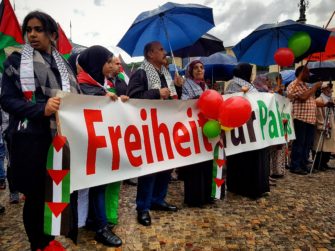
Palestine solidarity protest in Berlin (2018). Via Flickr user Hossam el-Hamalawy. CC BY-2.0.
David was not the only American Jew I have since met who was deeply critical of Israel. In fact, it was among Jews and Israelis in particular that I first heard about the Nakba. Thirty years ago it was a constant topic of discussion. Everyone placed “Shalom, Haver” stickers on their cars after Yitzhak Rabin was shot.[1] The saddest part of the book, therefore, is the fact that so many of the interlocutors were afraid of being identified, especially for speaking on behalf of Palestinians. The fact that there is “censorship of voices that support Palestinians” (150) in Germany is more than an unfortunate set of circumstances. It is indeed immoral. Galor and Atshan show that this dialogue, if approached with respect and empathy, is indispensable. They show that it is possible to be in solidarity with Israelis and Palestinians—that is, with the people on both sides who care for true friendship and true peace.
A New Start and a Traffic Light
Angela Merkel’s departure should be an opportunity in this regard: A new German “traffic light” coalition government that includes the Green Party should finally dare to assume a more active role vis-a-vis Israel/Palestine. Although foreign policy played hardly any role in the German elections this year, the Greens do have a clause about peace and human rights in their party platform which says that they want to pass a law to prevent arms sales to conflict regions in general. Those in Israel who fear their influence may not like this part of their platform, but they should feel comforted that Merkel’s sentence about Israel’s security being part of Germany’s Staatsräson can be found verbatim in the Green Party’s election campaign platform. It also says there that “the existence and security of Israel as the national home of the Jewish people with equal rights for all its citizens is non-negotiable” (my translation). The party condemns threats to the state of Israel and its sovereignty. There is no mention of Palestinians, but there is explicit criticism of “escalation of violence as well as measures contrary to international law such as the annexation of occupied territories or the continued expansion of settlements” for standing in the way of a peaceful political solution to the conflict and an end to the occupation. Prominent Greens have also positioned themselves strongly against the Boycott-Divestment-Sanctions (BDS) movement. Like Merkel, the Greens express support for a two-state solution on the basis of the borders of 1967. That certainly does not sound like a desire to stake one’s political future on a renewed commitment to peace in the Middle East. Ending the sale of submarines and fossil fuel contracts should be combined with a new German diplomatic offensive in the region focused on addressing human rights violations and wooing both Israelis and Palestinians back to the negotiating table with improvements in ecological agriculture, green energy, and innovative climate solutions for the entire region. Berlin should extend an invitation to the peacemakers on both sides and become—both physically and metaphorically—the place for a renewed peace process that centers the needs of the people on the ground. This would be in keeping with what Galor and Atshan envision, i.e. that “Israelis and Palestinians have the potential to create together a joint foundation of Israeli and Palestinian cultures that exist both separately and in an interwoven manner in a postcolonial context” (147). As stated above, this vision also allows for our Jewish-German Dialogue conversations to get un-stuck, and to develop new ways of speaking about Israel and Palestine, about antisemitism in all its facets, as a German responsibility. In addition to enjoying falafel and Klezmer music, Germans should encourage and facilitate uncomfortable conversations to show they have truly learned something from their many decades of Vergangenheitsbewältigung. Because that’s what friends are for.
[1] “Shalom, haver” = “Goodbye, friend” is how President Bill Clinton referred to Israel Prime Minister Yitzhak Rabin in his eulogy.
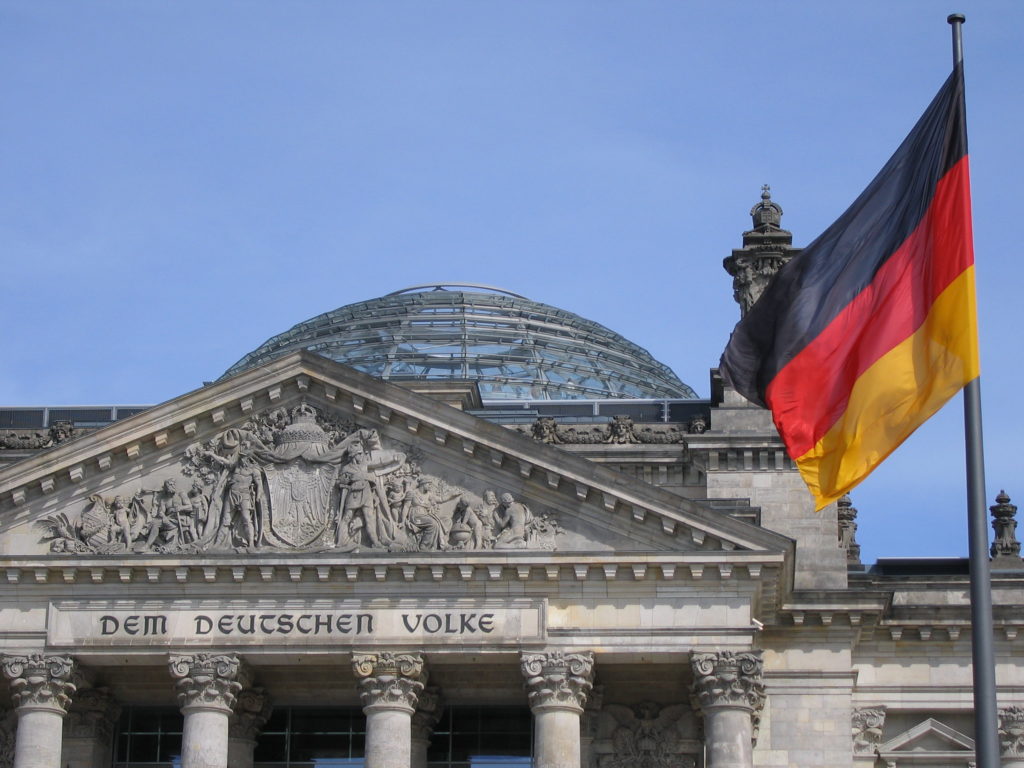
German Reichstag. Photo by jan zeschky. April 2007, CC BY-NC 2.0.
The Moral Triangle’s vision and motivation are its authors’ shared desire to extend the German state’s responsibility for the Holocaust to the Nakba. Could not, the authors ask, the Nakba be recognized as historically related to the failure of the pre-war project of German nation-building? If the German state’s affirmation of responsibility for the Holocaust implies a normative, moral commitment to support and protect Jews on a collective and individual level, can this commitment be practiced in ways that leads neither to a relativization of the Holocaust nor to a denial of Palestinians’ political rights in and beyond Germany? In asking this question, The Moral Triangle may be situated in the broader context of current efforts that demand liberal democracies recognize the persistent legacies of colonialism and racism. Underlying these efforts is a hope: Could not a more pluralist understanding of injustice enable a present and future less prone to rising nationalisms, political violence, and populist, racist agitation?
We concur that the hope for an extension of the memory and responsibility paradigm that developed in Germany with the institutionalization of the memory of the Holocaust may, indeed, lead to a recognition of more forms of violence and more historical victims. For example, it is through reference to the memory of the Holocaust that the claim for a recognition of its “other victims” gradually emerges. Yet, in this response we suggest that, contrary to Atshan and Galor, the desired pluralizationof victims does not necessarily lead to political pluralization, but perpetually inscribes the figure of the Jew as potential victim and the figure of the Palestinian as potential perpetrator. We suggest that, when implemented in the German context, the project of pluralization is bound to and determined by the German state’s desire to reconstitute itself as a liberal, democratic, and above all, anti-anti-Semitic polity. This reconstitution, however, has illiberal and violent consequences. It creates the need for a “new anti-Semite” against which Germany can re-invent itself as a protector of Jews, as well as the need to conceive of Jews as precarious “bare life.” The figure of the Jew does not stand in for religious difference and its recognition and protection, but is an empty foil that enables a German moral conversion from anti-Semitism to anti-anti-Semitism. When many Jews then relegate their political collective subjecthood to the Israeli nation state, Palestinians’ resistance to the latter is viewed through a German lens and reads as anti-Semitism. Consequently, the various forms of state violence committed against Palestinians are denied or met with indifference by large parts of the German public.
…the desired pluralizationof victims does not necessarily lead to political pluralization, but perpetually inscribes the figure of the Jew as potential victim and the figure of the Palestinian as potential perpetrator.
The city of Berlin is the site of Atshan and Galor’s ethnographic study. It is a place framed by the authors as a promising site at which the desire for an extension of moral responsibility could materialize: “Berlin is now known for its cosmopolitanism (in some ways reminiscent of pre-World War II Weimar culture); its critical engagements with the Holocaust; its grappling with issues of justice, immigration, social difference, and integration; its robust public discourse on moral responsibility; its vast cultural sphere; the massive refugee migration of 2015; and the rise of the far-right, populist and intolerant Alternative for Germany (Alternative für Deutschland; AfD) party” (5). As readers living in Berlin, such expressions of hope, of course, sound familiar to us: the multilayered branding of the new capital as “the most non-German German city”—the fostering of an image pointing towards a multicultural, liberal, non-nationalist European future—has been successful. Yet, as becomes abundantly clear from Atshan and Galor’s interviews, German conversations about “things Jewish”—from the Holocaust to Israel and Palestine to anti-Semitism and racism—are for some wrapped in fear of “civil death,” and for others in calculated or naïve innocence. Indeed, from among the “world champions of memory” (“Erinnerungsweltmeister”), as Germany’s memory culture is often referred to, only a handful of those who doubt Germany’s “memory success,” dared to be identified by name. It seems that beneath a carefully guarded, sanitized public layer of speech and performance of memory lies a tenuous, anxious, and fearful thickness. Let us, in the following, zoom into some aspects of this thickness.
Within the specific context of post-1989 Germany, Israelis are framed and addressed primarily as Jews. This seemingly banal fact matters because one of the central functions of German memory culture is to facilitate German inter/national rehabilitation and democratic, collective self-assurance. Seeking to demonstrate its stable and full belonging to the realm of “civilized nations,” the “new” German state institutionalized the memory of the Holocaust as its (post-) national, collective foundation. Especially after 1989, a shift in the reunited German state’s relation to the figure of the Jew is discernible: from now on, Jews are increasingly addressed no longer exclusively as survivors/witnesses from the past, but as living, flourishing, and active carriers of “Jewish life.” Israelis here function as embodiments of Jewish life, the “value” of which cannot be detached from the project of post-genocidal nation building and collective, anti-anti-Semitic self-assertion: “New Germany” became an identifiable nation, as well as a nation one can identify with, through a shift from a world in which the German state remembered its killed Jews to a world in which it actively protected living Jews globally, Israelis among them. In the exhibition “Berlin Global” of the Humboldt Forum, for example, visitors can watch a video-installation, in which, among others, a Jewish Israeli woman recounts how her grandparents fled from Berlin, and how, through her return to the city, a “circle is being closed” and the “sharp cut” is being healed. While the move from Israel to Berlin may, of course, be felt and personally referred to as a return, we suggest that the primary and ulterior importance and meaning of “Jewish life” here lies exclusively in its conceptualization as an answer to the Holocaust. It is part of a progressively evolving timeline that leads from Jews’ murder in the past to their revival/return in the present, and therewith, from German perpetration of atrocities against the Jews to German “guardianship” of Jews. “Jewish life” here has no significance beyond this—the protection of Jewish life does not entail, for example, any broader, normative recognition of religious practices of minorities (including Muslim religious practice) but is understood and globally marketed as a “sign against anti-Semitism.”
We suggest that this dynamic paradoxically necessitates ongoing Jewish precariousness: For it is Jewish vulnerability now that gives the guardians, supporters, and promoters of “Jewish life” the chance to experience the present as a new era—an era in which Germany can be marketed as having completed a collective moral conversion from genocidal, excessive nationalism, to liberal, democratic, and difference-embracing cosmopolitanism. The birth of a morally “improved” German collective, made of citizens who have “learned their lesson” and now wish to protect what their ancestors failed to protect earlier, necessitates not only the memory of the Holocaust to remain in vivid proximity, but also requires a sense of perpetual vulnerability of Jews in the present and future. By this we do by no means imply that Jews and Jewish communities in Germany are not de facto vulnerable. But we do suggest that such vulnerability—both as concrete reality and discursive trope—functions also as a necessary foil upon which German moral regeneration emerges.
German Reichstag. Photo by _chris_st, February 2010, CC BY-NC 2.0.
This latter dynamic is complicated by the fact that especially in a German, post-unification context, the figure of the Jew became a desired figure that promised both an exit from national(ist) Germanness and a post-national, post-racial German future. The figure of the Jew was made to stand in for everything the Nazi state was not. Summoning democratic and liberal sensibilities, it thus became an icon of a post-national European future that was imagined to share one and the same moral space with the ideal, democratic German citizen. When the Jew’s body is depicted as vulnerable and precarious, yet bristling with life and resilience, it functions as a universalizable “stand-in” for the body of the new, democratic political collective that is endangered by the same forces as, allegedly, Jews—such as, for example, new antisemitism, extremism from the right and left, or political Islam. The figure of the Jew thus is a figure, the visibility and legibility of which is rigorously produced and maintained, because in recognizing Jewishness, Germany recognizes itself. Seventy years after the Nazi genocide, the desire for visible “Jewish life” permeates the German political present and unites a broad coalition of politicians, community activists, and engaged citizens, with “Jewish life” functioning as an umbrella under which different rationalities can be harmoniously joined. For example, the (re-)construction of a synagogue can be supported by some politicians as a measure motivated by a principled diversity policy, marking the neighborhood as multicultural and tolerant; for others, the synagogue makes “Jewish life more visible,” and for yet others it is a measure coupled more tightly to rehabilitation. None of these reasonings make the construction of a synagogue dependent on the actual existence of a Jewish community that would need, and use, said synagogue; yet all of them entail a vision of what Germany is supposed to “look like.” The synagogue here marks German public space as Jewish, and relatedly, a town’s policies and its citizens, as anti-anti-Semitic, liberal and democratic, without requiring protection of any other minoritized group.
In the moral-emotional economy of post-unification Germany, the figure of the Jew was thus made visible and legible as both the “other” and the paradigmatic, exemplary new German. Its appeal, desirability, and attractiveness stem from its being remembered, marketed, and re-enacted as a subaltern, vulnerable “other,” while the precise contents of this otherness remain wholly of a piece with post-unification, majoritarian conceptions of what it means to stand, this time, finally, “on the right side of history.” This is a figure of subalternity that is simultaneously hegemonic, a figure of “disruption” that stabilizes, a figure of transnational cosmopolitanism that defines national belonging.
The birth of a morally “improved” German collective, made of citizens who have “learned their lesson” and now wish to protect what their ancestors failed to protect earlier, necessitates not only the memory of the Holocaust to remain in vivid proximity, but also requires a sense of perpetual vulnerability of Jews in the present and future.
Dominant identification with the figure of the Jew has multiple effects on the project of political pluralization. First of all, a polity that defines itself via a conversion from anti-Semitism to anti-anti-Semitism needs someone else to stand in for everything that Germany today is not: someone has to be the illiberal, undemocratic, and anti-Semitic threat against which the good citizen can define herself as that which she is no longer.
Second, it does not protect Jews and Muslims from the regulation, problematization, and stigmatization of religious practices such as circumcision or ritual slaughter. As is emphasized in this series by Sultan Doughan, in German memory culture the category of race is being allocated to the Nazi past—to the experience of the genocidal state and the workings of “pseudo-science”—and severed from the category “religion.” Pre-war forms of racialization of Jewish minorities can take new shape with regard to Muslims and Jews in Europe today and stick to Muslims’ and Jews’ non-statist communities, illiberal normative orders, and non-secular epistemologies. Dominant identification with the figure of the Jew thus cannot prevent the regulation (and in some cases, the threat of prohibition or criminalization) of the religious practices of minoritized collectives who do not experience themselves exclusively within a moral, affective-political space shaped by the needs of German rehabilitation.
And third, dominant identification with the figure of the Jew impacts Palestinians, with increasingly repressive outcomes. Those who seek to enter the public arena can discuss Palestine on “German terms” only and are marked as subjects that require preemptive monitoring and sanctioning. For the sake of Germany’s reconstitution, Palestinians have to uphold the assumption of the figure of the Jew’s universal, perpetual vulnerability, even when they suffer the consequences of Jewish privilege and power in Israel. The Moral Triangle indeed attests to the difficulty of articulating forms of critique of Israeli state violence that are not (“always already”) marked as anti-Semitic, or at least under suspicion thereof. Yet this difficulty cannot be “smoothed out” through liberal “encounters” in the most “non-German German” city, as The Moral Triangle suggests: As long as the figure of the Jew remains a medium through which German post-unification identity is articulated and experienced, the performance of Jewish collective difference and political agency will be exclusively relegated to the State of Israel. The figure of the Palestinian, as well as Palestinians’ political subjecthood and demands for equality will, in turn, be addressed as either an annoyance to be ignored or a threat to be criminalized—rather than as a crucial prism through which the multiple layers of legitimatized moral violence in Germany have to be recognized.
We would like to thank Patricia Piberger, Sami Khatib, and Elad Lapidot for their helpful comments.
Qasem, Sindyan. 2020. “Little more than terrorists”: Eine Reflexion über das Verhältnis von Islamismusprävention und Palästinadiskurs, Jahrbuch für Islamophobieforschung: 71-90.
Hannah Tzuberi studied Jewish Studies and Islamic Studies at Freie Universität Berlin and was a research assistant at the Institute for Jewish Studies (FU Berlin). Currently she is a post-doctoral researcher in a collaborative research project "Beyond Social Cohesion. Global Repertoires of Living Together (RePLITO)” at FU Berlin, directed by Prof. Schirin Amir-Moazami. She is the co-editor of “Jewish Friends: Contemporary Figures of the Jew” (Jewish Studies Quarterly 27:2–3, 2020) and is working on a book-project titled Reviving Judaism, Reviving the Nation: Post-Holocaust Imaginaries of the (German) Nation-State. Her research interests include contemporary European Jewry, nation-building, collective memory, religion, and secularism.
Nahed Samour is Fellow at the Law & Society Institute, Faculty of Law, Humboldt University Berlin. She has studied law and Islamic studies at the universities of Bonn, Birzeit/Ramallah, London (SOAS), Berlin (HU), Harvard, and Damascus. She was a doctoral fellow at the Max Planck Institute for European Legal History in Frankfurt/Main. She clerked at the Court of Appeals in Berlin, and held a Post Doc position at the Eric Castrén Institute of International Law and Human Rights, Helsinki University, Finland and was Early Career Fellow at the Lichtenberg-Kolleg, Göttingen Institute for Advance Study. She has taught as Junior Faculty at Harvard Law School Institute for Global Law and Policy from 2014–2018.
Memorial plaque “Never again!” at the Evangelical Lutheran parish hall in Arche, Borkum, Lower Saxony, Germany (2020). Photo Credit: Dietmar Rabich, Borkum, Evangelisch-lutherisches Gemeindehaus Arche — 2020 — 2814, CC BY-SA 4.0.
The Moral Triangle by Sa’ed Atshan and Katharina Galor follows Israelis, Palestinians, and Germans in Berlin from a daring perspective: What if the German state would extend its moral responsibility from its Jewish victims to Palestinians, as victims of ongoing Israeli state-building/indirect victims of the Holocaust? What if the Holocaust and Nakba could be recognized in a causal relation carried through the lived or inherited experiences of Palestinians and Israelis living in the diaspora? Atshan and Galor demand precisely that when they argue “that the German-Israeli-Palestinian moral triangle requires an inclusionary ethos from all three parties that creates room for recognition of the Holocaust and Nakba” (24). In my discussion of Atshan and Galor’s book, I will intervene into the idea of perpetratorship, and in a next step point out the way Protestant morality infuses the current political landscape with regards to Muslims, Jews, and Germans. I see my interventions as pushing the authors’ proposal into the problem-space of secularism and its workings in history and memory.
The authors offer an accessible and inclusive language when describing the conundrums of Middle Easterners, specifically Palestinians, in trying to forge a dignified life in multiethnic Berlin. The book provides a panoramic view onto a range of concerns that the authors connect to the foundational violence of the Holocaust. These concerns include: “experiences of the Nakba, trajectories in pursuit of reconciliation, pathways of migration, policies toward refugees, integration of religious and ethnic minorities, racism, European politics and the Israeli-Palestinian conflict” (prologue). The authors’ approach is grounded in the framework of “multidirectional memory” as conceptualized by literary theorist Michael Rothberg whereby the memory of the Holocaust, and the attached traumas, can be juxtaposed with other violent events and experiences, such as the Nakba. This is done in order to “uncover […] historical relatedness [of Israel/Palestine to Germany] and work […] through the partial overlaps and conflicting claims that constitute the memory and terrain of politics” (xi).
Atshan and Galor uncover historical relatedness in this instance by asking a range of Palestinians, Germans, and Israelis about their opinions, lived experiences, and relation to official discourses about the Holocaust, the Israeli-Palestinian conflict, antisemitism, and Islamophobia. While the interviewees are selected based on a seemingly narrow and clear categorization of national identity, the responses trouble such assumed identities and demonstrate how the interviewees position themselves vis-à-vis the issues interrogated. The authors refer to their interlocutors as “actors” (9), as if they had the agency to act and change the course of things. But agency is connected to a specific notion perpetratorship as I will explain below in more detail. They also state that most Palestinians preferred to stay anonymous because they feared repercussions for their statements. It becomes clear that all of these actors are not equal in society. I would add that Palestinians, much the same as most other German citizens of Middle Eastern descent, do not have the agency to act within politics and enact political change when it comes to these matters that concern them directly because they are considered dangerous Muslims before they are considered anything else. In other words, there is a situation in Germany and Europe in which the question of Palestine has become embroiled with the securitized “Muslim problem.” And perhaps this is the most important contribution of the book: it does not buy into this racializing politics, in which the Palestinian, as the quintessential figure of the Muslim, is a threat. Instead, The Moral Triangle claims a place of equality for Palestinians and brings them into a conversation that has been hitherto organized intimately between “the country of perpetrators or victims” (Chapter 2). The authors show that the victim narrative has a certain function within Israel and has also influenced Palestinian thinkers to reflect on being injured by the figure of the victim. Atshan and Galor open up a triangulated relationality through this figure and attach the Palestinian to the Israeli, as kind of a victim sibling. In Germany, however, this dynamic does not work so neatly. In fact, inmyown research with civic education programs in Berlin the place of Palestinian or Muslim victimhood was usually denounced as “victim-competition” and ultimately antisemitic. Atshan and Galor in contrast, both operate with these terms and include the Palestinian in need of political recognition for his victimhood. And they also question these two broad categorizations by meticulously showing how their interlocutors identify or reject these perpetrator/victim categories, or in the case of Palestinians, become attached to these categories because they are the victims of the victims.
The categories of victimhood and perpetrator are more than models of national identification. They in fact establish an orientation toward the nation-state project after the Holocaust. In other words, because the Nazi state committed a crime against Jews and others, the German state after the Holocaust has committed itself to act in ways that would protect Jews or prevent other attacks on them, either as individuals or as a collective, as a diasporic community, or as citizens of the state of Israel. People residing in Germany may disagree with this privately, as Atshan and Galor show us. But these privately held opinions only show us how effective Holocaust memory is in structuring state-citizen relations in public. Allow me to refer to Hannah Arendt, who was dismayed about the idea of perpetratorship that would translate into collective guilt. She stated that in a country in which everyone is guilty, no one is guilty. For Arendt, there were concrete perpetrators and criminals who had to be tried for their individual actions. According to her, guilt was neither inheritable nor something that could be collectively shared. Claiming guilt collectively, according to Arendt, just offered a cover for those perpetrators who were indeed guilty of specific crimes. For Arendt, then, guilt could be only valid at a symbolic level. But there is something that Arendt overlooks, as do Atshan and Galor in a certain respect. Beyond how people actually feel or actually think, perpetratorship is decoupled from historical and personal action and enables more than a national or symbolic identity as Atshan and Galor conceptualize it. Perpetratorship allows for repair and maintenance (Wiedergutmachung) of German liberal democracy.
The categories of victimhood and perpetrator are more than models of national identification. They in fact establish an orientation toward the nation-state project after the Holocaust.
Claiming historical perpetratorship has shaped the language and practice of citizenship. In my own research on memory politics and secularism, my interlocutors in German civic education usually stated: “Of course these teenagers are not guilty of any of those crimes. But they have a responsibility for liberal democracy. They need to be able to prevent such crimes from happening again.” In other words, the grand narrative of perpetratorship is a crucial element of citizenship, inculcated and practiced in non-formal civic education programs, but also in formal high school education and in ritualized Holocaust commemorations that work as a form of public pedagogy. This inculcation enables participation in public as a German citizen and ultimately shapes political agency. The ideal German citizen has cultivated the right capacities and sensibilities towards the figure of the Jew, liberal democracy, and the secular state after the Holocaust. And although these morally charged relations grow out of a particular German-European-Western Christian history, they thoroughly inform the universal category of the rights-bearing citizen.
Historical perpetratorship is an inclusive concept in Germany and it includes the figure of the Jew as a sacrificial victim. Once one submits to perpetratorship, it enables and empowers them to act and be recognized as a rightful citizen. In my observations with Middle Eastern civic educators, their recognition as rightful citizens went beyond the history of the Holocaust and Germany. They had to condemn Palestinian violence and omit the larger structure of occupation. Bringing up the structural issue of occupation could be read as criticism of Israel, especially when one was not similarly criticizing any other Middle Eastern country involved in comparable crimes. Palestinians, specifically those who trained to become civic educators, had to do the double labor of proving that they were not antisemitic by giving up their claims on Palestine as ancestral land. Clinging onto an idea of Palestine or pushing for a right to return was discussed in civic education and among antisemitism watchgroups as an attack against the Jewish character of Israel, even a potential genocide in planning. In other words, Palestinians could not simply naturalize into Germanhood by way of perpetratorship. Even if Palestinians naturalized into historical German perpetratorship, they appear as current and potential future perpetrators in German discourse, lacking the right conduct vis-à-vis the figure of the Jew. It was then only a matter of time until they were exposed as antisemites. This exposure, however, was usually talked about in depoliticizing terms as harboring sentiments of raw Islamist hatred, integral to Muslims since the days of the Prophet. By way of a discourse on “Muslim Antisemitism,” similar to, but different from “Christian Antijudaism,” Palestinians have become the central subjects of Islamic extremism prevention projects.
Institutionally, the position of the perpetrator was first claimed by the German Protestant Church (EKD). Lothar Kreyssig, a former judge and a major figure in the EKD, regarded the Holocaust as “a sin against God’s creation” and pushed for atonement beyond the church and interreligious dialogue. Atonement meant working through one’s burdened conscience by doing voluntary service in Israel and with victims of Nazi crimes. According to church records, however, the first volunteers in the early 1960s neither felt guilty nor particularly burdened. Some had not even reflected on their parents’ complicity in Nazi crimes when they started their service. Yet the volunteer service and the value attached to it connected them to a bigger cause of repair after genocide. Again, certain practices and forms of labor, such as caring for Holocaust survivors in an Israeli kibbutz, allowed for the shaping of sensibilities and capacities towards oneself as a person with a greater mission and a citizen oriented towards creating a more moral state after the Holocaust in relation to the figure of the Jew.
The history of post-Holocaust Germany and German-Jewish relations cannot be fully grasped without understanding the wider efforts of the Protestant Church. These efforts include the re-organization and incorporation of certain religious concepts, such as conscience, into the post-war German constitution. But they also include the EKD’s perception of the figure of the Jew as a human who had been killed, but who was also reborn in the state of Israel, thus giving Germans a second chance to make up for their sins against God. And although many Berliners might think of themselves as atheist, non-religious, or secular, as Atshan and Galor describe in their book, this conviction only speaks to how well certain religious concepts have been converted into the secular state’s foundational elements and public institutions. This conversion process includes the figures and elements through which the Holocaust remains experientially sacred, unique, and exceptional, and constitutes a civic responsibility for the creation of a better secular state and a liberal democracy.
The history of post-Holocaust Germany and German-Jewish relations cannot be fully grasped without understanding the wider efforts of the Protestant Church.
What I have hitherto discussed is how certain Protestant morals have found entrance into secular institutions and have helped overcome a political-moral impasse defined by a narrow notion of genocidal guilt. My intention is not to decry an incomplete secularism, but to point out how religious reason, memory politics, and citizenship are enmeshed in the secular state with far reaching consequences as to who belongs. In this context Germaness already is equated with the secular—because of a neat conversion of traditionally Christian practices through public, legal, and educational procedures—Muslims are equated with the religious, and being Jewish ambiguously designates in most cases belonging to the state of Israel. Consider for example how antisemitism and Islamophobia are understood by one of the interviewees: “Anti-Semitism is hatred of the state of Israel and Islamophobia is hatred of a religion” (105). Atshan and Galor describe this as a conflation of antisemitism with criticism of Israel. I would rather contend that this is the aforementioned successful conversion of Protestant morals within the secular state. The success lies in how it universalizes its own particularity and attracts pedagogical practices, integration, and reformist Islamic politics for an ethnically and religiously heterogeneous population of former migrants and refugees.
The task before us as scholars then is to understand and explain how Germans became secular, Middle Easterners/Palestinians became Muslim, and Jews came to stand for the state of Israel after the Holocaust. And what is the role of Holocaust memory in secular conversion? Perhaps this is work that must be done on scholarly terms before Atshan and Galor’s vision of mutual recognition among Germans, Israelis, and Palestinians can become true.
Sultan Doughan, PhD (University of California-Berkeley) is the Dr. Thomas Zand Visiting Assistant Professor of Holocaust Pedagogy and Antisemitism Studies at Clark University. Doughan is a political anthropologist with a research focus on contemporary Holocaust and human rights education, antisemitism, racism and racialization, Middle Eastern migration and diaspora, gendered religious difference, Muslims and Jews, and secularism and nationalism in Western European liberal democracies. Her primary research sites have been civic education projects in immigrant neighborhoods, schools, and neighborhood organizations across Berlin, Germany. More broadly, she is interested in how pedagogical practices intervene in state-citizen relations by affectively reshaping a relation to the Holocaust past, the figure of the Jew and forms of comporting, expressing, and experiencing oneself consistent with the ideal of citizenship. She is currently working on her first book, Converting Citizens: German Secularism and the Politics of Tolerance after the Holocaust. Her book brings back the minority question in order to conceptualize the various ways in which Muslims have to convert (assimilate, integrate, reform, re-learn) into German secularism.
Storming of the Capitol on January 6, 2021. Via Wikimedia Commons. CC BY-SA 2.0.
With the outbreak of Covid-19 in 2020 many involved in new age spirituality denied the reality of the pandemic entirely. They held this position in common with many on the political right-wing, particularly those labelled Christian nationalists. These groups may seem like strange bedfellows. New age spirituality involves understanding “the universe” as a form of divinity, composed of energy vibrating at certain frequencies, the raising of which has a millenarian outcome called the ascension, or in earlier parlance the coming “new age” of peace and harmony. It may seem genealogically connected with the 1960s counterculture, and so is often characterized as left-wing politically. How those involved in new age spirituality came to share common ground with Christian nationalism indicates conjoined roots in neoliberalism. A consideration of this convergence complicates our view of exactly what “religious nationalism” entails.
Instead of accepting the reality of the pandemic, those involved in new age spirituality blamed another environmental toxin like chemtrails, perhaps spread by 5G, which were designed for the purpose of forcing vaccinations and furthering government control. This denialism put many engaged in new age spirituality in line with the rapidly spreading QAnon theories, which they were exposed to through shared online ecosystems. Posts on social media combined hashtags for spiritual awakening and QAnon, indicating a cross-pollination between the two. One of my long-term interlocutors, a man I met because he slept in a tent in the backyard of the house where I studied meditation in Sedona, Arizona, began posting memes that indicated his shift toward Christian nationalism. This may seem surprising, but those involved in such spirituality are not, or are no longer, the left-wing hippies of caricature. What I first observed when I began my fieldwork in 2012 was a form of anti-politics. Many of those involved in new age spirituality rejected all political affiliations and did not want to be involved in politics at all as it was seen as lowering their “vibration.” By 2020, they had transformed into supporters of an imminent civil war because they felt under attack by mask and vaccine mandates.
As an anthropologist, I have been studying new age spirituality since 2012, completing multiple periods of ethnographic fieldwork in Sedona, a nucleus of the burgeoning spiritual scene in the US due to the presence of special energy locally known as “vortexes.” People involved in spirituality in Sedona would often report awakening experiences. It was a fundamentally disruptive experience that altered their life course, a key moment on their spiritual path that led them to become shamans, starseeds, or yoga teachers. They also expressed a fundamental disagreement with society as it is currently organized, with capitalism, environmental destruction, and political corruption as major complaints. There was also a prevalence of conspiracy theories concerning chemtrails, anti-vaxx, fluoride, UFOs, and deep underground military bases, or DUMBs. There was even a rumor in town that there was a DUMB underneath Secret Canyon. Political scientists and journalists often distinguish between “real” conspiracies, things that really happened, and “conspiracy theories,” things that are patently false and dangerous to democracy. But for my interlocutors, the existence of verifiable conspiracies indicated the truth of conspiracy theories; they were connected.
Conspirituality creates a space of convergence between new age spirituality and other religious traditions that may on the face of it seem to have disparate political commitments. Charlotte Ward and David Voas (2011) coined the term “conspirituality,” combining new age spirituality and conspiracy theory to describe this ostensibly surprising convergence. While conspiracy theories have long been a core part of new age spirituality, they are also becoming an increasing presence in contemporary American Christianity, especially among Christian nationalists, who express a conviction that God is on America’s side, Jesus died for their nation, and American prosperity is contingent on the Christian faith. Being against Christianity in any way is seen as being against America. This means that they think that their understanding of Christianity should be privileged in law and public policy, and if the government is not aligned with Christian nationalist ideology, it should be overthrown, which appears to be the justification of many of the rioters at the Capitol in Washington DC on January 6, 2021. In Taking America Back for God (2020), sociologists Andrew Whitehead and Samuel Perry link Christian nationalist commitments to support of a social order with a hierarchy based on gender, race, citizenship status, and sexuality. As the story goes, this social order is being undermined and Christian nationalists know it.
Much of the blame for the subversion of this social order is placed on “enemies,” both foreign and domestic. This is where conspiracy theories enter in as explanatory frameworks. Many of the conspiracy theories popular among Christian nationalists, like in new age spirituality, are animated by broadly populist sentiments—anti-government, anti-intellectual, anti-science, and anti-corporate (but pro-small business). The “elites” are doing something nefarious to the masses in an us vs. them situation. Conspiracy theories operate as explanations for events, occurrences that go against presumptions of the “natural” or “normal” order of things—9/11 must be an inside job because the great and mighty American empire cannot be undone by box cutters and amateur pilots; Obama must be a fraud because the president of America cannot be Black. In White Evangelical Racism, historian Anthea Butler recounts how conspiracy theories became more tolerated by evangelicals after the election of Obama, who they felt threatened their beliefs in a White nationalistic Christianity (130).
There are major differences between new age spirituality and Christian nationalism. For example, “America” as a nation is fetishized in the latter but rejected in the former. Spirituality is also more socially progressive than Christian nationalism. However, it is also fiscally conservative, even libertarian. Christian nationalists and those involved with new age spirituality hold prosperity in common as a value, the former via the prosperity gospel and that latter via prosperity consciousness, in which trusting the universe takes the place of trusting God’s plan as the route to riches. Prosperity for both is rooted in Whiteness, requiring an unacknowledged subjugation and exploitation of Blackness. Whiteness does not entail that these movements are composed entirely of White people, but rather that they are ideologies that uphold and promote what Butler calls a “cultural whiteness” (141). Another point in common is millenarianism. Both expect an imminent end of this world, with a new perfected world to be created in its place that is purged of impure elements. Both Christian nationalism and new age spirituality have adherents who have embraced QAnon, with those more influenced by Christianity seeing Trump as the messiah, and those more influenced by new age spirituality seeing him as a lightworker (a spiritually enlightened being working on Earth to help others achieve ascension). Both also face emic dismissal as perversions, as not being “true” Christianity or “real” spirituality.
Trump 2024 flag in Sedona, Arizona. Photo courtesy of the author.
In Neoliberalism’s Demons, Adam Kotsko theorizes that freedom is understood in a moral paradigm as an index of “blameworthiness” in which demonization is a “form of moral entrapment” (2018, 2) through which political systems rooted in Christian theology legitimate themselves. The current form of political theology is neoliberalism, which he calls “the paradigm in which the strategy of moral entrapment that I call demonization has been pushed to its uttermost limits. Neoliberalism makes demons of us all, confronting us with forced choices that serve to redirect the blame for social problems onto the ostensible poor decision making of individuals” (2–3). In Ripples of the Universe (2021), I describe how new age spirituality is connected to neoliberalism via a moral individualism wherein reality is entirely created by individual choice. This means that any poor choices, and the outcomes that follow from them, are entirely one’s own fault. Many who subscribe to this moral system find themselves trapped by circumstances that are beyond their control. Yet, they still label the problems that they face—e.g. health problems they can’t afford to treat, job losses they can’t rebound from—as the result of poor choices.
Conspiracy theories fill in this gap between assumption and reality. They operate as a theodicy; someone else is to blame, much like the devil is to blame for human sin and suffering. Health problems are from a “toxic environment” of chemtrails, fluoride, and vaccinations; economic problems are caused by a “dark cabal” in the government undermining the economy to force a “great reset” to socialism. Conspiracy theories flourish in systems of thought that have no place for systemic thinking, in which there are only individuals with agency, operating either for the good or the bad. So, when those who think this way experience misfortune, they find an external agent to blame, and devise elaborate conspiratorial connections rather than accept that collective, social problems exist.
The rejection of public health policies to mitigate Covid-19 and the January 6 insurrection are two instances that indicate the ongoing erosion of trust in social and political institutions. What is occurring is not simply a difference of opinion, but an epistemological crisis, wherein there is a wide scale breakdown of social consensus around what counts as true or false. Overt White supremacy is on the rise, but so also is covert White supremacy. The latter can be seen in the proliferation of conspiracy theories common to both new age spirituality and Christian nationalism. The likelihood of increased violent conflict as a result of these theories is high. Conspiracy theories have been a part of the worldview of every right-wing domestic terrorist incident in last 50 years (12). Over the same period, there has been a rise in stochastic terrorism, where leaders do not have to order violent action, but merely imply their desire for it. Here, violence results from individual actors who see themselves as responding to the words of leaders, rather than direct orders. The January 6 insurrectionists understood themselves to be at the Capitol in response to the words of former president Donald Trump, while he maintained a cloak of deniability that he was merely calling for peaceful protests.
Conspiracy theories motivate violence, and they are often spread by political actors in order to increase the likelihood of violence while simultaneously avoiding personal accountability. There was a political conspiracy behind January 6: a conspiracy to subvert the election of President Joe Biden by the former president Donald Trump and his allies. Conspiracy theories were spread to motivate people to take part in a violent riot to seize power by illegitimate means. “Real” political conspiracies and “conspiracy theories” work together in a dynamic that undermines democracy by exploiting people’s pre-existing beliefs, fears, ideals, values, and assumptions of a “natural” social order. A conspiracy theory explains something that transgresses those assumptions, something that therefore must be the work of an “evil” other. That other must be destroyed to restore the “natural” or “correct” social order. Because the stakes are so high, violence is justified from this point of view.
Susannah Crockford is a lecturer in anthropology at the University of Exeter, UK. Her research interests cover the ethnographic study of religion, ecology, and medicine, with field sites in the southern and midwestern US and northern Europe. Her first monograph was published in May 2021 by the Class 200 list of the University of Chicago Press, titled Ripples of the Universe: Spirituality in Sedona, Arizona. Her next book will be an ethnography of climate change. Follow on Twitter: @suscrockford.
The Memorial to the Murdered Jews of Europe (German: Denkmal für die ermordeten Juden Europas), also known as the Holocaust Memorial (German: Holocaust-Mahnmal). Photo Credit: Daniel Foster, via Flickr. CC BY-NC-SA 2.0.
It is not easy to summarize the rich, highly nuanced, and very timely The Moral Triangle: Germans, Israelis, Palestinians, by Sa’ed Atshan and Katharina Galor. This book sets out to understand the knotted relationship between Germans, Israelis, and Palestinians in the cosmopolitan city of Berlin in the second decade of the twenty-first century. It is a very important book because, as it notes, Berlin’s Palestinian community has become in recent years the largest in Europe, while the Israeli community is one of the largest outside Israel and probably the youngest (demographically). Hence the book’s attempt to present this complicated relationship systematically and “from below”—essentially by means of a series of interviews with Germans, Israelis, and Palestinians living in Berlin, which are discussed within broad political and cultural contexts—is extremely important.
In this short essay, I will not review or summarize the book, but rather “think with” it. What emerges from this engagement, at least from my perspective as an Israeli Jew reading it in Jerusalem, is a deep split in current German liberal identity. This split seems to cast some doubt on the alleged success of the big post-world-war German identity formation project of “coming to terms with the past” (Vergangenheitsbewältigung).
Dr. Jekyll and Mr. Hyde
On the one hand Germany (and particularly Berlin), viewed from Jerusalem, seems to be a stronghold of freedom and liberal-democratic culture and politics, and on certain issues (such as LGBTQ+ cultural and social inclusion, and climate change), even progressive. Germany’s strength and democratic stability are particularly evident when viewed (despite the rising of the AfD in recent years) against the backdrop of rising right-wing populist regimes both within and outside Europe. Germany is also seen as the unifying element in the European Union at a time of crisis in which it is in danger of breaking up. It is this liberal image of Germany (together with other more materialistic reasons) that has turned it, since the 1990s, into a desirable destination for tens of thousands of young Jewish Israeli migrants many of whom see it as a tolerant and open alternative to Israel. Generally speaking, these migrants have felt very welcome by Germany, especially in Berlin. At the same time, Germany has become an attractive destination for migrants, refugees, and asylum seekers from the MENA region, particularly following the citizenship reforms that were put into place at the beginning of the 2000s. Angela Merkel’s decision in 2015 to take in a million refugees and asylum seekers, mostly from Syria, Afghanistan, and Iraq, made Germany exemplary. And although, as the book portrays, these refugees were often met with implicit and explicit racist and Islamophobic attitudes, as the book also asserts: “Despite the significant increase in xenophobia and criticism of Merkel’s policy […] a tangible welcoming culture has emerged in Germany and more specifically in Berlin” (45). Holocaust survivor and literary scholar Ruth Kluger, who spoke at the German Bundestag to mark International Holocaust Remembrance Day on January 27, 2016, praised Merkel’s decision, calling her slogan Wir schaffen das, “we can do this” (absorb that many refugees, see 42), heroic. The connection she made to the Holocaust and the admiration she expressed were shared by many.
Meanwhile, it seems that in everything relating to the Palestinian criticism of Israel’s colonialism and occupation, Germany’s conduct—at official levels and also in civil society and even academia—is the most reactionary in all of Europe and the west. This too, as is evident in many of the book’s sections, is framed as learning the lessons of the Holocaust, lessons which have fashioned the DNA of the country’s political culture since the nineties and culminated in Merkel’s 2008 Knesset address asserting that due to its past, Israel’s security is Germany’s “reason of state” (Staatsräson) (36).
It might be enough to recall some of the events of recent years. In May 2019, the German parliament voted for a motion equating the BDS movement—which enjoys an overwhelming support among Palestinians—with antisemitism, and thus implicitly criminalizing all Palestinians as antisemites. Practically speaking, this motion made it very difficult for BDS supporters to get access to public spaces or funding in Germany (see also, 95–96). In a distortive way, the boycott of the state of Israel (a nuclear power, an occupier, an oppressor trampling the rights of others) reminds many Germans of the boycott of Jewish businesses in the 1930s by the oppressive Nazi state (see 151 – this association was explicitly included in the motion itself). Nowhere in Europe or indeed the world are anti-Israel stances or criticism of Israel identified so strongly with antisemitism as in Germany. This tendency is consolidated by, among others, Felix Klein, who since 2018 has been the federal commissioner for combatting antisemitism and strengthening Jewish life in Germany. He has done so with the encouraging support of Israeli officials. (Thus, for example the Israeli spokesperson of the Israeli Embassy in Berlin is quoted saying that it is in Israel’s “interest to maintain German guilt about the Holocaust” [150].)
Atshan and Galor describe well in their book the oppressive and antidemocratic outcomes of this atmosphere. Atshan, a Palestinian from Ramallah, was himself a victim of a persecutory position of this sort when, in August 2018, his invitation to lecture at the Jewish Museum in Berlin was cancelled. These tendencies reached a grotesque level of absurdity, when, following Felix Klein’s charge of antisemitism against the German-Jewish left wing and BDS-supporting organization Jüdische Stimme für gerechten Frieden in Nahost (Jewish Voice for a Just Peace in the Middle East), the German Bank for Social Economy (Bank für Sozialwirtschaft) decided to close their bank account (109).
These policies effect all spheres of life and effectively shape a very biased public discourse. But perhaps the most extreme example of this German trend towards discriminatory and antidemocratic behavior, intolerance, and racism, occurred after Atshan and Galor’s book was published. In September 2021, the broadcasting station WDR decided to cancel an employment contract with the physician and journalist Nemi Al-Hassan, who was supposed to present a popular TV programme on science. El-Hassan, the German-born daughter of Palestinian refugees, was accused of antisemitism because in 2014 she took part in the Al Quds march against Operation Protective Edge in Gaza (during which according to the Israeli human rights organization B’Tselem 2202 Palestinians were killed, 1391 of who were unarmed and 526 of whom were under the age of 18), and because she “liked” a post by the US anti-Zionist group Jewish Voice for Peace at the time of the “Guardian of the Walls” operation in Gaza in May 2021 (in which 256 Palestinians were killed, 66 of whom were children and at least 128 of whom were civilians). She was also a target of a vicious public attack led by the Bild tabloid and was subject to numerous death threats.
This then is the German split. On the one hand, it is a state with liberal-democratic and even progressive tendencies which attracts Israeli and Palestinian migrants. On the other hand, it is a reactionary state that cancels and criminalizes as antisemitic Palestinian protest and actually the very Palestinian discourse and narrative, and shields the state of Israel from any substantial criticism, even as the latter engages in occupation, expulsion, and systematic violation of Palestinians national, human, and civil rights. This split is to my understanding what constitutes the infrastructure of The Moral Triangle.
The Split between Two Global Narratives
In my mind, this split is related to a more general, perhaps global, narrative split. As the historian Charles Maier points out, the end of the twentieth century saw the development and proliferation of what he calls two great “moral historical narratives” in the west and beyond to explain modernity. Both are stories of historical catastrophe: the story of the Holocaust and the story of anti-/post-colonialism and imperialism. According to Maier, the former focuses mostly on issues of memory, whereas the latter centers on issues of (ongoing) domination and exploitation.
Most Israelis and Germans understand Israel and Zionism through the prism of the story of the Holocaust and paradoxically it functions as a story of redemption. For the Israelis, the state of Israel is the Jewish people’s decisive answer to the Holocaust and to antisemitism, the place where Holocaust survivors were able to rehabilitate their lives and their human dignity. For them, it is the only guarantee that a further Holocaust won’t happen in the future. It’s a redemptive story of “Holocaust and rebirth,” as the Zionist slogan puts it. For the Germans too—as the German-Israeli psychoanalyst Iris Hefetz has recently portrayed in a very nuanced article in the Berliner Zeitung—the story of the Holocaust is a part of a drama of redemption. The support for the state of Israel, ever since the Reparations Agreement, has been a way for the Germans to redeem themselves from their past and gain recognition as the new Germany. As a story of redemption, it is fundamental to the national identities of the two peoples, and any opposition to it is met by a very harsh response.
The Palestinians and many progressives around the world, meanwhile, understand the political reality in Palestine-Israel in the frame of the post-/anti-colonial narrative, which, like the Holocaust narrative, has also become global since the 1990s. Israel figures in this story mainly as the perpetrator of cruelty and violence in a story of settler colonialism where indigenous Palestinian inhabitants are the victims. This narrative holds that under the protection of the imperial powers, and in order to solve Europe’s antisemitism problem, Palestine was stolen from its original inhabitants, who underwent ethnic cleansing (the Nakba), becoming a minority in their homeland. These processes didn’t end in 1948 and are ongoing.
The Palestinian intellectual Raef Zreik articulated this rift very precisely: “The Europeans see the back of the Jewish refugee fleeing for his life. The Palestinian sees the face of the settler colonialist taking over his land.” These two perspectives cannot be more remote from each other than in the German case. Most Germans find it very difficult to accept the legitimacy, let alone the relevance, of the anticolonial perspective in relation to Israel, despite a prodigious historical research literature about it. For many Germans, referring to Israel as a settler colonial state, even as a historical analytic perspective, is a form of antisemitism that negates the lessons of the Holocaust. The abyss between these two historical narratives in general and with regard to Israel in particular seems unbridgeable in Germany, though the urgent challenge is indeed to bridge them. In my own work with Bashir Bashir we tried to suggest a way to bridge this rift.
Coming to Terms with the Past while Denying the Present
Recently the philosopher Susan Neiman published a much-discussed book, Learning from the Germans (2019). In it, she praised the Germans for their Vergangenheitsbewältigung (coming to terms with the past), which includes taking moral responsibility for the past and compensating its victims. She further suggests that Germany should serve as a model for the Americans in coming to terms with their own dark past. Indeed, this national project that emerged from Germany’s politics after the war, but also from admirable grassroots activism during the eighties and nineties, seemed for many years to set a model for the whole world to show how nations should deal with their own criminal past. However, The Moral Triangle, portraying the complex situation in Germany of the second decade of the twenty first century, casts some doubt on this often-celebrated Vergangenheitsbewältigung (a doubt, which I think Neiman has recently also come to share). The various dichotomic unbridgeable gaps and splits which emerge so forcefully from The Moral Triangle are to my mind anything but an indication of a successful process of working through the past.
A current unfolding affair in Germany seems to prove this point. The Alliance Against Anti-Semitism Kassel (supported by some mainstream liberal media) accused some artists who were supposed to present in Documenta—one of Germany’s most important and prestigious international contemporary art events in Kassel—as being antisemitic. One of the “sins” attached to a Palestinian artist—Yazan al-Khalili—was that he was associated in the past with a cultural center in Ramallah named after the Palestinian intellectual Khalil Al-Sakakini. Al-Sakakini, who had fled his home in Jerusalem during the 1948 Nakba, indeed sympathized (like many other anti-colonial leaders and intellectuals around the world—from Africa to India) with Nazi Germany in its war against imperial Great Britain. In fact, Al-Sakakini was a much more complex figure, but this is really beside the point. Because as Elke Buhr noted, it was not Sakakini—who died in 1953—who was invited to Kassel. Nor was it the cultural center named after him. An artist who was associated with the center was the invitee—and that was enough to declare him antisemitic and create a havoc. This does not seem to me a healthy process of “coming to terms with the past.” This looks to me more like a very dangerous ritual of exorcism, de-contamination, and scapegoating.
Personal and collective identities always hold tensions, ambivalences, paradoxes, and even contradictions. But when these become so extreme that the gaps cannot be negotiated, mitigated, bridged, or even discussed, they become a reason for deep (political) concern. To my mind, as a Jewish Israeli, this is characteristic of Zionism and of current Jewish Israeli identity. The contradiction between being “Jewish” and being “democratic” has become apparent and unbridgeable. What I have learned from Atshan and Galor’s book is that despite the nuances and complexities they portray, this can also be said, to a large extent, for Germany. Its democratic values and its alleged pro-Israelism—both lessons learned from the Holocaust—cannot be reconciled anymore.
I wish to thank Yehudit Yinhar and Prof. Stefanie Schüler-Springorum for their helpful comments. Obviously, I bare the sole responsibility for everything written in this essay.
Professor Amos Goldberg teaches Holocaust Studies at The Hebrew University of Jerusalem. Goldberg's work is interdisciplinary in nature, combining history, cultural studies, and psychoanalysis. Among his recent publications is his book Trauma in First Person: Diary Writing During the Holocaust (Indiana University Press, 2017) and his co-edited volume together with Bashir Bashir The Holocaust and the Nakba: A New Grammar of Trauma and History (Columbia University Press, 2018). Goldberg is active in fighting the abuse of “the fight against antisemitism” for suppressing Palestinian rights. His recently co-authored article together with Alon Confino and Raz Segal was published in the Berliner Zeitung.

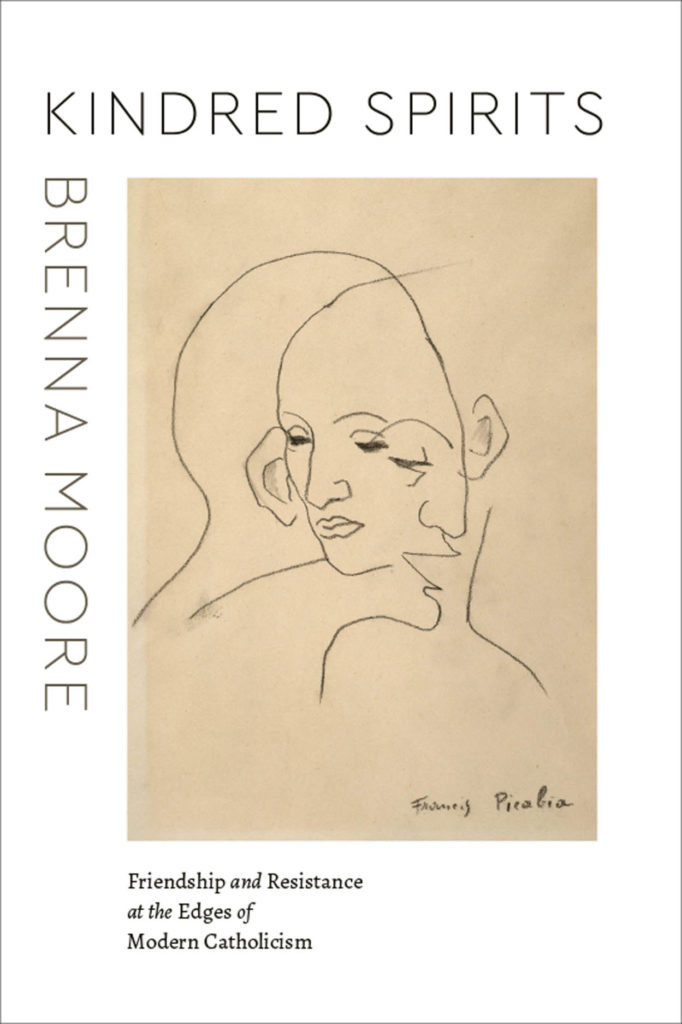 Modernity, it would seem, makes little room for friendship. Its economic logic, which often goes by the moniker neoliberalism, seeks to isolate us as individuals from the wider communal contexts in which we live. The Protestant reformation, as some scholars have contended, played no small part in ushering in modernity’s mechanistic and individualistic ethos and the economic system that accompanied it. The result of this process has been to reduce human beings down to their component parts so that we might be more active consumers and more disciplined workers. In the early part of the twentieth century, this reduction birthed totalitarian and liberal modes of governance alike.