Blog

Global Currents article

The End of Antisemitism: How the Fight Against Hate Became a Weapon of Repression

On Saturday October 29, 2023, at least 100,000 people demonstrated in London in solidarity with Palestinians. Photo Credit: Alisdare Hickson, CC BY-SA 2.0.

In the wake of the recent antisemitic shooting in Sydney, Australia we have witnessed a disturbing but increasingly familiar pattern. On December 14, 2025, two gunmen—a father and son—opened fire on a Hanukkah celebration at Bondi Beach, killing at least 15 people and injuring more than 40 others in what Australian Prime Minister Anthony Albanese called an act of antisemitic terrorism. However, this anti-Jewish violence has become the occasion not for serious reflection on bigotry, hatred, and communal safety, but for a coordinated campaign to silence Palestinian rights advocates, anti-Zionist Jews, and critics of Israeli state policy.

The response from Zionist institutions and figures was swift and revealing. Israeli Prime Minister Benjamin Netanyahu blamed the attack on Australia’s recognition of Palestinian statehood, declaring that its policy “pours fuel on the antisemitic fire.” Deborah Lipstadt, President Joe Biden’s former Special Envoy for Monitoring and Combating Antisemitism, immediately used the occasion to target Zohran Mamdani, New York City’s newly elected mayor, writing on social media that his refusal to condemn the phrase “globalize the intifada” helped “facilitate (not cause) the thinking that leads to Bondi Beach.” Outgoing Mayor Eric Adams was more direct, claiming the attack in Sydney was “exactly what it means to ‘globalize the intifada.’” The New York Times and other major outlets—most of which have still refuse to acknowledge Israel’s genocide in Gaza—amplified these narratives, treating the attack as vindication for those who have long argued that pro-Palestinian activism inherently endangers Jews.

The shooting was an anti-Jewish attack, and must be mourned and condemned as such. Yet, the speed with which it has been weaponized reveals something profound about how accusations of antisemitism function today. Notice the narratives being constructed: the attackers, identified as 50-year-old Sajid Akram and his 24-year-old son Naveed Akram, are depicted as “normative” Muslims whose religion naturally produces antisemitism, which in turn manifests as anti-Israel activism. Israeli Foreign Minister Gideon Sa’ar declared the attack “the result of the antisemitic rampage in the streets of Australia over the past two years,” explicitly linking campus protests and pro-Palestinian activism to mass murder.

Meanwhile, Ahmed al-Ahmed, the 43-year-old Muslim man whose refugee parents had just arrived from Syria and who wrestled a gun from one of the attackers and was himself shot in the process, is portrayed as a rare exception: the “good Muslim” whose heroism is invoked to highlight the supposed antisemitism of his coreligionists. Australian officials praised al-Ahmed as “a genuine hero” whose actions saved “many, many” lives, yet the broader discourse uses his exceptional bravery to reinforce the narrative that Muslims are inherently prone to antisemitism unless proven otherwise through extraordinary acts.

The clear message is that Muslims, Palestinians, and their supporters are inherently antisemitic—and therefore their critiques of Israeli apartheid, ethnic cleansing, and genocide must be dismissed as bigotry rather than engaged as political analysis and protest. The attack becomes evidence not of the need to address actual antisemitic violence, but of the danger posed by student protesters, by critics of Israeli policy, by anyone who invokes the phrase “from the river to the sea” or supports BDS.

The tragedy has been turned into a moment where the attackers’ antisemitism is weaponized against those who criticize Israel for genocide, apartheid, and ethnic cleansing. Historian Simon Schama exemplified this on Wednesday when he slandered progressive Jews and others as shedding “crocodile tears” over the killings, suggesting our grief is insincere because of our opposition to Israel’s actions in Gaza.

The tragedy has been turned into a moment where the attackers’ antisemitism is weaponized against those who criticize Israel for genocide, apartheid, and ethnic cleansing

In titling this post “The End of Antisemitism,” I don’t mean that anti-Jewish hatred has disappeared—far from it. Rather, I’m arguing that the term “antisemitism” has become so divorced from its 19th century origins, so thoroughly inverted and weaponized, that it no longer serves as a useful framework for understanding or combating anti-Jewish hatred. What began as a concept to name a specific form of modern racial hatred has been transformed into a tool for silencing dissent and expanding state violence against our most vulnerable populations.

To understand this transformation, it is helpful to trace the term’s historical trajectory. And if antisemitism has a history—if it therefore has a beginning—then it can also have an end.

The Origins of a Racial Category

The term “antisemitische” was, as best we know, coined in the 1860s by Jewish historian and linguist Moritz Steinschneider, who used it to describe the racial prejudices of his contemporaries, like Ernest Renan, who believed that Jews were part of an inferior race lower than that of Europeans. The context matters: 19th century philology was dividing humanity into racial categories based on language families, distinguishing “Semitic” peoples from “Aryans” or “Indo-Europeans.” This wasn’t neutral scholarship. The emerging race science portrayed Semitic languages and peoples as static, corrupted, deteriorating, and without a history of their own, while Indo-European languages and “native” Europeans were characterized as dynamic, healthy, progressive, and in charge of their own future.

The term ‘antisemitism’ has become so divorced from its 19th century origins, so thoroughly inverted and weaponized, that it no longer serves as a useful framework for understanding or combating anti-Jewish hatred.

Antisemitism, then, was born as a modern racial ideology, distinct from but building upon medieval Judeophobia. While older forms of anti-Jewish hatred primarily centered on religious difference, modern antisemitism portrayed Jews as a fundamentally separate race or nation, inherently incompatible with and dangerous to Western nations. This ideology blamed Jews for the brutal disruptions of industrialization, capitalism, urbanization—for everything disruptive about modernity itself. It insisted on Jewish exceptionalism, drawing on biblical notions of chosenness to argue for Jews’ fundamental incompatibility with Christian Europe and its white settler colonial offshoots. By the early 20th century, antisemitism had become the basis of political movements across Europe, culminating in Nazism’s genocidal program.

Even in its early history, however, the term was being weaponized not only by non-Jewish racists but also among Jewish communities themselves. Jewish traditionalists leveled accusations of antisemitism against scholars engaged in Higher Biblical Criticism. They argued that the new higher criticism represented “the antisemitism of today,” and threatened to strip Judaism of its foundational claims by questioning the divine authorship and historical reliability of the Torah. What became known as the Graf-Wellhausen Hypothesis was not merely a scholarly theory but an assault on Jewish identity itself. In another instance, Jewish nationalists, including Zionists, deployed it against more assimilated Jews, accusing them of “Jewish self-hatred” for their commitments to integration and universalism. The pattern was established: a term meant to name hatred could also be used to police Jewish identity and silence Jewish dissent.

Post-Holocaust Transformation

After 1945, two interconnected ideas fundamentally altered how antisemitism was understood. First, the Nazi Holocaust came to be seen as evidence that anti-Jewish hatred was uniquely and exceptionally insidious—more dangerous than other forms of bigotry and violence. This view required a willful blindness toward the genocides that were part and parcel of European colonialism outside Europe, treating the Holocaust as utterly unprecedented in history rather than as another manifestation of European racial violence now turned against other Europeans.

Second, there emerged among western leaders a consensus that the State of Israel was owed to the Jewish people as compensation for the Holocaust and the world’s indifference to it. This proved a convenient solution to the “Jewish Question” that had preoccupied Europe for more than a century, allowing western nations to avoid confronting their own legacies of anti-Judaism while supporting the creation of a Jewish state on someone else’s land.

The founding of Israel in 1948, of course, came at the direct expense of the Indigenous Palestinian community which became a target of Anglo-Zionist dispossession since at least 1917. In the Nakba, which had begun (or accelerated) in 1947, Israeli forces destroyed hundreds of Palestinian villages, murdered thousands, engaged in widespread sexual assault and hostage-taking, and forcibly displaced approximately 750,000 Palestinians from their homes into what we now call the West Bank and Gaza Strip, and into Jordan, Syria, and Lebanon.

Almost immediately, pro-Israel groups in the United States and Western Europe began deploying a new strategy: to speak out against these abuses, against the violations of Palestinian life and rights, was, they claimed, itself a manifestation of antisemitism. This eventually became known as the “new antisemitism,” which supposedly existed alongside “classical” antisemitism. The argument insisted that Israel spoke for all Jews worldwide—an idea initially rejected by many Jews but eventually embraced by major Jewish institutions, for whom the allure of state power proved irresistible.

Here’s the bitter irony: what has permitted Israel to violate the very international law that had been created partly to prevent a recurrence of WWII’s genocidal violence was precisely its ability to capitalize upon antisemitic notions of Jewish exceptionality and Jewish difference. By insisting that Israel deserved special treatment because of Jewish suffering, by claiming that any criticism of Israeli policy was an attack on all Jews everywhere, the Israeli state and its supporters reinforced and exploited the very logic of antisemitism they claimed to oppose.

The Contemporary Inversion

Over subsequent decades, as Israel’s human rights violations became increasingly visible—through the intifadas, the apartheid system, settlement expansion, the 2006 and 2008–2009 wars on Gaza—the accusations of antisemitism intensified rather than diminished. The 1975 UN General Assembly declaration that Zionism was a form of racism—passed as post-colonial nations gained representation—was treated as proof of antisemitism rather than as a legitimate political analysis of settler colonialism. The BDS movement, a nonviolent call from Palestinian civil society to boycott, divest from, and sanction Israel, has been criminalized in more than 30 U.S. states in the name of “combating antisemitism.”

By insisting that Israel deserved special treatment because of Jewish suffering, by claiming that any criticism of Israeli policy was an attack on all Jews everywhere, the Israeli state and its supporters reinforced and exploited the very logic of antisemitism they claimed to oppose.

The weaponization reached a new level with the adoption of the International Holocaust Remembrance Alliance (IHRA) definition of antisemitism by governments, universities, and institutions worldwide. In practice, this definition has been employed almost exclusively to silence criticism of Israel and to target Palestinian rights advocates. Meanwhile, actual “classical” antisemitism has grown dramatically: the Tree of Life synagogue massacre, the white supremacist march in Charlottesville where participants chanted“Jews will not replace us,” the rise of QAnon and Christian nationalist movements that traffic openly in antisemitic conspiracy theories.

The recent emergence of the Heritage Foundation’s Project Esther—released on October 7, 2024, as part of the broader Project 2025 agenda—marks perhaps the culmination of this inversion. As the Academic Council of Jewish Voice for Peace has noted in this space, this document creates a framework of a “Hamas Support Network” that encompasses virtually all progressive advocacy: Palestinian human rights organizations, campus activism, diversity and inclusion programs, ethnic studies departments, even challenges to unfettered executive power. Notably, Project Esther contains no mention whatsoever of what we might think of as “classical” antisemitism—no discussion of white supremacy, Christian nationalism, or the actual violent threats facing Jews today.

Instead, it provides a playbook for using antisemitism accusations to attack students, sanction Palestinian human rights organizations like CAIR, Al-Haq, and Al Mezan, dismantle DEI and affirmative action programs, defund ethnic and Middle East studies programs, attack transgender rights, undermine international law, and—most crucially—to further the genocide and ethnic cleansing of Palestinians. It offers a roadmap for the rise of racist nationalist states worldwide, all performed in the name of protecting Jews.

Toward an End and a Beginning

In what should be plainly obvious by now, none of these efforts undertaken in the name of combating antisemitism have made the world safer for Jews. They have not reduced hate crimes or challenged racial supremacist ideologies. They have not stopped attacks on Jewish communities. They have not addressed the Christian nationalist movements that see Jews as pawns in an apocalyptic drama. Instead, they have become mechanisms for expanding state power through violence against the most vulnerable populations—Palestinians first but foremost, but also students, activists, refugees, transgender people, and anyone engaged in solidarity work.

This is why I argue we have reached the end of antisemitism—not as a lived reality of anti-Jewish hatred, which persists and must be opposed, but as a useful analytical category. The term has been so thoroughly emptied out, inverted, and weaponized that it now describes its opposite: not a defense of a vulnerable people against state violence but a mechanism for expanding state violence against vulnerable peoples.

The task ahead isn’t to abandon the fight against anti-Jewish hatred. It’s to reclaim that fight on the basis of an ethical framework that rests upon common humanity rather than exceptionalism. This means recognizing that anti-Jewish hatred has always operated within larger systems of racial, colonial, and religious domination—not apart from them. It means reconnecting Jewish safety with universal struggles for justice rather than with nationalist or militarized projects. It means building bonds of genuine solidarity, divorcing anti-Zionism from anti-Jewish hatred, and pushing back against those who weaponize Jewish history to persecute others.

Rather than parsing endlessly over whether to hyphenate or capitalize the term—as if any of this would have material impact—we need new frameworks rooted in history and solidarity, not fear and censorship. We need to stop treating the term “antisemitism” as if it names a timeless, transhistorical hatred, and recognize it instead as what it has become: a weapon in the hands of those who would silence critique, expand state violence, and perpetuate genocide.

If antisemitism as we’ve known it is ending, then something new must begin: a genuine commitment to opposing all forms of hatred and violence, including anti-Jewish hatred, rooted not in the logic of exceptionalism but in the recognition of our shared vulnerability and our common struggle for liberation.

Barry Trachtenberg
Barry Trachtenber is a historian of modern Jewish history, the Holocaust, and genocide, Barry Trachtenberg is the author of The Holocaust & the Exile of Yiddish (Rutgers, 2022), The United States and the Nazi Holocaust: Race, Refuge, and Remembrance (Bloomsbury, 2018), and The Revolutionary Roots of Modern Yiddish, 1903-1917 (Syracuse, 2008). He has published on issues related to American support for Israel, Zionism, anti-Zionism, and antisemitism in venues such as Jewish Currents, the Guardian, the Forward, Electronic Intifada, and Mondoweiss. In 2017, he testified to the US Congress on the topic of antisemitism on college and university campuses. In 2023, he submitted with colleagues expert testimony in support of a lawsuit filed by the Center for Constitutional Rights and in 2024 testified in the trial DCI-Palestine v. Biden seeking an emergency injunction to stop military and diplomatic support for Israel’s genocidal assault on Gaza. He is a member of the Academic Advisory Boards of Jewish Voice for Peace and the Institute for the Critical Study of Zionism and is Faculty Affiliate of the Center for Security, Race and Rights at Rutgers Law School. He holds the Michael H. and Deborah Rubin Presidential Chair in Jewish History at Wake Forest University in Winston-Salem, NC.
Global Currents article
Meghan J. Clark
Meghan J. Clark, Ph.D., is a professor of moral theology at St John’s University (NY). In 2022, she was the Assistant Coordinator of the North American Working Group of the “Doing Theology from the Existential Peripheries” Project for the Migrant & Refugees Section of the Vatican’s Dicastery for Promoting Integral Human Development. She is a member of the Catholic team for the Dicastery for Promoting Christian Unity’s Informal Conversations with the Salvation Army (2022-2027). She is a senior fellow of the Vincentian Center for Church and Society and serves as a faculty expert for the Holy See’s Mission to the United Nations. In 2015, Dr. Clark was a Fulbright Scholar to the Hekima Institute for Peace Studies and International Relations at Hekima University College, Nairobi, Kenya. She has conducted fieldwork on human rights and solidarity in Sudan, Kenya, Ethiopia and Tanzania. In May 2018, she was a Visiting Residential Research Fellow at the Centre for Catholic Studies at the University of Durham (UK). 
She is author of The Vision of Catholic Social Thought: the Virtue of Solidarity and the Praxis of Human Rights (Fortress Press, 2014).  Active in public theology, she is a columnist for US Catholic magazine and has written for America MagazineNational Catholic Reporter, and other public outlets. She received her Ph.D. in Theological Ethics from Boston College (2009).
Theorizing Modernities article

Mysticism, the Ordinary, and the Sacred: An Interview with Andrew Prevot

Joshua Lupo (JL): Professor Prevot, thanks for talking with Contending Modernities about your recent book The Mysticism of Ordinary Life: Theology, Philosophy, and Feminism (2023), a work that engages with a wide range of thinkers who often approach the topic of mysticism and ordinary life from very different starting points. Despite their differing starting points, you show that they are all working on projects with significant overlaps that have bearing on important issues in Christian theology. The book, in short, seeks to bring the resources of feminist theory to bear on Catholic theological conversations around the everyday experiences of the divine. In doing so, it shows how such experiences often lead those on the socio-political margins to push for change. To begin with, what motivated you to take up this project, and what was your process for selecting the thinkers on whom you write?

Andrew Prevot (AP): I first conceived this book as a sequel to Thinking Prayer: Theology and Spirituality amid the Crisis of Modernity. The diverse roster of interlocutors in The Mysticism of Ordinary Life reflects choices already made in this earlier work. Both books develop a central theme in Christian spirituality (whether prayer or mysticism) by examining its influence on contemporary Catholic theology, postmodern philosophy, and diverse social-praxis contexts: European, Latine, and Black. On a more personal note, these are all pieces of myself. I am an American Catholic theologian with a background in continental philosophy, a mixed African and French ancestry, and a strong sense of obligation to resist oppression in whatever form it takes. Spirituality, which for me means a life in intimate relationship with God, motivates my work at all of these levels.

In Thinking Prayer, I focused on sources that could help me articulate a doxological alternative to metaphysics, that is, a way of approaching God through praise and worship instead of abstract systems of knowledge and being. I also discussed sources that expressed a spiritual basis for the struggle against economic and racial violence. I turned in The Mysticism of Ordinary Life toward a different, yet connected, set of questions surrounding the potential for a transformative mystical response to the metaphysics and politics of gender. I had been reading feminist theorists such as Grace Jantzen, Amy Hollywood, Catherine Keller, Sarah Coakley, and others, who were drawing on Christian mystical writings to make fascinating philosophical and theological arguments in this area, and I agreed with much that I found in their works. However, there was more that I wanted to say, especially by bringing a certain Catholic clarity (if that’s a fair word for it) to the philosophy-theology relationship and by taking a more intersectional approach to the feminist interpretation of mysticism.

I also wanted to emphasize that my concerns were not just about thought but life—ordinary life. The deeper I got into the research, the more I realized that this word “ordinary” was at least as difficult as the word “mystical,” because of the paradoxical manner in which it simultaneously channels the crushing powers of normativity and contests them through appeals to our never-fully-governable, living flesh (i.e., the “quotidian”).

Although I find Catholic theologians such as Karl Rahner and Hans Urs von Balthasar useful in their efforts to retrieve an everyday Christian mysticism amid the hazards of western modernity, they remain vulnerable to rigorous feminist critique. The mystical theology they represent, therefore, needs further development. The postmodern reception of Christian mysticism, parsed as a symbol of Michel Henry’s notion of auto-affective immanence (the feeling of oneself that grounds subjectivity and humans’ connection to divinity) and Michel de Certeau’s disruptive alterity (that is, the “otherness” that disrupts our normative orders) has, whatever its theological limitations, been generative of new spiritually and socially meaningful approaches. The so-called “French feminists” Luce Irigaray and Julia Kristeva show the power of this sort of postmodern mystical thinking, both to subvert the androcentrism of psychoanalysis and western philosophy more broadly, and to develop women’s (and men’s) subjectivity. I wanted to take stock of all this theological and philosophical literature, while sorting out its different disciplinary warrants. I also wanted to bring it into dialogue with mystical works by women living in the wake of conquest and slavery, including Gloria Anzaldúa, Ada María Isasi-Díaz, Alice Walker, and M. Shawn Copeland, among others. I wanted to show that a theologically responsible, postmodernly revitalized feminist mystical theology could go beyond typical Eurocentrism. The quotidian lives of Black and Brown women are sites of divine presence to which theology and philosophy need to attend.

JL: To pick up a central feature of the argument you mentioned in your first response, I want to ask you to unpack two central concepts in the book—mysticism and the ordinary—for us. What do these terms mean in the context of your theological argument? And how do they relate to the pursuit of justice? They have at times been treated in academic and broader public discourse as reflective more of individual concerns rather than collective ones. Still, you have something different in mind, I think.

AP: There is a common feminist slogan, “the personal is political.” I endorse this statement and add my own spin by asserting that “the mystical is political.” Domestic spaces where patriarchy reigns unchecked, everyday struggles to put food on the table, the hard work of developing a voice as a member of a subaltern group, the quiet pain of living as a hated racial or sexual minority, the challenge of coping with intergenerational traumas—all of these are not merely examples of personal experience. They are socially constructed situations in which a potentially revolutionary encounter with the unknown God of incarnate love might occur. This is my argument in a nutshell.

To be more precise, it may help, as you suggest, to clarify my central concepts of mysticism and the ordinary. In the introduction to the book, I distinguish two broad ways of understanding mysticism. One of these is more philosophical or psychological (which does not mean it is off-limits to theology, but only that theology does not define it). This account associates mysticism with certain modifications of human consciousness, language, or embodiment, which push these features of our finite existence beyond the ways in which they typically appear or function. We might think of a mind in a state of ecstasy, in which the faculties of memory, intellect, and will are suspended. We might think of uses of language that feature bold negations, provocative metaphors, or incomprehensible paradoxes. We might think of out-of-body experiences or unexplainable visions or sensations. This model of mysticism brackets the question of its cause. Perhaps such alterations are a result of naturally occurring or meditatively or psychedelically induced shifts in brain chemistry. They may indicate some supernatural forces at play, whether demonic, angelic, or divine. Knowing the answer to this causal question is not necessary. The moral status of such mysticism is, therefore, ambiguous, as is its value for theology. It relies merely on some perceived difference between the ordinary and the extraordinary in human experience.

By contrast, a properly theological understanding of mysticism makes a claim about God. It holds that mysticism occurs when God enters into an intimate, perhaps even boundary-blurring relationship with human beings, transforming them into—or perhaps simply revealing them to be—vessels of divine love, goodness, or virtue. On this account, mysticism is a particular type of grace. It is not merely a gift of divine assistance; it is a deep partnership or intermingling between the divine and the human, which God initiates. A true recipient of such mystical grace aspires to live as God would have them live, and so the moral ambiguity largely drops away. Efforts to demonstrate the presence of such grace by appealing to unusual psychosomatic phenomena are misguided, because these prove nothing essential. By the same token, a person living a seemingly conventional life may be a true mystic walking among us: someone profoundly united with God. Compared with the preceding philosophical or psychological approach, this theological one can more easily recognize a mysticism of ordinary life without fear of contradiction, because, for it, mysticism is not defined as a departure from supposedly ordinary phenomenological norms but simply as God’s gracious union with us.

However, if mysticism means being one with God, as this account holds, then it follows that mysticism will resist social conventions that violate God’s benevolent intentions for humanity and creation. Therefore, the theological approach also allows for a mystical subversion of norms, but only to the extent that such norms contradict the loving and healing aims of divine grace. In a cultural environment where certain kinds of bodies are valued more than others because of race, gender, sexuality, ability, and other differences, and where such hierarchies are violently enforced, the word “ordinary” can hardly be innocent. It carries the awful weight of this malicious sorting of people into categories of lovable and unlovable, grievable and ungrievable, welcome and unwelcome, free and unfree. The antagonistic energy found in both philosophical and theological forms of mysticism can be harnessed to oppose such unholy normativity.

In a cultural environment where certain kinds of bodies are valued more than others…and where such hierarchies are violently enforced, the word “ordinary” can hardly be innocent.

Yet, in this revolt, mysticism retains a positive relationship with ordinary life for at least two reasons. First, mysticism inevitably finds expression in what I call the “quotidian”: that is, the experiential, temporal, contextual, singular, plural, opaque everydayness of life, which is never fully governed by norms. There is nowhere else for it to appear, even if its phenomenological features are extraordinary. The normal and the quotidian are two poles of the equivocal concept of the ordinary. Second, mysticism, especially but not exclusively in the theological sense, encourages the development of diverse communities that are not merely sites of chaos but places of shareable, incarnate love. Theological mysticism is not anti-normative per se. It is only hostile to those norms that unjustly stigmatize, imperil, or otherwise harm the precious, mysterious creatures God has made, but this is enough to make it a powerful, justice-seeking force in the world.

JL: This framing of the mystical ordinary clearly poses a significant challenge to secularism and modernity as ideological projects. The norms embodied in those projects are no doubt responsible for the oppression that continues to run rampant in our world. The final two chapters in the book draw on mestizo/a and Womanist philosophies and theologies to build a liberatory alternative. Could you provide us with an example or two of how these thinkers challenge these forms of domination?

AP: While it is true that my book contests secularism, I also want to acknowledge that some varieties of the mysticism of ordinary life are compatible with, and even sustained by, secular (or secularizing) philosophy. We might consider, for example, certain streams in nineteenth-century romanticism and idealism that attempt to unite the absolute with the contingent in a manner that draws on German mystical thought while verging on atheism. As Part 1 of the book indicates, this is the intellectual milieu that influential twentieth-century theologians, such as Rahner and Balthasar, both presuppose and challenge in their efforts to recover a more orthodox mystical theology that would, nevertheless, take advantage of certain modern philosophical emendations.

Theological mysticism is not anti-normative per se. It is only hostile to those norms that unjustly stigmatize, imperil, or otherwise harm the precious, mysterious creatures God has made.

Part 2 shows how the postmodern, primarily Francophone, late-twentieth-century turn away from the totalizing ambitions of modern metaphysics goes hand-in-hand with an alternative way of secularizing the mysticism of ordinary life. The postmodern thinkers I discuss meditate on the phenomena of touch, affect, flesh, immanence, on the one hand, and otherness, strangeness, and difference, on the other, and treat these phenomena as analogous to, and perhaps even as substitutes for, God’s presence and transcendence. Although a new God of the philosophers is conceivable within this postmodern mystical discourse, as Henry and Irigaray perhaps show most clearly, it is also possible to take leave of God and advance an atheistic mysticism, in line with Georges Bataille. In these first two parts of the book, I attempt to sort out what a more traditional, grace-based mystical theology could look like amid the secularizing intellectual shifts not just of modernity but also of postmodernity.

In Part 3, which was more the focus of your question, I consider the configurations of the mysticism of ordinary life on the colonized and racialized undersides of modernity and postmodernity. All of the thinkers I study in this section refuse the secular insofar as it is an ideological project of cultural erasure. However, certain figures, such as the Chicana poet and theorist Gloria Anzaldúa and the founder of womanism, Alice Walker, approach mysticism in a manner that may be regarded as philosophical, psychological, or naturalist. For the most part, their sense of the divine as immanent in quotidian life is not derived from Christian scripture or tradition (though they do occasionally comment on such sources) but from Indigenous and personal experience. Anzaldúa and Walker are not atheists, but they do write in a manner that some might consider “spiritual but not religious” (SBNR)—or, if still religious, then neither Christian nor institutional. Anzaldúa and Walker find the strength to resist oppression through their intimate connections with a pervasive, life-giving Spirit, to whom Anzaldúa prays, “Oh, Spirit—wind sun sea earth sky—inside us, all around us, enlivening all / We honor tu presencia” (159; quoted in Prevot, The Mysticism of Ordinary Life, 196). Walker’s character Shug expresses a similar perspective: “My first step from the old white man was trees. Then air. Then birds. Then other people. But one day when I was sitting quiet and feeling like a motherless child, which I was, it come to me: that feeling of being part of everything, not separate at all. I knew that if I cut a tree, my arm would bleed” (195; quoted in Prevot, The Mysticism of Ordinary Life, 241).

By contrast, the Catholic theologians Ada María Isasi-Díaz and M. Shawn Copeland take a more obviously confessional approach to the interpretation of Latina and Black women’s experiences of mystical grace, including in some cases their own. While walking a picket line, Isasi-Díaz had a sudden feeling of God’s indwelling love: “I could feel, sense God, and I could wrap my arms around the divine” (24, quoted in Prevot, The Mysticism of Ordinary Life, 203). Copeland reflects on the personal closeness that enslaved persons found with the crucified Jesus: “Bloodied and nailed to rough wooden plans, he was the One who went all the way with them and for them” (26; quoted in The Mysticism of Ordinary Life, 255). These are just a few examples. I want to be clear that, just because Isasi-Díaz and Copeland write as doctrinally committed theologians and thereby maintain a greater distance from the post-Christian secularity of modern and postmodern thought than Anzaldúa and Walker do, this does not make them more resistant to enslaving, conquering, and rapacious violence than Anzaldúa and Walker are. The diverse philosophical and theological versions of the mysticism of ordinary life that all of these thinkers elaborate are comparable in their level of defiance against the body- and soul-destroying evil of the present age.

JL: Your response to the previous question helpfully clarifies your methodology and relationships to the various currents in modern and postmodern theology and philosophy. As a final question, I wanted to ask you to consider the place of the book and its argument alongside another emerging trend in recent scholarship on religion.

Over the past few years, scholars in religious studies have returned to the language of the sacred as a challenge to something like what you call above “unholy normativity.” We see this in the work of religious studies scholars Barbara Sostaita, who finds the sacred, for example, in the crosses marking the sites where migrants died near the border between the US and Mexico, and in the work of Joseph Winters, who finds the sacred in hip hop artists who channel an unruly normativity to challenge White supremacy. Reading your book, I saw a kind of convergence in theological work and work in religious studies around a desire to find alternatives outside the constraints of a hegemonic rationalist discourse in the academy. Do you see your work as a part of (or in solidarity with) the “turn to the sacred”? Or does its desire to form a more orthodox theological response to the moment place it in a different lineage?

​​AP: I definitely see my work in solidarity with the projects of Barbara Sostaita, Joseph Winters, and others who reclaim “the sacred” as an honorific title for migrant, Black, Indigenous, and diversely gendered lives insofar as they disrupt, exceed, flee, or fight structures of domination, from which they, nevertheless, continue to suffer. (And thanks for drawing attention to these important books!) This use of “the sacred” is very closely aligned—to the point of being virtually synonymous—with postmodern accounts of “the mystical” as an anti-normative, quotidian flesh and otherness, especially as such accounts have been received and modified by the thinkers in Latine and Black studies and intersectional feminism whom I discuss in the last part of my book. Whether we call it “mystical” or “sacred,” this lived, critical distance from systems of control and punishment is an undeniable focal point of the sort of literature, theory, psychology, and politics that I regard as actually speaking truth in this era of rampant misinformation and ideology.

I grant that, by and large, the authors who share this sensibility are not writing as theologians. Often, they choose words like “sacred” and “mystical” carefully, precisely in order to avoid making doctrinal statements about God, even while holding fast to certain values or experiences that have religious resonances: e.g., sanctuary or ecstasy. Nevertheless, I maintain that such scholars are invaluable interlocutors for theology. Those of us in theology who are trying to work out the meaning of Christian faith in the midst of this violent world—in spite of the shameful Christian complicity in it, of which we are painfully aware; indeed, in hopes of reducing the level of this complicity and actually following the way of Jesus—need these nontheological seers of the sacred in much the same way that Augustine needed Plotinus, Aquinas needed Aristotle, or Rahner needed Schelling. They provide the “natural philosophy” in relation to which we can hope to formulate a new theology of mystical grace. To speak about how God may touch the lives of people in this world, theologians need to understand the material and structural conditions under which such lives survive, dance, hope, and pray.

Those of us in theology who are trying to work out the meaning of Christian faith in the midst of this violent world…need these nontheological seers of the sacred in much the same way that Augustine needed Plotinus, Aquinas needed Aristotle, or Rahner needed Schelling.

One goal of my explicitly theological work is to maintain a space within academic literature where the God-talk of racially oppressed women and men can be represented without being transposed into a register where questions of God are bracketed as a matter of course. Crying out to God, singing hymns to God, and placing all one’s hopes in God are prevalent practices in Latine and Black communities. I acknowledge that they are not universal: secularism exists in such spaces too. However, many of the embattled persons whom scholars across disciplines endeavor to support would associate the sacred and the mystical precisely with experiences of God working graciously in their lives, moving in their bodies and souls, and, at least in some cases, answering their prayers. They would think of such terms, if they recognized themselves in them at all, not merely as symbols of a lived antagonism toward normativity, but as names pointing to a personal relationship with an agential, powerful, loving, and mysterious deity. Theology enables me to express solidarity with these persons in their faith and to explore its complex connections with their culture and politics. To some extent, this is what religious studies and other nontheological fields are doing too by speaking of “the sacred,” but theology is, by design, more open to interpretations of this term that reveal levels of meaning beyond the natural and the anthropological.

Of course, these disciplinary differences are ultimately matters of personal preference. And, in any case, solidarity does not imply uniformity. In my books and my ongoing teaching and research, I embrace contributions across various academic and nonacademic, theological and nontheological sectors of the struggle, and I see my work as making just one small addition to what is a diverse, collective effort. I stand with anyone who strives to affirm quotidian lives and to resist oppression. To me, this is a sacred practice regardless of whether it is done for religious or nonreligious reasons.

Andrew Prevot
Andrew Prevot is the Joseph and Winifred Amaturo Chair in Catholic Studies; Senior Fellow at the Berkley Center for Religion, Peace, and World Affairs; Professor in Theology and Religious Studies; and Affiliate Faculty in Black Studies at Georgetown University. He is the author of Black Life and Christian Spirituality (Orbis Books, forthcoming); The Mysticism of Ordinary Life: Theology, Philosophy, and Feminism (Oxford University Press, 2023); Theology and Race: Black and Womanist Traditions in the United States (Brill, 2018); and Thinking Prayer: Theology and Spirituality amid the Crises of Modernity (University of Notre Dame Press, 2015). He co-edited Anti-Blackness and Christian Ethics (Orbis Books, 2017) and has published more than thirty articles and essays. Before coming to Georgetown, he was on the faculty at Boston College. He holds a Ph.D. and M.T.S. in Systematic Theology from the University of Notre Dame and a B.A. in Philosophy from the Colorado College. 
Joshua S. Lupo
Joshua S. Lupo is the Assistant Director of the Contending Modernities research initiative. In this role, he serves as the editor and writer for the Contending Modernities Blog and the classroom coordinator for the Madrasa Discourses program. He has published articles and reviews in Sophia, Soundings, Critical Muslim, Reading Religion, and Religious Studies Review. With CM Co-Director Atalia Omer, he is the co-editor of Broken Solidarities: Feminism, Race, and Transnationalism (Notre Dame Press, 2022) and Religion, Populism, and Modernity: Confronting White Christian Nationalism and Racism  (Notre Dame Press, 2023). His forthcoming book with UND press is titled After Essentialism: A Critical Phenomenology for the Study of Religion.
Theorizing Modernities article

Against Abolition, Against Reform: The Case for a Transformational Vision of Restorative Justice

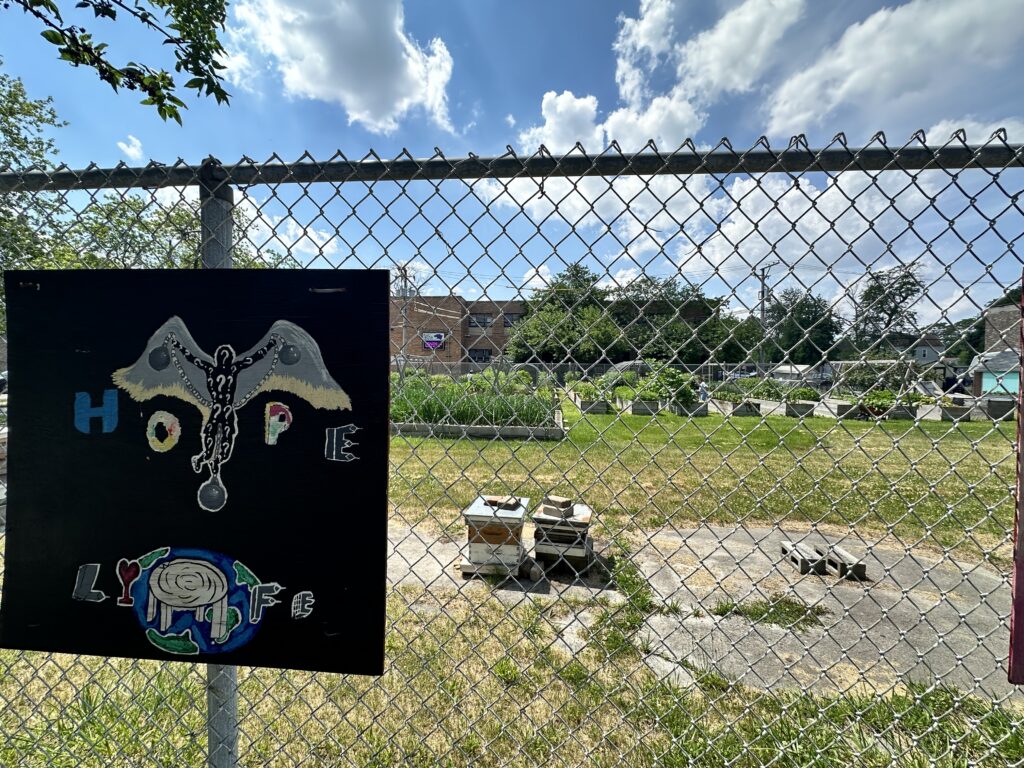
Originally empty lots that PBMR transformed into community gardens, and which have now grown into a full-fledged urban farm that feeds the surrounding neighborhood. Photo by Jason Springs.

The responses gathered here illuminate one of the central purposes of Restorative Justice and Lived Religion: to develop an account of how restorative justice has emerged as a transformational social movement, and what such a movement can do to address harms that are not merely perpetuated by one individual against another but reproduced by an entire “justice” system. To accomplish this, I explore the ways that several lived restorative justice initiatives on the South and West sides of Chicago both resist, but also transformatively engage, the criminal legal system. In light of this focus, in the first part of this response, I return to the controversy among contemporary restorative justice practitioners over the ability—or alleged inability—of restorative justice to transform systemic injustices (with specific attention to the context of U.S. mass incarceration). I reiterate that restorative justice must be understood holistically, taking into account what I argue are its distinctive moral and spiritual dynamics. Doing so, I contend, allows us to overcome a reform vs. abolition dichotomy that has emerged in scholarship and activism. In the second part of this response, I reflect on the colonial and racial dynamics that undergird work in the scholarly community’s restorative justice and lived religion spaces.

Beyond the Reform vs. Abolition Dichotomy

To reiterate an insight shared by the respondents in this symposium, I begin by affirming that justice must be pursued at all levels and in all forms. This process requires transforming individuals through practices that ennoble and empower; transforming communities through cultivating healthy, just, and sustainable relationships; and transforming systems and structures. I agree with Professor Peters’s point that focusing on transformation should not overlook the importance of revolutionary change. However, it should also recognize the vital role played by reform efforts, which are often dismissed by those who advocate solely for revolutionary change.

The logic of revolution also has its limits, and fixation upon that logic has its dangers. The culture and legal wars over abortion to which Peters points analogically are acutely instructive on the point.  The prevailing belief has been that the revolution in reproductive health rights effected by Roe vs. Wade, with its status as a near fifty-year established precedent, could only be lost by a counter-revolutionary overturning of that ruling. It is arguable that precisely such fixation upon this revolutionary logic made the reproductive health rights movement ripe for ambush by what was, in fact, cumulative transformation built gradually over decades by the anti-abortion movement in stark contrast to revolutionary happenstance. As a result, when Roe vs. Wade was actually reversed it came in the wake of the “million cuts” against reproductive health rights that occurred over decades of slowly cultivated anti-abortion ideology, cultural movement-building, and, perhaps most importantly, institution building and transformation (for example, the invention, rooting, and expansion of the Federalist Society starting in the early 1980s, ultimately making possible capture of the Supreme Court itself). The logic of transformation, by contrast, helps us see how the anti-abortion movement effected gradual transition in its strategic developments of “fetal personhood” and judicial battlegrounds that eventually resulted in Roe vs. Wade being overturned as a tipping point (rather than revolutionary endpoint). This movement now turns its efforts to the States.[1]  The reproductive health rights movement will need to overcome the limitations of the logic of revolution and counter-revolution if it is to successfully counter these developments.

The logic of revolution also has its limits, and fixation upon that logic has its dangers.

I argue that a transformational social movement for restorative justice must heighten the contradiction between those who believe that only piecemeal reforms of the current criminal legal system are sufficient and those activists who argue that the entire criminal justice system should be abolished in a revolutionary way. This illuminates what I call the “reform/abolition” dichotomy. This dichotomy has become a major obstacle for many who teach about and work against the U.S. prison-industrial complex. A central goal of my book is to mediate this rigid opposition.

In contrast to those who portray restorative justice as strictly “interpersonal” and then call for revolutionary change in opposition to it, I argue that the capacity to counter structural and cultural violence is intrinsic to restorative justice when it is holistically understood and practiced. More specifically, I suggest that restorative justice has the capacity to transform structural and cultural violence in and through the cultivation of healthy and just relationships (rather than as an adjunct, after, or separate from that cultivation).

Approached holistically, restorative justice is a theory of justice with concrete practices that foster moral and spiritual forms of association between people. This approach rejects the view that restorative justice is a “tool in a tool kit” to help mediate conflict. Instead, it recognizes that restorative justice offers a framework for envisioning and cultivating an integrated approach to individual agency, life together in community, policy and legal change, and society more broadly.

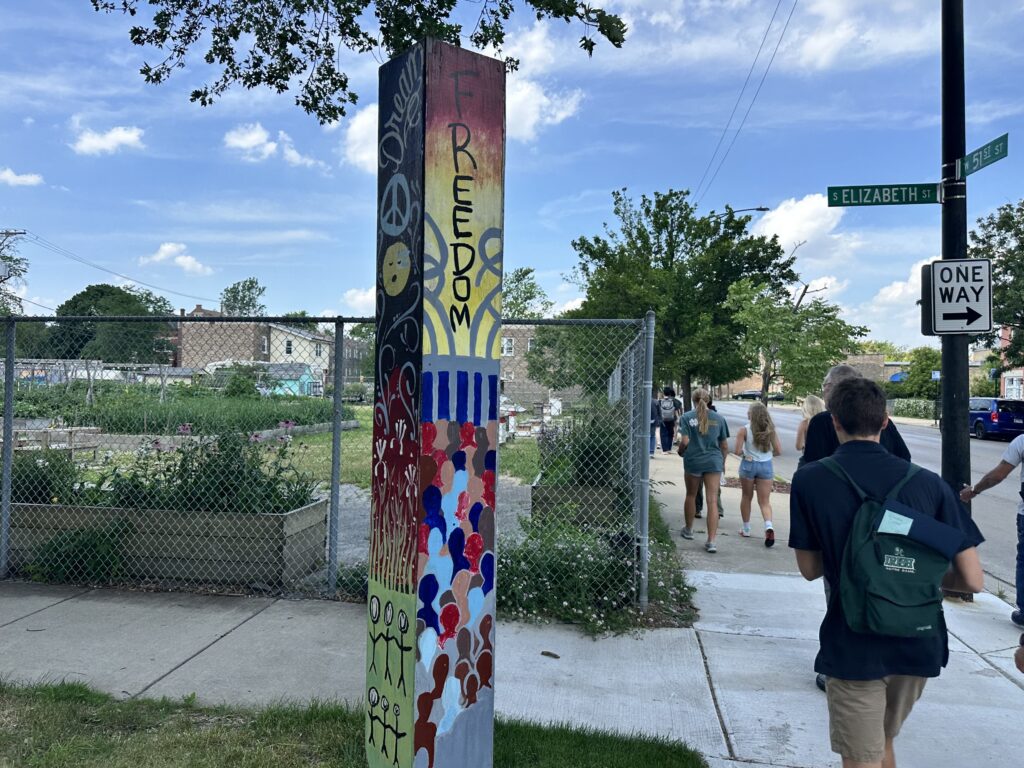
A “peace pole” marking the PBMR campus in the middle of Back of the Yards. The peace poles are made in PBMR’s wood shop, and the artwork for which is designed and created in the PBMR art studio. Photo by Jason Springs.

Many actors in the system (judges, attorneys, and policymakers) recognize how unsustainable and destructive it is to all the people it enmeshes. Many of them are searching for ways to divert young people and families out of the system. Their efforts enable practitioners implementing diversions to pursue aims that might differ from those of the system. This happens in part through the conceptualization and implementation of a culture of restorative justice in particular neighborhoods and, gradually, across wider sections of U.S. society. In the book, I also offer examples of legislative and policy changes achieved by restorative justice proponents. For example, Julie Anderson led a mothers’ peacemaking circle and others in a relentless effort to pass state legislation abolishing the mandatory sentencing of juveniles to life without the possibility of parole (see chap. 11, 130–51).

The aim of such work is not to make the system as it exists kinder, more humane, and/or more palatable. It is rather to weave together and expand upward and outward transformed understandings of justice; it is to stitch together practices, initiatives, and community centers that are community-based and community-led to address harms and needs and to enact a constructive and reparative form of accountability. The key point I make in my book is that the daily, grinding, sometimes piecemeal work that is often diminished or dismissed as “reform”—when built upward and outward strategically over time—can contribute vitally to the work of transformation (though these are not sufficient on their own). Revolutionary ideals, energy, and utopian aspirations also can call and/or push the transformational process forward to its highest ideals and aspirations (though, in isolation, they are often un-pragmatic, alienating to needed third-party allies and potential collaborators, and fall prey to self-sabotage).  And thus the selective examples Peters holds up from my book only skim the surface of the case for transformation that I build there, and the numerous other examples I offer of the work of Chicago’s restorative justice community that accumulate in transformational potential and impact. Indeed, the policy vs. ideology account Peters sets forth is part of the problem. Sustained and sustainable transformation—and how to “change it all”—must be all of the above. It must occur in cumulative change through organizing people and communities around small then increasingly larger issues and goals. It must build up over time in changes in policy and law. It must occur in institutional changes and transformation of practices, as well as culture. It must seep into and come to pervade widely shared commonsense understandings. Each of these is occurring in the movement that I document in my book, and need to be recognized and understood for the ways they interweave and work together. My purpose in building this case is to counter the impulse to limit our imagination to either reform or abolition and to chart a more constructive path forward. This is a point to which James Hill’s response speaks powerfully.

Coloniality and Restorative Justice

Frantz Fanon found colonized intellectuals despicable. These were intellectuals who came from, lived among, and counted themselves among those who had been oppressed. Even in their efforts to somehow escape the colonial discursive regime that suffused their thinking, they maintained its hegemony. It is precisely this sense that James Hill’s meditation so instructively illuminates about the methodological and critical dimensions of my book. He illuminates the key methodological point of my book—namely, that the entirety of academia and “modern scholarship” is a discursive regime shot through with dynamics of its own self-fixation. Of course, this includes Black Theory and Black academic thinking as well. Black Theory (including Black lived religion) is not “outside” the funhouse, as though it somehow extirpates itself of the very discursive stuff in and through which it has its being. Black theory is a part of academic discourse and thus does not escape its funhouse.

Of course, Fanon did not simply castigate and reject the credentialed, professional academics and theorists who spoke among and on behalf of the colonized. Fanon held out some hope, saying they might—just might—eventually come to “discover the strength of the village assemblies, the power of the people’s commissions and the extraordinary productiveness of neighborhood and section committee meetings” (11). They might, in other words, cease striving to certify their “anti-colonial bona fides,” and open themselves up to what people on the ground actually engaged in resistance are saying, thinking, and doing. Through critical-participatory action research, my book undertakes precisely such work. Indeed, the whole point of Paulo Freire’s work on this point (who’s Pedagogy of the Oppressed drew upon Fanon’s account of praxis by inverting it from violence to love) is that the oppressed do not need an elite class of academics to theorize on their behalf. Through praxis—the use of critical intelligence to reflect upon practice in light of the work they undertake to transform the world—they, in effect, “theorize in passing” for themselves. I explicitly explore and convey this point numerous times throughout my book (Connie Mick’s response—a comparative meditation on her teaching in prison and the peacemaking circles I studied—provides a different, but no less powerful, example of what this can look like). Indeed, time and again, I call on academics to learn to be quiet, listen, and actually learn something in the process of critical participatory action research (the true, and only methodological and theoretical “anchor” in the book). Thus, the examples of “lived religion” I explore emerge from and are exemplified in the nonnegotiable independence yet persistent relationship-building insisted upon and struggled for by the restorative justice initiatives and practitioners themselves. In fact, critical participatory action research compels scholars and researchers to move inductively, so that, again, it is the agency—the praxis—of those with whom we engage, seek to understand, and learn from that orients and inflects the content of our terms. Such an approach is especially challenging for scholars of religion to grasp, let alone put into practice. This is because the theoretical and methodological castles in the air that credentialed scholars of religion formulate and build are just that—professionally credentialed and sanctioned—and thus function in precisely the way that Fanon despised, whatever their color, and however hegemonic or transgressive. Welcome to the funhouse, indeed.  

I call on academics to learn to be quiet, listen, and actually learn something in the process of critical participatory action research (the true, and only methodological and theoretical “anchor” in the book).

What I discovered in my work was that the reality within which the restorative justice practitioners live, move, and act is interspersed and interwoven with ideals (moral and spiritual) that take the form of practices of restorative justice. These are the practices and tools —and, indeed, tradition (as Josh Lupo helpfully points out and Amy Carr illustrates in her response)—through which these people have become—and are becoming—architects of their own liberation. The account of tradition toward which Lupo gestures illuminates that the point of holding up and amplifying examples is not merely to praise and imitate the ideals they embody and practice. It is also to subject those exemplified, embodied ideals to further discussion, deeper understanding, historical and present-day contextualization, and critical exposition. In so doing, it makes them available for further enriched practice and implementation in new circumstances and different, novel contexts. This all stands in the background of the concept of “tradition” Lupo invokes, and it also is at the heart of the concept of “critical praxis” that I rely upon throughout the book. So, portraying the moral and spiritual ideals embodied in the implementation of restorative justice is not simply act of reportage, but rather serves to make them available for further discussion and novel forms of application. These ideals are living and breathing in the bodies, lives, and practices of communities featured throughout the book, rather than static and imprisoned. As such, they are part of a living tradition of ideal-infused practice, and it is critical reflection upon this practice that makes wider structural changes realizable in the long term through further, enriched practical application.

Saturday “Sanctuary”

While I was working, there were many calls to abolish or defund the police. Such calls are an example of ideals imprisoned in rhetoric, with limited traction in practice (beyond protest). To such calls, Fr. Dave Kelly, a central figure in the book, asked, “And then what? What do you propose to put in its place?” Kelly told me again and again that if you speak of defunding the police, you must immediately qualify that with specific, concrete proposals to re-route and re-invest funding in local community settings to underwrite positive, constructive, community-led practices. While they infuse energy, analysis, and a vigilant posture that are valuable, rhetorical appeals to social revolution are not close to enough, not without concrete, practical plans and examples of actual transformation.

PBMR peace garden that the community built on the vacant field of rubble that the diocese left behind when it removed the St John of God parish church, sending the 180 ft bell towers to St Raphael’s on Chicago’s north side and stained glass windows to Loyola University. Photo by Jason Springs.

An example of transformational justice in practice is a program that a restorative justice community center in Back of the Yards Precious Blood Ministry of Reconciliation, calls “Saturday Sanction.” This example demonstrates what happens when we listen to those on the ground rather than theorize abstractly from within protected academic spaces. The center started this program at the request of the Cook County juvenile justice system. Probation Department representatives asked them for a program to refer young people in the system to fulfill their community service sentences. Indeed, the name “Saturday Sanction” was assigned by the Probation Department. Yet once placed in the hands of restorative justice practitioners and community members who were building a restorative justice community in Back of the Yards, the transformational possibilities I describe above opened up.

Precious Blood runs the program as anything but a “sanction.” The program is devoted to restoratively oriented relationship building with youth and young adults. The group integrates peacemaking circles for purposes of relationship building, sometimes in response to harm and wrongdoing. But it also takes the young people on day trips across Chicago and the region. In fact, the description of the group’s purposes and activities was so antithetical to “sanctions” that I worried I might have mis-transcribed the name in my initial interviews. In following up with the Director of the center, Fr. Dave Kelly, I asked whether the program was actually named “Saturday Sanctuary,” thinking it meant to convey that the group meetings and activities were a refuge from the various forms of violence that the young people in the group were dealing with. “No,” Kelly replied, “but [sanctuary] would be a good name for it. It was named by Probation [Department] so it was designed [to be a sanction]. But we never used it that way. And we were very forthcoming in telling them, ‘We won’t do that.’” He continued,

For us it’s Saturday engagement. It’s a chance for us to get to know these young people more, and to do something outside of our community. So it would broaden their world. . . . But it’s interesting because . . . the word [‘sanction’] was overwhelmed by what it became. So it’s like ‘sanction”’didn’t mean ‘sanction’ anymore. It was something that kids said, ‘Can I go?,’ ‘Can I do that?’ So it wasn’t punishment, even though the words, by definition . . . that’s what they called it. . . . And I told [the Probation Department representatives] right from the very beginning, because the idea was that rather than locking somebody up, they would send these kids to the [restorative justice] hubs and the organizations would have them paint, or clean, or something. I said, ‘I’m not interested in that. But I will take that young person and strive to build a relationship with them and strive to make them feel like they’re part of the community, and take them out of the neighborhood to let him experience something beyond their ghetto. I will do that.’ And they didn’t buck that. They just said, ‘Okay, well, it’s your program. Do what you want with it.’[2]

Kelly describes an opportunity that Precious Blood embraced to matter-of-factly resist the punitive orientation of the Cook County criminal justice system, even—and perhaps especially—when that system understood itself to be in a “reformist” mode (willing to collaborate with the hubs). The program implemented an altogether different engagement with youth and young adults caught in the system—quite literally transforming the very meaning of the word “sanction” in this context and circumstance. For this opportunity to present itself in the first place, Precious Blood and the other members of the community restorative justice hub network had to be in relationship with actors in “the system” (in this case, the Probation Department, as well as prosecutors and justices across the Cook County juvenile justice system). They had to be willing to talk and work with them, rather than maintain a strictly rejective, oppositional stance toward the state actors and representatives. It is, however, in their explicit, firm refusal to cooperate with the punitive interests and purposes of the system, and in their insistence that they remain free of the system’s dictates, that resistance and constructive transformation could merge in and through relationship building. Indeed, it was the trust and reliability that certain system representatives felt in their relationships with Precious Blood that led Probation administrators to hand the program over entirely to the discretion of Precious Blood, and ultimately say, “Okay, well, it’s your program. Do what you want with it.”

Operating at the grassroots level within neighborhood settings through holistic self-sufficiency and community building, as well as advocating for policy and legal reforms to create spaces of relative self-determination that are strategically resistant to state dominance—while still engaging with and relating to actors within the state—this approach mediates between the real and the ideal. These practices of restorative justice aim to avoid dictatorial control by the justice system itself, while also remaining open to collaboration with actors within that system who are willing to engage restoratively and to acknowledge and respect the integrity of restorative justice norms and practices. The key difference is that the latter works within the constitutional, liberal-democratic context to challenge and transform it, rather than trying to (somehow) leap outside it.

[1] See, for example, Mary Ziegler, After Roe: The Lost History of the Abortion Debate  and Personhood: The New Civil War over Reproduction.

[2] Kelly, interview.

Jason Springs
Jason A. Springs is professor of religion, ethics, and peace studies at the University of Notre Dame. Springs is particularly interested in ethical, philosophical, and religious dimensions of restorative justice, attending specifically to its potential to intervene in racialized and class dimensions of the U.S. prison-industrial complex. He works on questions of structural and cultural violence, conceptions of religious toleration and the challenges posed by religious pluralism for transforming conflict, Islamophobia in Europe and North America, and democratic theories and practices. These concerns are oriented by his broader research interests in American Pragmatist thought. Springs’s most recent book, Resurrection in Back of the Yards: Restorative Justice and Lived Religion on Chicago’s South and West Sides (2024), examines the effectiveness of restorative justice initiatives in responding to structural forms of racism and injustice (e.g., the New Jim Crow). He is the author of Healthy Conflict in Contemporary American Society: From Enemy to Adversary (2018), Toward a Generous Orthodoxy: Prospects for Hans Frei’s Postliberal Theology (2010), and coauthor (with Atalia Omer) of Religious Nationalism: A Reference Handbook (2013). His articles appear in Journal of Religious EthicsJournal of the American Academy of ReligionThe Journal of ReligionModern Theology, and Contemporary Pragmatism, among others. 
Theorizing Modernities article

Restorative Justice and Prison Education as Transformative Visions of Justice


Detail of a mural in the Back of the Yards area of Chicago by @ateliertree2. Photo Courtesy of Flickr User Terence Faircloth.

Restorative Justice and Lived Religion: Transforming Mass Incarceration in Chicago by Jason Springs takes Back of the Yards Chicago as its primary setting, a place with an exceptionally high incarceration and poverty rate. As Equal Justice Initiative founder Bryan Stevenson says, “In too many places, the opposite of poverty is not wealth. The opposite of poverty is justice” (17). In a world of plenty, the presence of poverty signals the presence of injustice. Poverty is both a cause and a consequence of incarceration. While this is a thoroughly academic book that theorizes and argues that restorative justice practices enact justice, it is also a book about the people who teach us how to do that work. Through his description of the Precious Blood Ministry of Reconciliation work, Springs invites readers to visit a place with high poverty and low justice populated by people with immeasurable vision and love. Springs helps us see how transformation happens through critical participatory action research and deep, empathetic listening.

Springs includes the voice of critics of restorative justice from the beginning to the end of the book. The power and place of restorative justice in our world today, he establishes, is a living question and we live in a critical moment for determining how it can play a role in transforming mass incarceration across the United States. He outlines critical debates related to restorative justice and mass incarceration: interpersonal versus systemic transformation, religious versus spiritual frameworks, and prison abolition versus prison reform. He gives all positions careful attention while showing that restorative justice has often been misrepresented by its critics.

Teaching Justice Inside and Out

I teach a course inside the Westville Correctional Facility, a 3,400-bed Indiana state men’s prison. Every Friday, I take University of Notre Dame students into the prison to learn with incarcerated men and corrections staff in a course called “Poverty and Justice: Inside-Out.” This book prompted me to consider how this program fits into the ecosystem of restorative justice.

One day in this class, one of the younger incarcerated students arrived with his blaze orange synthetic knit hat pulled way down on one side. But he could not pull that hat down far enough to hide his huge black eye. He was late and sat quickly between two outside Notre Dame students. The students sit in a circle alternating between those who live inside and outside the prison so that they can get to know each other. They are not allowed to touch one another in any way. All exchange of materials has to go through me, so there’s a spoke system with the instructor in the center. The inefficiencies in the system are incredibly irritating—and enlightening. I have these tiny moments throughout the day where I get to look at each student and exchange a few words. I savor those opportunities to connect.

In a world of plenty, the presence of poverty signals the presence of injustice. Poverty is both a cause and a consequence of incarceration.

This student was agitated and I was deciding how I should address him as I handed him materials. I never ask how an inside student’s week has been going. I assume it hasn’t been going great. In these situations, I try to focus on the present. So that day, I said what I always said, “It’s good to see you. I’m glad you’re here.”

He paused to see if I was going to ask the obvious question or demand a story. I did not. Then he said, “Shit happens.” I said, “Yep, shit happens.” And I moved along. He relaxed and participated fully in class. His cap gradually moved back up to normal position.

This image came to me when I read Springs’s description of our current justice system as retributive, a system that “isolates and incapacitates,” that prescribes “an eye for an eye” (79). In this case, an eye was the literal payment for some transaction in the underground economy of the prison, which functions a lot like the above-ground economy in that it extracts and exploits us until we are broke and broken. Oppression replicates oppression.

In his description of the Precious Blood Ministry of Reconciliation neighborhood, Springs notes that this is the same place Upton Sinclair exposes in his muckraking 1906 book The Jungle. Springs says Sinclair describes the “squalor of impoverished life” there, and those of us who know that area today might say that in some ways that description still applies (29). I assign The Jungle to my Inside-Out class so that they can connect the injustices described centuries ago to what they have observed and experienced in their own lives in that same region. The phantom of systemic injustice emerges as something very real and tangible through their recognition of these historic continuities. Sinclair writes, “There is one kind of prison where the man is behind bars, and everything that he desires is outside. And there is another kind where the things are behind the bars, and the man is outside” (235). For some people, the persistence of poverty and injustice means that being inside or being outside a physical prison isn’t that different.

And to complete this class picture, I will share that another young inside student in that class had lost an eye entirely. His wound was older and had healed, physically anyway. I cannot help but think that these men bore the physical scars of the psychological wounds we inflict through our current justice system, which is blind to the pain it causes.

Inside-Out Courses as Restorative Justice?

I don’t know if Inside-Out courses would be considered pure models of restorative justice, but they are certainly informed by it. While Inside-Out trains us to teach in circles and build community, it also mandates that we not contact the inside students after our class ends. Relatedly, Springs notes, “The criminal justice system operates by severing relationships. This is one of its structural features” (56). This Inside-Out rule, which is in place for valid reasons—protecting confidentiality of inside and outside students so that there is no question that we are there purely for academic purposes—thus seems to run counter to that goal of building and maintaining relationships.

Still, somehow, I do think this course works toward that restorative justice goal of humanizing all participants. It operates at the individual level, of course, so it might not achieve the systemic transformation Springs argues is key to restorative justice. But I think it is in the right orbit. Let me make the case for its relevance to Springs’s vision for restorative justice by reflecting on a recent change made to the course.

During the Spring 2025 semester, my class included 8 Notre Dame undergraduates, 4 Notre Dame Law students (at least two of whom want to be prosecutors), 9 incarcerated men, and 4 corrections staff. This was the first time that corrections staff were included in a Westville Inside-Out course. It is a rare exception to how Inside-Out classes are organized anywhere. The founder of Inside-Out cautioned me about taking this approach.

Through his description of the Precious Blood Ministry of Reconciliation work, Springs invites readers to visit a place with high poverty and low justice populated by people with immeasurable vision and love.

But I did so at the request of the Deputy Warden of Westville and the Director of Prison Education for the Indiana Department of Corrections, key partners for all the Notre Dame Prison Education Programs. We have a longstanding and strong relationship with them, and to keep the prison education programs in good standing, we entertained this request.

To be honest, I was willing to include corrections staff immediately. It was clear to me that they often come from similar backgrounds as the incarcerated men and thus would be rich conversation partners for the other students. I could only take four of the six selected. The Deputy Warden said that was fine, the others could do it the next time. I was glad to hear that he was already invested in a “next time.”

It went as expected—a little bumpy. On the first day, one of the incarcerated students said something about the corrections staff getting paid to be there, and they quickly corrected him that they were off-the-clock and there by choice (or more accurately incentivized, in part, by the three credits, just like every other student in the class). Later, one of the corrections staff got into a back-and-forth with one of the incarcerated students about why people end up in prison. We moved on, but on the way home, the outside students said they were uncomfortable with the exchange and I considered how I could address it. Then at the start of the next class, the corrections staff person apologized to the student unprompted.

Is that a spark of systemic transformation? Are the core elements of holistic restorative justice as Springs outlines them present here: encounter, accountability, and transformation (76)? Or is this program an example of restorative justice being co-opted, “captured” by the state? (161). I do not know. I do know that this experience made us throw out our reductive dichotomous labels—our “inside” and “outside” geographies were no longer the most important part of how we showed up in class (Springs, 75, 96, chap. 14). What became more important was what we held inside ourselves and what we choose to put outside into the center of the human circle we created.

Like Springs does so often in his book, I find myself asking questions as I think about this work. I wonder, for example, is it cruel to talk about poverty and justice in the heart of mass incarceration? The more I teach there, the more I am convinced that this is exactly the place for serious academic discussion on poverty and justice. It is a form of critical praxis, Springs says, “that facilitates people’s recognition of the sources, nature, and character of the injustices they experience in their lives and in their communities” (77). In some ways an honest education is cruel—it’s hard to confront the atrocities of our ancestors and our contemporaries.

But honesty is a core principle of restorative justice. And right now many schools are expunging that history from the curriculum in the United States as it relates to DEI and critical race theory. If we censor evidence of those harms, there is no avenue to even consider restorative justice as a means of addressing those harms. And that unresolved pain often shows up in and is amplified by our carceral system. As we read Matthew Desmond’s Poverty, By America, incarcerated students said things like, “I always felt like things were stacked against me, that I couldn’t get ahead. Desmond confirms that it’s not just me, there’s a whole system out to get me. Desmond has citations, he has science.”

Shit happens—by design.

That evidence can be both heartbreaking and liberating. There are street smarts and there are Wall Street smarts. This class is defensive training against powerful predatory financial and social systems that rely on ignorance and submission. Springs quotes Fr. David Kelly quoting Fr. Greg Boyle of Homeboy Industries as saying, “nothing stops a bullet like a job.” But maybe books are bulletproof, too; books read in accompaniment, in radically inclusive classrooms.

Narratives of Justice

As I read Restorative Justice and Lived Religion, my mind also wandered to two popular kinds of heroic justice transformation stories from my youth. The first was the DC Comics Hall of Justice that held superheroes, the kind that started out “mild mannered” and quite ordinary until they went into a phonebooth to change or spun into Amazonian perfection. In a flash of dramatic transformation, these heroes had the power to impose justice on anyone who violated their rules. They were the indomitable League of Justice. As I read Restorative Justice and Lived Religion, I wondered if there’s a restorative justice flash that signals successful transformation.

Then I thought of the other, even more popular, transformative justice story from my youth: the story of Jesus. In this story we start with the all-powerful hero, and that hero does the most unexpected, extraordinary thing: he divests his power, he becomes human. Fully human. Jesus ate, he drank. He made friends, he made enemies. He taught, he learned. He lived and he bled.

So what does restorative and transformative justice look like?

I taught at Westville on Valentine’s Day. Holidays are tough to celebrate in prison.

Nonetheless, I still wanted to acknowledge the holiday, so I opened the class by asking the students to define a different kind of love, agape love. The collective wisdom was impressive. They said that Agapic love is “unconditional,” “empathetic,” “abundant,” “action-oriented,” and “selfless.”

We had finished reading Poverty, By America for that class. In his conclusion, Desmond has his readers imagine a world without poverty. He encourages us to ensure all Americans have their basic needs met so that they do not feel the kind of isolation and disconnection that leads to acts of despair. He has us imagine a place where that better world is enacted through what Springs might call critical praxis.

So I handed out blank paper to the students and had them draw agape love. Some drew pictures of an abundant and flourishing natural world with clean water and air. One student drew the basketball court where his struggling family would gather in their own cheering section to support him. Another drew hands reaching to connect.

Then I had the class read pages 36 to 37 of Restorative Justice and Lived Religion aloud. This passage describes how Precious Blood reclaimed the dismantled and denuded space where St. John of God church had stood. What the formal church vacated, the everyday church re-inhabited, transforming “the vacant crater that the diocese left into a peace garden—a welcoming space, mowed, blooming, and useable,” replete with grills, a basketball court, and beehives. The students read this passage aloud, summoning this sacred space, breathing agape love into the room. And for just a second I felt that transformative flash. I felt that maybe this book has the power to stop bullets.

Connie Mick
Connie Snyder Mick is senior associate director and director of academic affairs at the Institute for Social Concerns where she directs the Poverty Studies Interdisciplinary Minor. Mick teaches Introduction to Poverty Studies and Research and Writing for Social Change. At Westville Correctional Facility, she teaches Poverty & Justice: Inside-Out with “outside” students from Notre Dame, Holy Cross College, and Saint Mary’s College and “inside” students incarcerated in the prison or working as corrections staff.

Mick’s research addresses the role of writing in social change, the rhetoric of poverty, and the pedagogies of community engagement. She edits the Journal of Poverty and Public Policy (Wiley) and the Enacting Catholic Social Tradition series (Liturgical Press). Her books include Poverty/Privilege: A Reader for Writers (Oxford University Press) and Good Writing: An Argument Rhetoric (Oxford University Press). Her essay “Letting the Light In,” exploring how poverty imprisons us, appears in the winter 2025 issue of Notre Dame Magazine.
Decoloniality article

The Influencer in Eden: De/coloniality of the AI Data Paradigm and the Counter-exegesis of Human Life

Domenichino, The Rebuke of Adam and Eve, 1626. Oil on canvas. National Gallery of Art, Washington, D.C. Public Domain.

Would Noah have updated his Instagram story while building the ark? On TikTok, millions have watched Artificial Intelligence-generated short videos that imagine just that: Bible characters recast as modern-day influencers in 2025. We see a pregnant Mary posting vlogs from a barn—giving it five stars for privacy and zero for comfort—and Daniel livestreaming from inside the lion’s den. For many viewers, these may be humorous, ephemeral clips to be “liked” and scrolled past. Part of their appeal lies in making ancient stories relatable; imagining Moses checking his phone for a “divine notification” collapses the temporal and cultural gap between the distant past and the familiar present. For all their humor, however, these AI-generated vignettes are more than fleeting memes or “AI slops.” They are also potent artifacts that show how today’s most powerful computational systems can be used to repurpose ancient texts, extending a colonial logic that operates in a datafied world.

While different AI large language models (LLMs) may think differently, they do not imagine in a vacuum; they draw on a vast corpus of digitized information, including biases baked into centuries of texts and images. In one popular TikTok video featuring Eve as an influencer, she is consistently cast as a slender, blonde, White woman, posing in a curated Eden. Whereas the book of Genesis indicates that Eve’s husband was “with her” when she took the fruit (Genesis 3:6), the AI-generated video isolates her in the scene and later has Adam declare, “This is literally your fault, Eve!”—a line entirely absent from the biblical text. This algorithmic canonization of bias, in fact, echoes centuries of patriarchal interpretive patterns of gendered blame placed on Eve in art and commentary. On a textual level, this was done by omitting the phrase “with her” in a number of versions of the English translation of the Bible, including the Revised English Translation (1989), as Julie Faith Parker demonstrates (740). Whether by mistake or on purpose, this lost phrase in translation has now been reproduced by an algorithm, giving an automated imprimatur to centuries of a misogynistic interpretation that has long assigned primary culpability to the woman.

AI-generated vignettes are potent artifacts that show how today’s most powerful computational systems can be used to repurpose ancient texts, extending a colonial logic that operates in a datafied world.

Yet the problem runs deeper than the replication of existing prejudices. The production of AI-generated biblical retelling exposes a discrepancy between what these models actually know and the human perception of their knowledge and credibility. LLMs generalize across assorted data types by processing through the model’s dominant language. This means an English-dominant model processing the Genesis account in different languages, along with medieval Eve paintings and contemporary influencer aesthetics will think about all of them through an English-centric framework, collapsing them into a seemingly coherent but essentially distorted output. Meanwhile, humans also generalize about LLM capabilities, assuming that these models exhibit human-like patterns of expertise and believing that a model’s ability to produce a desired result is a sign of reliable understanding.

More than reviving predispositions and spins, the phenomenon of AI-generated videos based on the Bible exemplifies what Nick Couldry and Ulises A. Mejias define as “data colonialism”—a new and intensifying phase of capitalism that continues the extractive logic of historical colonialism through a new mechanism they identify as the “appropriation of social resources” (85). While historical colonialism involved the seizure of tangible assets like land and natural resources, data colonialism appropriates social resources, including human behaviors, relationships, desires, and expressions, and transforms them into a resource for profit. In her critique of current AI ethics, Rachel Adams also argues that AI’s reliance on Eurocentric modes of thought and racializing logics constitute a universal “colonial rationality” (179, 182–85). Seen through the lens of coloniality, this dynamic not only extends extractive relations but also reveals how the epistemic hierarchies of colonialism persist beyond the formal end of colonial rule, suggesting that AI’s modes of knowledge production may reproduce these enduring asymmetries.

The issue isn’t just in the AI training data or the architecture of the LLMs, but in the collapse of critical distance between user and machine. The algorithms that drive AI do not just illustrate a story; they decide how that story should look, feel, and be received by millions of human users, whose agency in the decision-making process is steadily diminishing. Guided by user prompts, these systems can reinforce the dominant values of the influencer economy—charisma, relatability, and aesthetic polish—and map them onto the ancient text. In this way, these AI-generated videos can do what empires have done for centuries: reshape the Bible to match the logic of cultural power. When the Bible arrived in colonial India, wielded by British missionaries, a group of Hindu intellectuals began to “talk back.” As R. S. Sugirtharajah shows, they did not simply reject the biblical text. Rather, they reinterpreted it as an act of cultural and political resistance. Thinkers like Keshub Chunder Sen, for example, argued for an “Asiatic Christ,” seeking to detach Jesus from his European missionary packaging and reclaim him for an Eastern context (64–65). Through this reshaping, the Bible became a text that could coexist with India’s many divinities, rather than a monolithic text of global dominance (210).

Eve as a modern-day influencer in Eden, based on the biblical narrative in Genesis 3.” Image generated by the author using Sora (OpenAI, 2025).

To be sure, this is not the first time the Bible has been reimagined. Appropriation and reproductions are at the heart of the history of biblical interpretation. What we see on TikTok today is one of the latest iterations in a long and contested history of humanity’s relationship with scripture across different cultures and eras. The Bible has always been repurposed to reflect cultural priorities that are never socially and politically neutral, and such reinterpretations are often direct responses to the ancient text’s own ambiguities. Consider the passage preceding the flood in Genesis 6, which describes the encounter between the “sons of gods” and the “daughters of humans” and mentions the mysterious Nephilim. Read on its own terms, the text portrays neither the Nephilim nor the event as sinful. In verse 4, their origin is set against the backdrop of unions between divine beings and human women, but the text contains no language of wickedness or corruption that could justify the flood that follows. The passage, however, took a different interpretive trajectory in late antiquity. The book of Enoch recasts the brief, cryptic passage into a full-blown cosmic rebellion. In its version, fallen angels, led by Shemihazah, descend to earth, take human wives—an act described as a “great sin”—which results in the birth of giant offspring, the Nephilim (1 Enoch 6:3–6). This retelling has proven influential for centuries, resurfacing in modern pop culture—most notably in Darren Aronofsky’s film Noah (2014), which visually adapts these fallen angels as colossal, rock-like beings.

The common thread in these examples is that interpretation did not just explain the Bible; it reshaped its meaning. Where ancient readers saw gaps and filled them with giants and fallen angels, modern humanity sees those same spaces and fills them with AI-mediated imaginations, reflecting our own digital selves back at us. The challenge, then, is not whether such reinterpretations should exist—they always have—but how responsibly and consciously we produce and consume them. The Bible’s stories endure precisely because they are retold, yet each retelling, whether inscribed on parchment, rendered in paint, or generated in pixels, carries the political weight of interpretation—the power to reinforce or subvert certain meanings. An Eve with an iPhone might look like a laughable meme, but it is also a mirror—reflecting how today’s most prominent digital technology continues to carry the age-old struggle over who owns the Bible’s meaning.

At this juncture, I argue that a decolonial response should not demand a simple dismissal of AI technology. Instead, it can emerge through the pursuit of a counter-exegesis that engages both ancient scripture and our modern experience of human-computer interaction. In the similar way that Couldry and Mejias’ concept of “counterhistories” challenges dominant historiography’s singular narrative (111), a counter-exegesis can invite us to uncover multiple possibilities in the human interpretation of life, including the afterlives of scripture. The very algorithms designed to capture our attention and appropriate human desires also generate an unprecedented exposure of our collective consciousness—what some find humorous, what others hold sacred, and what we are willing to rationalize as typical. This exposure can become a site for critical intervention toward the decoloniality of the data paradigm. The human task, then, is to move from being the data that AI models read and consolidate to becoming readers and interpreters of the algorithms, so that human meaning remains not a resource to be mined but an unfinished future sustained by the friction of conscious interpretation.

Ki-Eun Jang
Ki-Eun Jang is Assistant Professor of Hebrew Bible at Fordham University, Bronx, NY. Her forthcoming book, Contesting Labeled Identities: The Sociology of Gentilics in Biblical and Northwest Semitic Literatures, examines both the social world of ancient West Asia that produced the Hebrew Bible and the intellectual legacy of modernity that has shaped how the (post-)modern humanities have conceived of materials received from the past.
Theorizing Modernities article

Resurrecting the Corporate Body: On the Flight of a Legal Fugitive

Edgar, c.943/4-75. Illuminated manuscript. Charter of Edgar to the New Minster, Winchester, 966. MS Cott. Vesp A. VIII, folio 2, verso, British Library. S 745. Edgar is flanked by the Virgin Mary and St Peter, and he is offering the charter to Christ, who sits enthroned above, surrounded by four angels. Sean Miller, Charters of New Minster, Winchester, 2001, pp. 95, 105. Cropped image, via Wikimedia Commons.

Introduction

In seventeenth-century England, incorporation once described a moral act: the joining of persons into a common body under law, bound to shared purpose and enduring beyond individual lives. The language of incorporation, the way in which it was imagined, was theological before it became technical, linking corporate life to divine order and civic obligation.

In July 2025, the venture capital firm Andreessen Horowitz moved its corporate registration from Delaware to Nevada. The decision followed a series of court rulings in Delaware that expanded the personal liability of corporate officers and directors. Nevada instead offered fewer restrictions, weaker fiduciary enforcement, and no obligation to prioritize stakeholder interests. Andreessen Horowitz left Delaware claiming its courts had become unpredictable and biased against founders of companies, while Nevada offered statutory protections and business-friendly reforms that ensured greater certainty for boards and investors.

The move was part of what commentators have begun to call “DExit,” a growing migration of firms out of Delaware in search of looser rules and lighter scrutiny. For much of the twentieth century, Delaware attracted corporations because it provided a reliable court system and laws that favored managerial discretion. That stability once anchored corporate governance, but it now serves as a point of departure for firms seeking greater freedom elsewhere. Either way, the shift away from Delaware reflects a deeper transformation in how corporations understand their legal identity. The modern corporation no longer receives its structural form from the place where it was chartered or created, it instead selects that form according to its advantage. This flexibility is praised as efficiency but functions as a flight from jurisdiction that undermines the public good.

In seventeenth-century England, William Sheppard, author of the first book in English devoted entirely to corporate law, described incorporation in very different terms. In Of Corporations (1659), he defined a corporation as “an Aggregate of many persons” who, “by their common consent,” are able “to grant, give, receive, or take any thing within the compass of their Charter, or to sue, and be sued, as any one man may do.” A corporation, in this formulation, was not an empty legal container that was easily transmutable or transferable based on convenience. It was a public body formed through consent and defined by its myriad obligations, which endowed it with the privileges of legal personhood only within the bounds of its charter. In Sheppard’s early legal theorizing, incorporation was intended to approach a higher calling. The ability to incorporate into one imaginary body gave to man, he wrote, “the nearest resemblance of his Maker, that is, to be in a sort immortal.”

The corporate person has been stripped of its public character and remade into a fugitive form, defined less by fellowship or place than by the pursuit of advantageous exemptions to the detriment of society.

Sheppard’s account reminds us that incorporation was once imagined as a sacred covenantal body, granted authority and bound to obligation. This language belongs to the early modern tradition of political theology, where law and sovereignty were repeatedly framed through theological concepts. As Carl Schmitt later argued, “all significant concepts of the modern theory of the state are secularized theological concepts” (35), a claim especially evident in the way Sheppard grounded incorporation in divine analogy. The move from Delaware to Nevada by Andreessen Horowitz reveals how far that vision has collapsed. This post argues that the corporate person has been stripped of its public character and remade into a fugitive form, defined less by fellowship or place than by the pursuit of advantageous exemptions to the detriment of society.

Sheppard and the Moral Framework of Incorporation

William Sheppard’s short book begins with a spare definition. “A Corporation, or an Incorporation (which is all one) is a Body, in fiction of Law; or, a Body Politick that indureth in perpetuall succession.” He distinguishes between natural and political bodies, noting that abbeys and priories once counted among the latter, while ecclesiastical, civil, and mixed corporations continued to be recognized as distinct legal forms under mid-seventeenth-century English law. This juridical body, unlike a natural one, could endure beyond the lives of its members, own property, and act in law as a single agent.

Sheppard returns repeatedly to the idea that a corporation is both artificial and moral. He describes it as “a body politick, Authorized by the Lord Protector’s Charter, to have a Common Seal, Head-Officer, or Officers and Members; all which together are able by their Common consent… to sue, and be sued, as any one man may do, or be.” Or again, “an Assembly or Cominalty, of many men… joined together in a City, Town, or Burrough, into one fellowship, Brotherhood, or Mind… for their mutuall good, and advantage in a perpetuall succession.” In this respect, the corporate body was a legal fiction with continuity beyond the lives of its members.

Title-page to Hobbes’s ‘Leviathan’ (London: Andrew Cooke, 1651)

Sheppard pressed the comparison further with his claims about a corporation’s resemblance to humanity’s “Maker,” and that resemblance carried theological and ethical weight: privileges were justified only by common purpose and service to the greater good. Sheppard argued, “other Laws are adapted, but for the benefit of Individuals [but the law of corporations] has a more noble end, and, if it were possible, would preserve the species.” Perry Miller called the biblical idea of covenant “the marrow of Puritan divinity,” a reminder that early New England Puritan communities grounded collective obligation and authority in covenant with God.

Modern corporate law preserves the structure Sheppard described while emptying it of his moral frame. The Delaware General Corporation Law sets out nearly the same list of privileges and capacities, which include perpetual existence, the right to sue and be sued, and the power to hold and transfer property (§122), along with broad authority to exercise all powers “necessary or convenient” to business purposes (§121). These provisions reproduce the same powers Sheppard described. What has changed is the foundation: where he linked incorporation to obligation and higher purpose, the statute presents it only as an instrument of business and profit.

In Sheppard’s framework, the immortality of the corporate body signified far more than continuity of legal rights for this imagined creation. It instead represented a form of ethical durability, a way of binding people into common moral-ethical purpose that outlived any single generation. Sheppard’s account presented incorporation as a covenant that joined members into a lasting civic and economic fellowship. The privileges of perpetual succession and collective authority carried meaning only when they served the wider commonwealth, and the privileges of incorporation were justified precisely because it marked a higher calling rather than a private refuge.

Corporate Personhood as Legal Fiction

Sheppard developed his theory in the service of a political revolution. By 1659, Oliver Cromwell’s revolutionary regime was unraveling, but Sheppard remained committed to the constitutional and religious logic that had underwritten the republic. Sheppard’s corporations were conceived as something more than economic instruments or institutional conveniences. They were mechanisms for sustaining collective identity in a tumultuous interregnum period after the execution of Charles I.

During Cromwell’s Protectorate, Sheppard was appointed to commissions charged with revising borough charters and systematizing legal procedure. Of Corporations reflects that work, since it treats incorporation as a legal device that authorized towns, guilds, and other bodies to act with a single voice and to endure beyond the lives of their members. In his account, the corporate “artificial person” provided a framework for order and continuity at a moment when traditional institutions were unsettled and in search of a stronger legal foundation.

Ernst Kantorowicz showed that the doctrine of corporate and political bodies drew on the Christological model of the king’s “two bodies”—mortal and immortal fused into one enduring persona. Sheppard’s legal fiction of the corporation belonged to this wider tradition, in which the durability of collective life was justified by analogy to divine order.

In Sheppard’s scheme, incorporation created a body that carried defined obligations. Charters were read “with the most favourable interpretation in Law” so as “to advance the Work intended by it,” and increasing revenues “shall be imployed to the publique use of the Corporation.” Ordinances had to be “reasonable” and “not repugnant to the Laws,” and clauses that “restrain the liberty of Trade” were “unlawfull.” A corporation could even be “dissolved by the Lord Protector.” The form bound members into a continuing entity answerable to authority and to the uses for which it was founded.

In Sheppard’s framework, incorporation was a grant that imposed both opportunity and duty. Modern corporate migrations treat incorporation as a matter of jurisdictional choice, a way to secure advantage rather than a framework that binds members to a shared responsibility. By eliding these responsibilities and fleeing a location when it is convenient, the corporation ceases to live up to its foundational function.

From Fellowship to Evasion: The Corporate Form in Transition

Andreessen Horowitz’s move to Nevada shows how incorporation has become a tool of evasion. Nevada law provides a ready refuge: broader protection for directors, narrow grounds for shareholder suits, statutes designed to guarantee continuity with fewer constraints, and a complete imbalance of power between the corporation and the state. The decision illustrates how incorporation now serves those seeking freedom from accountability rather than those seeking a common charge. This trend means the corporation’s function has been dissolved for something different, something less accountable and ultimately detrimental to the health of society. Nevada is inviting these operators in as a means of competition, but who stands to benefit most from these changes?

As noted above, in Sheppard’s time, the durability of the corporate body rested on its service to the commonwealth with a defined purpose. When that purpose failed, the grant could be revoked.

Today this durability is detached from such conditions. Reincorporation lets firms carry their identity freely across borders without hesitation, reshaping their duties while keeping intact the privileges of continuity. Legal theorists call it regulatory arbitrage. It is better seen as the flight of a legal fugitive, a body that survives by outrunning jurisdiction. In this form the corporation survives as a legal body emptied of the responsibilities that originally gave it legitimacy.

Theological and Political Implications

When Sheppard wrote of corporations, he described their formation as a kind of legal act of divine creation. The charter raised a group from the status of individuals into a single body, capable of acting and enduring beyond the span of its members’ lives. This body could speak and bind itself to contracts and causes. The corporation’s survival was not natural, it was granted by law, conditional on the terms of its creation and the moral grounds that justified its existence.

Modern law guarantees that corporations can shift their legal home without interruption. Delaware’s General Corporation Law §259 provides that, after a merger or consolidation, the surviving corporation inherits “all the rights, privileges, powers and franchises” of its predecessors, along with their debts and duties. Nevada’s Revised Statutes §92A.205 sets out a process for conversion in which a company may file articles of conversion and continue its existence in Nevada under a new charter. Together these statutes establish that corporate identity carries forward even when jurisdiction changes, ensuring continuity of privileges while allowing the conditions of accountability to be renegotiated.

Closeup of the Nevada State Seal on the Nevada Historical Marker at Schellbourne, Nevada. Via Wikimedia Commons.

This legal durability is often treated as a neutral feature of business organization. In practice, it allows corporations to preserve authority while escaping obligations. The corporate body persists even as its charter is rewritten, its duties narrowed, and its relationship to the wider community reduced. Sheppard warned against such uses, insisting that incorporation was a covenant formed in public for common purpose. He framed it as a legal exception grounded in moral order. Modern corporations treat it as a default mechanism of enterprise, stripping continuity of the responsibility that once gave it legitimacy. At a time when environmental and political challenges demand greater accountability, the ability of powerful firms to cross jurisdictions without pause represents a collapse of the corporate form’s initial public purpose.

Philip Goodchild observes the same dynamic in contemporary finance, where “all are under an obligation to spend or acquire money and to view the world from the perspective of one who seeks to spend or acquire money. All political demands must be subordinated to the obligation to preserve the stability of a fragile financial system” (214). In this respect, the modern economy reproduces a political theology of obligation, binding collective life to an abstract order while evacuating it of covenantal purpose. The result is a form of incorporation in which obedience to markets dictates the terms of collective life. What endures is a corporate body reduced to compulsion, emptied of a moral covenant and common purpose.

Conclusion: Resurrecting or Refusing the Corporate Body?

Sheppard framed incorporation as a legal elevation: to be made one body with others, endowed with rights and duties, given special privileges, and permitted to act as a single agent in law. That elevation carried moral and civic expectations. The ability to speak, act, and endure as an artificial person was granted for a purpose, and the state retained the right to dissolve it when that purpose failed. The present debate over “DExit” shows how far this logic has collapsed. In Nevada, companies can reincorporate without public scrutiny, benefit from statutes that broadly limit director and officer liability, and adopt indemnification provisions that further protect executives from personal exposure, often shifting their legal presence without altering their practical operations. The law preserves continuity while removing accountability. Some, of course, will argue that corporations exist only to serve their investors and stakeholders.

Yet if corporations claim only fiduciary duties, why are they granted public protections, perpetual life, and the power to rewrite their obligations by moving across jurisdictions? If they are legal persons, why do they inhabit an imaginary legal world without borders while the rest of us remain bound to the one they have so significantly damaged? Sheppard’s framework reminds us that incorporation is not a neutral filing process but a political act that creates power with consequences for the entire community. The question is no longer whether corporations can flee jurisdiction but whether we are willing to authorize forms of corporate personhood that dissolve their public responsibility at the very moment when responsibility is most needed.

Brandon Taylor
Brandon Taylor is an Assistant Professor of English at Mount Marty University, where he specializes in early modern literature and political theology. His research explores how literary and rhetorical forms intersect with institutional and economic structures in the seventeenth century. He is the author of Empire of the Unincorporated (forthcoming with McGill-Queen’s University Press), a study of how corporate discourse shaped political authority and colonial ambition in early modern England. He is also developing a TEI-based digital edition of The Letters of John Chamberlain, building an open-access archive of early modern political correspondence at earlymodernletters.org
Theorizing Modernities article

Restorative Justice, Lived Religion, and the Theopolitics of Abortion

Protests at the Supreme Court of the United States on the day Roe vs Wade was overturned. Via Wikimedia Commons.

In Restorative Justice and Lived Religion, Jason Springs is deeply invested in establishing that restorative justice is a strategy that can transform the systemic injustice of America’s carceral system. He builds his case by analyzing a variety of activities that restorative justice advocates pursue in their work in and around Chicago. While all of the strategies that he describes are deeply intentional, they are not always focused directly on facilitating systemic or structural change. This begs the question then of how to define transformation.

Strategies for Change

Working to theorize the dialectical relationship between individual moral and theological formation (virtue ethics) and transformational structural change that leads toward justice (social ethics), I have been challenged to think concretely about the goals and efficacy of different types of strategies that religious social ethicists and activists pursue in our work for social change. I think these categories bear on how Springs thinks about the transformative potential of restorative justice. I have categorized three types of strategies—reform, transform, and revolution—for pursuing social change. The purpose of naming and describing these different categories is not to suggest that they exist in any type of hierarchy of importance (or virtue) but to recognize that they are distinct and that they do different kinds of work.

Reform is the work of procedural change. It engages in incremental change that can be transformational for individuals, but it does not effect systemic change. Examples of reform work or procedural change include the incredible work that members of CRIIC (Communities and Relatives of Illinois’ Incarcerated Children) engaged in to effect the significant reforms that Springs describes in the book:

  • Changing the number of visits for inmates across Illinois from four to seven a month
  • Resisting replacing in-person visits with virtual visits
  • Changing the predatory pricing of vending machines during visits
  • Fighting the arbitrary exclusion of family visitors on visit days

To be clear, these reforms were enormous wins that changed the quality of life for the CRIIC members and for their incarcerated children and these wins should be celebrated. Reform is an essential element of social change that addresses the immediate injustices that make life challenging on a day-to-day basis. But reform rarely touches the structural injustices that shape our world. They make the systems a little more humane or bearable, but they don’t fundamentally change the systems.

Transformational change, on the other hand, is that work of social change that is targeted directly at changing the very structures that shape our social life: the carceral system, the education system, the funding of elections, etc. “Zero tolerance” and “three strikes” are examples of policies that marked a transformational change (albeit a negative one!) in the carceral system in the US in the 1980s. Such change led to the current punitive, racialized policing that Michelle Alexander has labeled “the New Jim Crow.” Structural change in the carceral system would represent changes that did more than make the lives of inmates more humane, it would change the policies that make it easier for innocent people to plead guilty, or equalize the penalties for crack cocaine and powder cocaine, or eliminate the “Broken Windows” and “Stop and Frisk” policing that dominate the streets of urban America.

At the same time, it will be almost impossible to achieve the kind of transformative structural change that restorative justice seeks without also recognizing the importance of revolutionary change. Revolutionary change is focused on ideological or worldview change and it is virtually impossible to imagine moving beyond the “Broken Window” or “Stop and Frisk” policies until we work to unlearn and defang the deeply violent ideologies of White supremacy, patriarchy, and misogyny that are the undercurrent and lifeblood that shape not only our carceral system but also the public who tolerates, supports, and encourages it. This kind of revolutionary ideological change is the kind of change imagined by the most radical branches of the prison abolition movement who imagine a world where incarceration as justice is anathema. Instead, their vision is for a world that sees and values the humanity and human rights of all people and seeks to address problems of crime through rehabilitation, education, restorative justice, and the building of communities of justice and peace. For this kind of deep revolutionary ideological change we would need to move from a retributive justice model to a restorative justice model and this requires nothing less than a complete ideological shift and a concomittant structural reconfiguring of our economic and social relationships to reflect a world in which people have access to the education, jobs, wages, healthcare, housing, and other basic social needs to build lives of meaning and purpose.

Let me shift now to parallels in my own work with reproductive justice to further illustrate the point of why ideological change is necessary and how and why theology and religious communities are essential to long-term successful social change.

Abortion & Reproductive Justice

People concerned with issues of reproductive health, rights, and justice face a hegemonic ideology that functions similarly to the way retributive justice works in relation to the carceral system. Namely, we live in a country where abortion has been demonized, along with the people who have them. It is a country deeply shaped by an ideology of justification that believes abortion is immoral and therefore women must justify their desire to end a pregnancy. This hegemonic worldview of justification shapes how we think and talk about abortion in the US and is reflected in the ubiquitous polls that ask if people think abortion should be legal always, never, or under “certain circumstances”—those circumstances primarily representing what are considered to be the morally acceptable justifications for ending a pregnancy. I call these the PRIM reasons: prenatal health, rape, incest, and mother’s life. PRIM abortions represent roughly one-quarter of abortions, meaning 75% of abortions in the US are culturally condemned by an ideology of justification brought to us by misogynist and patriarchal interpretations of Christianity.

In other words, absent misogynist interpretations of Christianity that teleologically women are to be wives and mothers and the relatively recent invention of fetal personhood—there is no foundation for requiring people to justify their desire to end a pregnancy. This ideology of justification not only undergirds how we think and talk about abortion in the country, it impacts our ability to build a culture rooted in reproductive justice.

Early strategies to decriminalize abortion in the 1960s took two different tacks: repeal or reform.

The reform approach sought to rewrite the statues to decriminalize and open up access to abortion care. And while Roe made abortion legal nationally through the point of viability, the incremental nature of Roe’s impact was evident in its vulnerability to successive waves of anti-abortion reforms that chipped away at people’s access to abortion care. This began almost immediately after Roe was implemented in 1973 when two years later the Hyde amendment was passed. This amendment prohibited government funding for abortion, making abortion access more difficult and even impossible for economically vulnerable women, many of whom were young and/or BIPOC. The precarity of the reform approach became increasingly obvious through the 2010’s as Targeted Restrictions on Abortion Provider (TRAP) laws and abortion bans began to be passed across the country, ultimately laying the groundwork for the Dobbs decision that overturned Roe.

The repeal approach sought to provide longer lasting structural change around the policing of women’s sexuality and women’s reproductive autonomy by taking the issue out of the legal system entirely. The argument of those who took this approach was rooted in an human rights approach, which held that women have basic human rights that must be respected, including the right to bodily autonomy and the right to make decisions about whether and when they will bear children. Taking abortion out of the legislative sphere entirely would have had the transformational structural impact of placing abortion back in the sphere of health care where it belongs.

Ultimately, however, the problem that we face with regards to abortion is not one that can be solved either by procedural changes (reform) or structural changes (transform) because as long as we live in a culture that marks abortion as sin, tragedy, and death, not only will abortion be vulnerable to recriminalization, people having abortions will be subject to shaming, stigma, and the public violence of forced pregnancy and death.

Unless and until we reject the idea that abortion is murder and dismantle the justification framework that supports it, not only will we continue to fight about where to draw the legislative line about abortion, but we will also fail to move beyond the profound stigma associated with abortion. A stigma that not only allows for things like abortion bans to pass but that also fosters the internalized stigma and a culture of silence and shame associated with abortion. Building the kind of deep ideological and revolutionary change needed to move toward reproductive justice requires reimagining our theological understanding of pregnancy, abortion, and parenting. It is only when we replace the justification ideology with a worldview that reflects a commitment to reproductive justice that we will know we live in a society that values people equally and that respects that individuals are capable of managing their reproductive power with dignity and grace.

Conclusion

Similarly, we cannot trust that any progress we make on reforming laws related to inmates or policing or sentencing are secure when we continue to live under an ideology of retributive justice. Similar concerns to the ones I outline about abortion access would apply if we were able to repeal the “Broken Windows” and “Stop and Frisk” approaches to policing. What is revolutionary about restorative justice is that it seeks a complete shift in the ideological foundation of how we think about crime, harm, community, safety, and the common good. So, yes, the work of restorative justice can and does focus on transforming the hearts and lives of individuals and on transforming the material structures of the prison-industrial complex. But the true success of the movement will only come when the principles, values, and practices of restorative justice replace those of retributive justice. That is what revolutionary ethics looks like.

Rebecca Todd Peters
Dr. Rebecca Todd Peters is Professor of Religious Studies and Founding Director of the Poverty and Social Justice Program at Elon University. Her work is focused on globalization, economic, environmental, and reproductive justice and she is author of Trust Women: A Progressive Christian Argument for Reproductive Justice (Beacon, 2018). Ordained in the Presbyterian Church (U.S.A.), she has been active denominationally and ecumenically for more than thirty years and represented the PCUSA as a member of the Faith and Order Standing Commission of the World Council of Churches for eighteen years. She serves on Planned Parenthood Federation of America’s Clergy Advocacy Board, is a founding member of SACReD (Spiritual Alliance of Communities for Reproductive Dignity), and the 2025-26 President of the Society of Christian Ethics.
Theorizing Modernities article

Reflections on Restorative Justice as Lived Religion: Comparative Notes from a Rural Reservation Town in Upper Michigan

Statue of Bishop Baraga. Those five pillars represent the five Ojibwe communities around Lake Superior that Bishop Baraga served.

When I was invited to immerse myself in Jason Springs’s Restorative Justice and Lived Religion: Transforming Mass Incarceration in Chicago, it was for a panel discussion of the book for the Lutheran Scholars Network. So I opened it with an eye to engaging his account of restorative justice as a Lutheran theologian. As I read, I thought also of my experience as a human rights activist that began in 1989–90 when I worked with the Chicago Religious Leadership Network on Central America (now on Latin America) as part of a year in the Lutheran Volunteer Corps. But I most found myself testing out Springs’s account of restorative justice practices—like the peacemaking circle—in light of my observations as someone who grew up in a town surrounded by the Keweenaw Bay Indian Community, a largely Ojibwe reservation to which I did not belong, but which was part of the fabric of the rural county in which I was raised. Below I name and explore some open-ended questions about how urban restorative justice efforts might appear differently in communities that are rural and exist at the intersection of tribal and federal government authorities. I also pose a theological question about Springs’s depiction of peacemaking circles as a variegated, ecumenical expression of lived religion—a question that opens the door to wondering about when or how religious differences matter, wherever justice-seeking communities might themselves serve as an adequate and universalizable expression of religion.

Springs writes for a wide audience that includes both activists and scholars. Mindful throughout of readers who view prison abolition as a condition of truly transformative justice, Springs weaves together a thick description of restorative justice communities in Chicago and a multifaceted theoretical analysis that tags conversations in ethics, peace studies, and religious studies. He describes how interpersonal restorative justice practices, such as those that foster truth-telling encounters between perpetrators and those they have harmed, have made a profound difference for participants by building trust, accountability, and a sense of agency among those living in Chicago neighborhoods that have been destabilized by White cultural violence, “stigmatization, fragmentation, and marginalization” (84–85; chap. 6). Empowerment amid relationship-building in turn nourish organized efforts to transform laws regarding incarceration, however incrementally (78, 86, 134, 164–65, 181–82; chaps. 6, 14). Moreover, Springs argues that the pursuit and experience of a more just world is inherently religious in nature: when approached holistically, restorative justice provides a “framework” to both “envision and cultivate” life together “only because it fosters moral and spiritual forms of association between people” (1). Springs here draws upon the “analytical lenses of lived or everyday religion” to intervene in debates among prison abolitionists and restorative justice movements about whether restorative justice is just a “vague ‘spirituality’ that provides moral camouflage for the systemic injustice of mass incarceration” (12). Because it interrupts “a dichotomous framing of ‘the secular’ versus ‘the religious,’” the lens of lived religion reveals how the “sensibilities” animating restorative justice practices can be “modes of critical practice through which resistance to and transformation of social injustices become possible” (12; see also 182–86, 190).

Springs’s account of restorative justice practices is suffused with normative implications for how we ought to live, how we ought to structure society and responses to harm, and even how we ought to think about the sacred.

Springs illustrates his apologetics for restorative justice as lived religion by observing how features of lived religion—such as “collaborative resilience through shared meaning making” (12)—are at play even for non-theists in the central ritual practices of restorative justice, like peacemaking circles among perpetrators and those they harmed (103, 107, 196; Chapters 8, 10, 15). Whether “spiritual” refers to a transcendent reality or simply to nurturing the good of others beyond the self (107, 197), those involved in restorative justice often “use the term ‘spiritual’ to describe a basic reference for the interrelationality and communal bonds that are integral to human personhood” and their communities—and that are precisely what “the prison-industrial complex violates” (200).

How might construing restorative justice practices (like peacemaking circles) as lived religion inform a moral and spiritual account of the broader ways we dwell together in communities? What are possible theological implications with regard to the definition of religious belonging itself? Certainly Springs’s own account of restorative justice practices is suffused with normative implications for how we ought to live, how we ought to structure society and responses to harm, and even how we ought to think about the sacred. With this in mind, I will ponder Springs’s analysis of peace circles in relation to the moral and spiritual dimensions of broader forms of everyday life together when considered beyond the domain of restorative justice work in response to mass incarceration.

Restorative Justice and Communal Bonds at the Intersection of Tribal and Federal Sovereignties

I begin with a hypothesis: peace circles illuminate possibilities of community building and flourishing with justice, but not in a way that is directly replicable in all morally relevant spheres of our daily interactions—be they sacred (ritually set-apart) or profane (too mundane to consciously mark as set apart). However, if peace circles function something like what a Christian theologian like myself might call a sacramental center in a larger theory of lived religion, then we might interpret other domains of shared existence in light of what peace circles make visible, namely what Springs calls (drawing on John Dewey) a “common faith”—a form of religion or spirituality that centers human dignity in “relationships of mutual recognition and empowerment” (243–44).

I want to test this hypothesis with an example of a conflict in a community in which everyone already knows one another, to some degree. As I was reading Springs’s book, I found myself testing out his insights about restorative justice in relation to a conflict in my home county in the Upper Peninsula of Michigan that involved abuse of police power, and something akin to reconciliation over time. I do not know if peace circles were employed at any point, but my hunch is that one challenge in using them in a rural community is that a circle would not be bringing together strangers who were enemies from a distance, but persons who already have lifelong bonds. If peace circles were used within the Keweenaw Bay Indian Community (KBIC)—the locus of the conflict in the place I grew up—then they were not part of the public record as I know it, as someone who is not a tribal member. But thinking about the contours of the public story, I want to ponder both the limits and possible extensions of the moral and spiritual vision of “interrelationality and communal bonds that are integral to human personhood” (200) that Springs presents in his account of lived religion in the restorative justice movement, especially within the intimacy of a peacemaking circle among those estranged from one another.

How might construing restorative justice practices (like peacemaking circles) as lived religion inform a moral and spiritual account of the broader ways we dwell together in communities?

The Keweenaw Bay Indian Community overlaps with my hometown of L’Anse, Michigan, a town of about 2000 people on the shore of Lake Superior, which is part of Baraga County (pop. 8300). The county is named after Bishop Frederic Baraga, a 19th century Slovenian Jesuit priest who formed Catholic missions among Ojibwe or Anishinaabe communities all around Lake Superior. Bishop Baraga translated the Bible into Ojibwe, and is one reason why many members of the KBIC are Catholic in a way that comfortably integrates Indigenous practices. A friend on my high school debate team told me that Father John Hascall OFM Cap, the local Ojibwe Catholic priest at the time, taught that the Deer Spirit and Christ were the same. Even as a teenager, my friend contributed to efforts to canonize the first Native American saint, Kateri Tekakwitha.

In the mid-1980’s, KBIC became the first tribe to work through the legal hurdles in the federal courts to be able to open a casino on tribal grounds. One woman in my neighborhood had written a letter to the local newspaper, predicting that the mafia would come in, and that people would get addicted to gambling—as had happened to her ex-husband elsewhere. Indeed, it didn’t take long to see the effects of gambling addiction. A Lebanese-born couple that had a corner store split up when the husband put up the store one night when gambling, and lost.

Then, when I was living in Chicago in the 1990’s, my eye caught the headline on the front page of a Sunday edition of the Tribune: “Casino Fallout: A Tribe Divided.”[1] I knew the people in the cover photo, and realized the story was about the conflict in the KBIC. There was disagreement on the tribal council, in part about management of the casino and its profits. The tribal chief, Fred Dakota, who had the idea of opening a casino and worked to make it happen, was trying to remove tribal members who disagreed with him from the voting roles. A group called Fight for Justice  (FFJ) formed and tried to physically protect the voting rolls in tribal headquarters. Fred Dakota had the tribal police arrest those who participated in even one FFJ meeting. Because Father Hascall had permitted FFJ meetings to take place on church property (next to tribal headquarters), he began receiving death threats. These tensions persisted, with local and state authorities unable to do anything, legally.

But then the other prediction of the woman in my neighborhood came true: Fred Dakota was arrested after evidence emerged that he was in fact working with the mafia. Because this was a federal crime, and because only federal courts had jurisdiction that superseded the tribal courts, Dakota ended up serving time in federal prison. While he was there, the tensions among tribal members began to fade. Last summer, friends said that the tribe is in a more inclusive, democratic space now.

This description of events suggests weight is placed on only the first of two focal points of Springs’s analysis: repair among particular individuals, on one hand; and transformation leading to the abolishment of the prison industrial complex, on the other. KBIC’s community college offers associate degrees in law enforcement to enable tribal members to secure jobs at the Michigan state prison that opened in 1993. A restorative justice lens might ask whether the experience of an abusive use of tribal police authority should instead prompt the kind of soul-searching that leads to dismantling tribal law enforcement, rather than training workers for the state prison. Instead, the tribe has invested in available employment opportunities—the prison and casino alongside forestry, fishing, natural resource maintenance, and cultural investments such as the annual pow wow. Baraga County used to rival Detroit’s Wayne County in having the highest poverty rates in the state. Now it is just below the national average of 12.5%.

Moreover, justice that involves giving one what is one’s due (118) also involves attending to the collective level. Here thinking about a tribal context can extend Springs’s own nuanced approach to debates about the degree to which justice requires fundamental transformation of state institutions (e.g., prison abolition) rather than restorative justice within existing legal systems. Conditioning belonging to tribal lands upon tribal identity means that where a restoration of tribal sovereignty is part of a vision of justice in response to the legacy of European colonization, Native strategies might be used that look unjust in another context. In high school, I learned that my house was on land that a tribal member had sold under the Dawes Act, and that the tribe wanted it back. Today, I’ve heard that if a tribal member buys property that falls within the limits of the reservation boundaries (which also encompass all of Baraga, one of the county’s two largest towns), that tribal member should not resell the property except to another tribal member.[2] Here a restrictive housing covenant has a restorative intent rather than a racist one. Relatedly, I doubt the tribe would cease to arrest non-Native poachers on tribal lands. Abandoning tribal police power would easily erode tribal sovereignty established by treaty. In this context, might regarding prison abolition as what Dewey calls the ideal “ends-in-view” (Springs, 244, n. 10) prevent seeing how the very right to possess the coercive power of a state—in this case, through tribal justice systems—can itself be reparative, not simply retributive? Preserving tribal communal bonds involves relating well to the larger world by maintaining a distinctive community to which most cannot belong, except as friend or neighbor.

Theological and Ethical Musings on Local Depolarizing as a Restorative Justice Practice

Thinking theologically, Christians might here constructively engage what Luther called the first use of the law: finding moral purpose in using tribal police powers to curb sin and foster good order for an Indigenous community marred by European colonization. This principle can be expressed without a theistic framing by any who perceive a place for tribal deployment of authorized force to protect a tribal community from harm.

With regard to misuse of tribal power itself, the moral practices I witnessed at play in the KBIC conflict might offer insights for how restorative justice is sought within tight-knit communities (rural and/or tribal), with or without the utilization of peacemaking circles. One practice was removal of an abusive leader. When the tribal chief was sent to a federal prison, others in the tribe found themselves depolarizing. There can be a time and season for removing a member of one’s own kinship group and re-setting relationships without their authoritative presence. Perhaps that can be done without a prison system. But notice that the moral framing here is not one of dehumanizing punishment, but of forced accountability through temporary removal of a known person who had made destructive decisions, set within the desire to re-humanize relations within the larger community.

A second practice I witnessed in the easing of tensions is one Springs mentions in relation to peacemaking circles and the debates between abolitionist and restorative justice movements: recognizing moral complexity. After Fred Dakota was imprisoned, my father said that in spite of whatever Fred did wrong, he respected Fred for having the foresight and drive to move the tribe beyond what my father perceived to be its demoralized state in the mid-20th century. Whatever one may think of casinos, Dakota was a leader in developing the tribe economically.

A third depolarizing practice is simply tacking in a new direction relationally, without the intense confessional and explicit plan of reparation available through a peace circle. In this case, Dakota’s desire to hold onto power and disempower those who were not his allies was interrupted by his violation of a federal law that was itself only part of his wrongdoing. But the broader tensions in the tribe dissolved in part because, in his absence, new tribal leadership took shape. The democratic processes within the tribe allowed this to occur. But so did the passage of time and the various ways that people in at least smaller communities simply find to live together—sometimes talking about the traumas, and sometimes just doing things differently than before. To take a different example: while there is far more accountability that Christians could and should do in relation to our long history of anti-Judaism, post-Holocaust liturgical changes often do move in another direction from those of past centuries. When asked, Christian students in my college courses in Illinois have rarely heard a sermon that calls for the conversion or persecution of Jews—even as antisemitism persists in other forms. Does this kind of simple shifting of gears—without public repentance or direct resolution of a past conflict—have a name among ethicists?

Springs’s analysis of peace circles as lived religion, buoyed by a vision of restorative justice, prompted me to think about how to analyze the moral and spiritual dimensions of conflict resolution in the more diffuse forms both often take in the historical life of communities. The perhaps instinctive depolarizing practices I’ve described are worth ethical analysis, even if they might not bear the ritual marks of lived religion as peace circles do.

A Concluding Theological Question: Is God-Talk Redundant?

This brings me to a final question: Does Springs’s account of restorative justice as lived religion imply a kind of perennial philosophy of being-in-right-relationship that applies to all—whether they identify as religious or as secular? If so, are more particular religious identities superfluous?

In Ordinary Faith in Polarized Times, Christine Helmer and I describe the heart of Christian identity as justification by faith, not as being about picking one side when there is a genuinely contested vision of what constitutes justice. Baptismal belonging enables Christians to see themselves in what Springs calls “relational personhood” (78) with one another within the corporate body of Christ. Instead of having to morally earn the right, they are gifted with belonging to one another in a covenantal way. From there, the Spirit stirs Christians to ask and debate what justice looks like.

Would Springs suggest that centering justice for the Beloved Community as itself the beating heart of a lived religion? Love of neighbor as oneself—with or without love of God?

While Springs’s rendering of restorative justice as an expression of lived religion makes room for a Christian position like ours, I wonder if he might suggest that what really matters is the hunger for justice and flourishing as the sufficient center of any lived religion. He writes that “John Dewey’s account of religious sensibilities best describes the kinds of lived religion and moral and spiritual characteristics of restorative justice practices” (243, n. 10). Dewey defines what’s “religious” as “any activity pursued in behalf of an ideal end, against obstacles … because of conviction of its general and enduring value.” Here relational personhood is both a basis for a theory of justice, and its ideal end once it is more fully achieved in actual relationships. Would Springs suggest that centering justice for the Beloved Community as itself the beating heart of a lived religion? Love of neighbor as oneself—with or without love of God?

Readers will answer such questions for themselves in various ways, of course! Springs’s own emphasis was on making a case for perceiving restorative justice practices as moral and spiritual in nature, across all manner of theistic or non-theistic worldviews—not necessarily to promote a normative religious vision that is reducible to a barebones notion of interrelationality. Perhaps he might suggest that this is a necessary and sufficient definition of rightly lived religion. All the same, some of us will hunger to develop Springs’s account of restorative justice by utilizing the vocabulary and fuller frames of reference found in our respective religious or theological understandings. However, all readers will find an array of stories and interpretive lenses to ponder deeply in Springs’s intricate, moving, and accessible portrait of restorative justice practices in Chicago.

[1] Paul Salopek, “Casino Fallout: A Tribe Divided: The Ojibwas of Michigan’s Upper Peninsulaare Reaping Riches from Gambling, but a Fight for Control of the Cash has Sparked a Civil War that is Tearing Apart their Lives and Reservation,” Chicago Tribune (1963-1996), Jul 07, 1996.

[2] Is this a norm or tribal law? It may depend on future interpretations involving the distinction between “allotted lands” (owned by individuals, perhaps dating back to the Dawes Act) and “assigned lands” (owned by the Tribe and assigned to families). See, for example, Article VII, Section 4 of the Constitution and By-Laws of the Keweenaw Bay Indian Community of Michigan: “Upon the death of any Indian holding a standard assignment his heirs or other individuals designated by him, by will or written request, shall have a preference in the reassignment of the land, provided such persons are members of the Community who would be eligible to receive a standard assignment.”

Amy Carr
Amy Carr is a Professor in the Department of Race, Religion, Gender, and Multidisciplinary Studies at Western Illinois University. She is co-author with Christine Helmer of Ordinary Faith in Polarized Times: Justification and the Pursuit of Justice (Baylor, 2023), and at work on Facing Divine Affliction: A Lutheran Theodicy for the Sinned-Against as part of a Cascade series on Lutheran reconstructions of doctrine. She has served in leadership roles with the Midwest American Academy of Religion, and currently serves as a representative on the Faculty Advisory Council to the Illinois Board of Higher Education, where she thinks with colleagues across the state about all manner of higher ed issues. 
Theorizing Modernities article

Is Restorative Justice a Tradition? Reframing the Practices and Values of Restorative Justice

“Layers,” by Flickr User Steve Crane. CC BY-NC-ND 2.0.

In Restorative Justice and Lived Religion, Jason Springs argues that mass incarceration in the US is being challenged via restorative justice practices. These practices are being enacted by people living in the communities that have most suffered from mass incarceration and its rippling harmful effects. As Springs documents, mass incarceration has wreaked havoc on the economic, social, political, and spiritual lives of people living in predominantly Black and Brown communities across the US. Springs trains his attention on a few neighborhoods in Chicago where local community members, accompanied by restorative justice practitioners, have instituted alternative practices to redressing harm than that of the retributive model of the state. In response to harm, the state locks people away, often for years. But in some of the communities where restorative justice initiatives have been implemented, people gather in face-to-face meetings where they work to repair the relationships that have been harmed as a result of wrongdoing.

This analysis is at its best in the chapters where Springs recounts his on the ground engagement with practitioners in the Precious Blood Ministry in the Back of the Yards community. Here, sometimes with sanction from the state, an alternative to the retributive model for addressing harm is being practiced. Crucially, for Springs, it is through the enactment of this alternative for repairing harms and achieving justice that a critique and transformation of the wider system of mass incarceration is able to take place. This transformation is not sweeping—it is not a revolution—but occurs rather through piecemeal work, community-by-community, person-by-person. Springs’s ultimate argument is that restorative justice practices and the values they cultivate in practitioners create the virtues necessary to combat mass incarceration at more structural levels. This might occur when members of the community advocate for changing laws around sentencing practices for minors or in working within the system to create more pathways for restorative justice alternatives for those who are caught up in the criminal justice system. As Springs notes, such work is slow and requires constant vigilance to avoid being coopted by the system of retributive justice. But rejecting any involvement with this system, as those who call themselves abolitionists often do, is simply not possible for those seeking to redress the harmful effects of mass incarceration in the present.

I want to focus in this post on what Springs argues is one of the secrets to restorative justices’ success and to its transformational vision for the wider system in which we attempt to repair harm in this country, and that is spirituality. I argue that Springs’s critique of purist accounts of abolition—which advocate for more restrictive understandings of religion to counter the secular state—are on target, but his account of restorative justice might be strengthened by reframing it not only as a set of practices and a theory of justice but as a moral tradition in its own right. The payoff of characterizing restorative justice in this way is that it clarifies its potential as a robust alternative to the dominant form of justice as practiced in our society.

Restorative Justice, Lived Religion, and Spirituality

Let me first unpack the role of lived religion and spirituality within the larger argument of the book. It is most clearly in the final two chapters that Springs clarifies how he understands the role of religion in the practices and values of restorative justice. For him this role is best exemplified by the category of lived religion, which refers to “meaning making that takes place through ad hoc practices of piety, reverence, devotion, and informally (or perhaps formally) ritualized action” (191). In other words, lived religion points to the everyday ways in which people embody their religious identity, rather than to the doctrinal and institutional forms of practice that we might typically associate with religion. Lived religion, for Springs, is no less of a “valid” or “authentic” form of religious practice, and in fact is responsible for the success of ministries like Precious Blood. Even though Precious Blood is associated with the Catholic Church, the restorative justice practices that they engage in at their ministry have been developed over time in what Claude Levi Strauss would have called a “bricolage” manner, drawing on ideas and practices from various religious and Indigenous traditions (see also Jeffrey Stout’s repurposing of this idea in the field of religious ethics). Springs meticulously documents how these practices are carried out at Precious Blood and the profound positive impact that they have had not only on those who have been victims and perpetrators of harm, but also their wider communities. By not being associated with any particular religious tradition, those who might otherwise avoid such practices are made welcome. Indeed, Springs adopts the language of “spirituality,” which is often derided by scholars, to describe how those engaged in restorative justice work understand their purpose. In the “co-creation of community” and in an other-regarding ethics, Springs makes the case for a lived religion and spirituality that enables a transformative vision of criminal justice in this country.

Springs counters those critics who see in this spirituality an unmoored form of religious practice that is all surface and no depth. For such critics, without tethering the practices and values of restorative justice to a particular religious tradition, such practices are unable to have a substantive effect on the problem of mass incarceration. They risk conceptual drift and at best help individuals without addressing systemic problems. For critics of restorative justice, this form of restorative justice does not pose real problems to the power of the state because of its weak spirituality. Where the Christian tradition offers a trenchant and historically and traditionally grounded vision of harm, punishment, and restitution that can counter the state’s power, restorative justice in the form currently practiced merely offers a bland and ultimately unimpactful alternative. For some critics, then, the goal should not be the reform of the current system via restorative justice practices, but instead its abolishment. And because the state operates on a secular logic, it is religion that should lead the abolition movement.

Springs adopts the language of “spirituality,” which is often derided by scholars, to describe how those engaged in restorative justice work understand their purpose.

Springs pushes against this binary choice—both in terms of secular vs. religion and reform vs. abolition—via the categories of lived religion and spirituality. The movement for abolition, as he sees it, is too often the victim of idealist thinking from intellectuals who do not face the grim realities that are the result of the New Jim Crow. But it is nonetheless accurate in its diagnosis of the dire conditions faced by marginalized communities. As such Springs proposes a transformative vision that pushes for dramatic change to the system while focusing on the “ad hoc” practices of restorative justice as the means to achieve such change. By showing how restorative justice not only offers an alternative to individuals within the criminal justice system but also makes possible a transformation of the structures that undergird the system, Springs attempts to thread together individual and structural transformation.

Restorative Justice as a Tradition

Springs’s critique of the secular/religious binary as it operates in these spaces is compelling. His on-the-ground analysis shows the seriousness with which practitioners of restorative justice engage their work and the measurable impacts they are having in their local, state, and national communities. But one area where I would like to do some conceptual unpacking and critique is in his use of lived religion and spirituality. Springs sets these in somewhat of an opposition to “official” or “doctrinal” religion. He does not claim that those who bring their religious beliefs into restorative justice spaces are wrong to do so, but rather that the restorative justice space is one that is characterized by a kind of Rawlsian overlapping consensus. Such consensus makes it possible for a host of people who might or might not hold the same religious beliefs to come into a shared space where they pursue common goals. In this space, they might begin to cultivate a shared spirituality based in the practices that are developed and refined over time. Nonetheless, in this case, for Springs, it seems like the more flexible approach to religious identity is preferable to a stricter understanding. But in order to retain this flexibility, Springs is compelled to use more moderate language in his description of what restorative justice actually is. At times in the book he refers to it as a “framework,” an “ethics,” “a set of practices and values,” perhaps least modestly as a “critical praxis,” and even a “theory of justice.” But he does not, as far as I could find, theorize it robustly as a tradition. In fact, Springs often sets “tradition” in opposition to restorative justice. And this does make some sense since to refer to it as a tradition would perhaps risk seeing it as too restrictive in its practices. Yet, I worry that avoiding such a description diminishes the robustness and compellingness of restorative justice as an alternative to retributive justice. The latter, which is supported by “law and order” politicians—however cynically—is often steeped in the language of tradition and this is in part what gives it its power. For example, Republican Senator Josh Hawley, in his address to the 2024 National Conservatism conference grounds his vision of “law and order,” with its retributive approach to migration and protests against police violence, in his particular reading of the Augustinian Christian tradition. In such a climate why not boldly name restorative justice as a tradition?

I think that Springs has, perhaps inadvertently, already demonstrated that restorative justice is a moral tradition in its own right via the content of the book. If we define a tradition as “a historically extended, socially embodied argument” as Alasdair MacIntyre does, (1981, 222), or as “enduring discursive practices,” as Jeffrey Stout does (136), we might begin to see why this is the case. In the heart of the book, Springs outlines the norms, practices, and history of restorative justice movements. He provides arguments for why practices like sitting in circle are effective for transforming relationships and communities. Given Springs’s engagement with the extensive literature on restorative justice in these sections of the book, it is clear that these practices are themselves contested and argued by those committed to restorative justice. Springs also speaks of restorative justice as aiming at promoting “human flourishing,” a not immodest goal that is often spoken of in scholarly debates around the aims of tradition. This might make Springs a bit nervous. For one of the things that makes restorative justice so powerful, in his view, is its dynamism. A longer quote from Springs on this:

Restorative justice has an array of historical origins and sources, is conceptualized in manifold ways, and is implemented in a variety of configurations. It is constituted by a historically instituted set of practices that are as dynamic as the communities in which they are developed. It is precisely this internal diversity that affords restorative justice ethics and practices hybridity and flexibility that can accommodate numerous specific religions and moral traditions, as well as ethical humanisms and nontheistic philosophies. (192)

The virtue of this rendering of restorative justice is that it is flexible and amenable to different contexts and historical moments. The risk, of course, is that in being so flexible it loses its hold as a coherent philosophy and worldview. This latter risk is not merely semantic, but practical. For part of what makes a tradition successful or not is its ability to create a coherent set of assumptions and practices that are able to be built upon by later generations. Knowledge and experience allow for the critique and improvement of practices and ultimately lead those in the community closer to attaining the ends that they seek. If the community is unable to sustain this dialogue through time, it might prove unable to sustain itself as a tradition, and in this case, as a plausible alternative tradition by which justice is meted out in this country. As noted previously, Springs has already begun to outline the contours of the restorative justice tradition in the bulk of the chapters in the book. By theorizing it explicitly as a tradition—or perhaps part of a tradition, like the democratic one—he would only strengthen the potency of these sections. And we need not adopt the more siloed understanding of tradition that communitarians and now postliberals like Hawley put forward. For as Springs reminds us, concrete reality is messier than we often give it credit for in the academy. People move between and within different traditions on an everyday basis in our democratic society.

As I have suggested, the language of tradition is impactful in the public sphere and can help bolster restorative justice ethics into the public realm more profoundly. The language of tradition continues to be used by the Right in the United States to promote misogynistic, anti-LGBT, and heteronormative views and laws that support those views. By reclaiming this language, the Left might strengthen the case for alternatives to their worldview that include traditions like that of restorative justice. In Democracy and Tradition, Jeffrey Stout argued against those who oppose democratic culture with that of a pre-liberal or post-liberal traditionalism. He notes, “Democracy is a culture, a tradition, in its own right. It has an ethical life of its own, which philosophers would do well to articulate” (13). Perhaps the same could be said of restorative justice in the context of Springs’ work.

Joshua S. Lupo
Joshua S. Lupo is the Assistant Director of the Contending Modernities research initiative. In this role, he serves as the editor and writer for the Contending Modernities Blog and the classroom coordinator for the Madrasa Discourses program. He has published articles and reviews in Sophia, Soundings, Critical Muslim, Reading Religion, and Religious Studies Review. With CM Co-Director Atalia Omer, he is the co-editor of Broken Solidarities: Feminism, Race, and Transnationalism (Notre Dame Press, 2022) and Religion, Populism, and Modernity: Confronting White Christian Nationalism and Racism  (Notre Dame Press, 2023). His forthcoming book with UND press is titled After Essentialism: A Critical Phenomenology for the Study of Religion.