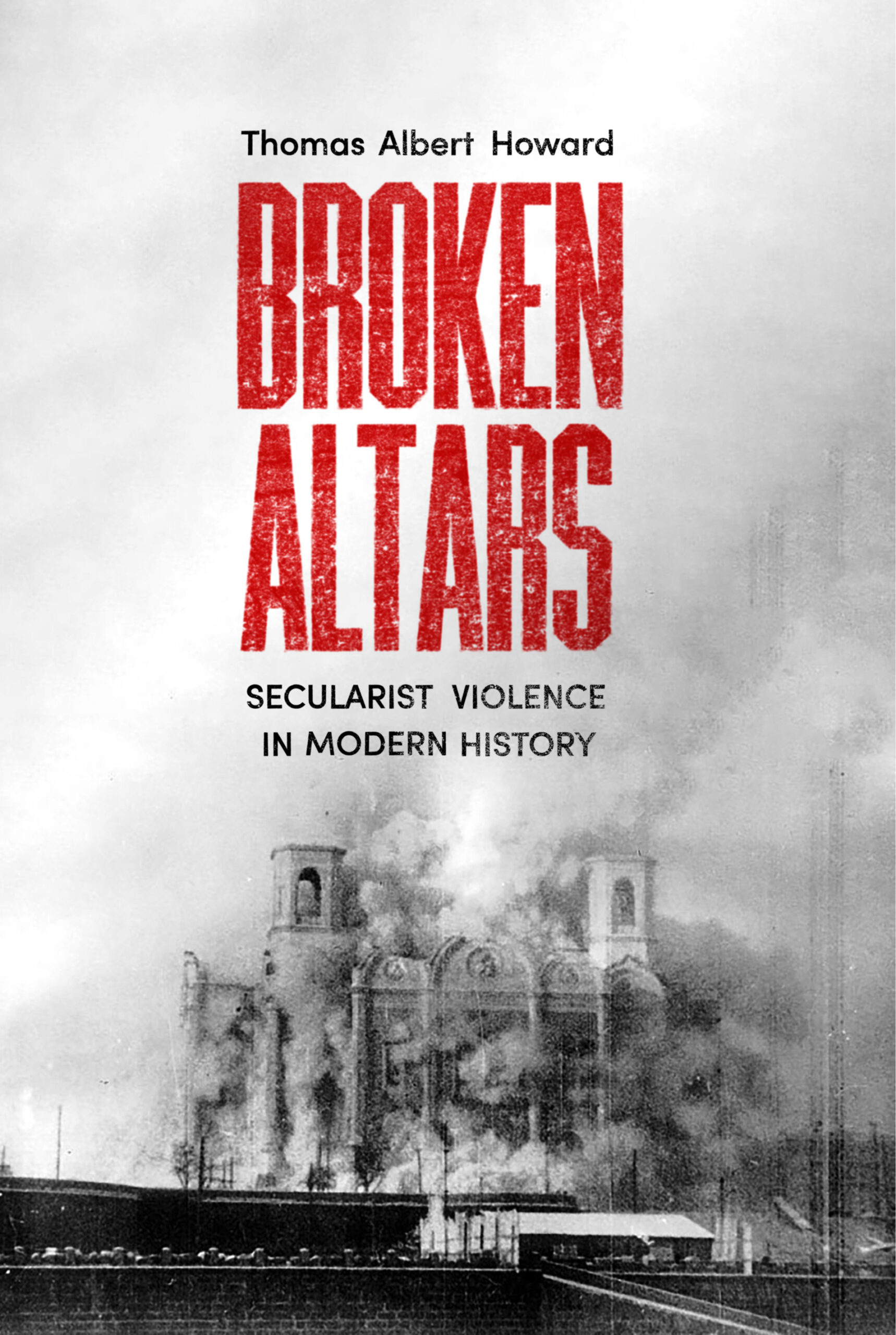
 Joshua Lupo: Professor Howard, thank you for taking the time to talk with Contending Modernities about your recently published book, Broken Altars: Secularist Violence in Modern History. I wanted to begin by asking you to talk a little about what drew you to this project and what you see as the primary intervention it makes into the study of religion, secularism, and modernity?
Tal Howard: Much has been written about religion and violence, especially since 9/11. Some of this scholarship is compelling; some of it less so. In much of it, however, I detected a subtle assumption that religion is inherently prone to violence and therefore must always be restrained or counterbalanced by political secularism. That may be true in certain contexts, but the matter is more complex than this. As I argue in Broken Altars, not all forms of secularism are alike. Some varieties—what I call combative secularism and eliminationist secularism—have themselves generated significant forms of violence. Indeed, one of the book’s central contentions is that the modern era has witnessed not only religiously inspired violence but also large-scale violence carried out in the name of secularist ideologies and projects. Consequently, I call for a more discriminating understanding of secularism and a greater awareness of the forms of violence it has sometimes spawned, particularly in movements such as Marxism-Leninism and Maoism, which I regard as species of eliminationist secularism. This argument does not excuse violence committed in the name of religion, of course. Rather, it situates such violence within a broader and more nuanced scholarly understanding of the modern world and its competing ideological visions.
Joshua: The three-form typology of secularism you describe—passive, combative, and eliminationist—is very helpful for distinguishing among different ways modern secular governments have approached religion. Can you unpack briefly how you define these three types in relation to one another and provide examples from the book in doing so?
Tal: Sure. To understand the modern history of secularism, it is important to recognize that secularism has not existed in only one form. What I call passive secularism is what most people have in mind when they think of political secularism. The American First Amendment is a classic example, insofar as it prohibits the federal government from establishing a national religion while also protecting the free exercise of religion. Yet this model is hardly unique to the United States. The Belgian Constitution of 1831 embodied similar principles, and comparable arrangements can be found in other Western democracies. Passive secularism seeks neither to privilege nor suppress religion, but to create a framework within which diverse religious communities may coexist.
The mistake is to assume that this is the only form secularism has taken. In the book, as you indicate, I distinguish between passive secularism, combative secularism, and eliminationist secularism. The latter two have exercised considerable global influence in their own right and have proven far more destructive toward religious communities and their material cultures.
Combative secularism emerged most dramatically during the radical phases of the French Revolution in the 1790s, when revolutionaries launched a sustained assault on the Catholic Church. From France, this model spread elsewhere. Twentieth-century examples include revolutionary Mexico, Republican Spain, and Kemalist Turkey. Although these regimes differed significantly, each viewed religion not as something to be protected or even left alone, but as a force to be weakened, marginalized, or transformed in service of a modern political project.
More destructive still was what I call eliminationist secularism. Its intellectual roots lay in Marxist and other radical currents of nineteenth-century thought, but it achieved political power with the Bolshevik Revolution of 1917. Unlike passive secularism, which seeks neutrality, or combative secularism, which seeks subordination of religion, eliminationist secularism aspires ultimately to the eradication of religion itself. The anti-religious campaigns of Marxist-Leninist regimes, later amplified under Maoism and related revolutionary movements, produced some of the most extensive persecution and destruction of religious institutions in modern history. Measured by their human and cultural costs, these campaigns constituted the most devastating assault on religious communities of the twentieth century.
Joshua: As you note in the book, scholarship on religion and secularism is often rooted in debates surrounding political liberalism, and especially in the Enlightenment project of the US and Europe. This history of course connects to what you call passive and combative secularism, but it often leaves out Communism and the places in which it has been practiced, like the Soviet Union and China. In bringing eliminationist secularism in as a category, your book begins to correct this gap, which other scholars have also suggested is needed. Given the breadth of material you gathered here, I wanted to know your thoughts on why you think this lacuna in scholarship on secularism has been so pervasive? And what does widening the scope of what is included under the umbrella of secularism reveal about the concept itself?
Tal: Thanks, Joshua. That is an excellent question. As you suggest, when historians and sociologists discuss secularism, the conversation has largely been framed by the history of the modern North Atlantic world—by the Enlightenment, liberal constitutionalism, church-state relations, and debates over political liberalism. Those are important histories, but they are not the whole story.
I think there are several reasons for this. First, the field (secularism studies) itself emerged largely in Western Europe and North America, so its categories and questions have naturally reflected Western experiences. Second, at least in some sectors of the academy, there has been a certain reluctance to reckon fully with the failures of Communist regimes and the devastating consequences of their campaigns against religion. This complicates a widely held narrative of modernity as progressive emancipation. I do not mean that scholars ignore Communist violence altogether, but it has often been treated as peripheral to discussions of secularism rather than as central to them—even if Marx himself was certainly a child of the Enlightenment.
A related point is that many scholars have preferred to describe Communist regimes as examples of “political religion” or ideological fanaticism rather than as forms of secularism. That framework is not without some valuable insights, but it has also had the effect of placing Marxist-Leninist and Maoist assaults on religion outside the mainstream history of secularism. In Broken Altars, I argue that this separation obscures an important historical reality. What is more, it bolsters a simplistic point of view that regards religion, in whatever form, as inherently prone to violence.
Finally, there is a geographical dimension. Some of the most radical experiments in what I call eliminationist secularism occurred in places that have occupied a relatively marginal place in Anglophone scholarship on secularism—Albania, Lithuania, Kazakhstan, North Korea, Mongolia, Tibet, and elsewhere across the Soviet bloc and Maoist China. Yet for millions of people, harsh state-imposed anti-religious ideologies were the paradigmatic experiences of secularism in the twentieth century.
Widening our lens beyond the North Atlantic changes the conversation in an important way. It reveals that secularism is not a single historical project but a family of distinct political arrangements. Passive secularism seeks to protect religious liberty; combative secularism seeks to stigmatize and marginalize religion from public life; eliminationist secularism seeks to eradicate it altogether. Recovering this wider history does not diminish the achievements of liberal secularism, nor does it excuse violence committed in the name of religion. Rather, it gives us a more historically nuanced and globally representative understanding of secularism itself—and of the various forms it has taken in modern history.
Joshua: As a final question, I wanted to ask you to bring the lessons from your book into reflection on our current moment. There is a great deal of discussion in the US now about the “return of religion.” In our politics, we see this in the increased prominence of openly right-wing Christian nationalists taking leadership roles in Washington. Passive secularism, it would seem, is under threat, and this has ramifications for the global order as well. I wonder what you might say to those who see a more militant secularism as the antidote to this problem? And what, if any, alternatives to the secular/religious binary you might propose for diagnosing and addressing challenges in contemporary politics?
Tal: Historians must always do a good deal of throat-clearing before commenting on the present. Any assessment of a “present moment” is necessarily fragmentary because we cannot fully know all the forces shaping the world in which we live. With that caveat, let me offer three observations.
First, I agree that what I call “passive secularism” is under pressure, though perhaps now less from secularism itself than from movements seeking to infuse government with a greater degree of (ham-fisted) cultural religiosity. One sees this not only in the United States but also across Europe and Latin America, where many far-right movements are animated by nostalgia for Christendom, even if many of their leaders and supporters are not especially religious in their own beliefs or practices.
Second, from another angle, some forms of right-wing nationalism have been fueled by reactions against past governmental encroachments upon religious liberty. A frequently cited example is the effort under Obama’s Affordable Care Act to require the Little Sisters of the Poor to provide contraception through the health plans associated with the institutions they operate, despite the order’s Catholic convictions. This worrisome episode alone does not explain the rise of Christian nationalism in its entirety, but it does illuminate one strand within a much larger and more complicated causal nexus. Extremes tend to beget extremes.
Finally, I would argue that an aggressively secularist politics is not the solution. Historically, the United States has cultivated a remarkably healthy form of religious pluralism (passive secularism, in my vocabulary), one that has generally proven more successful than some European models at integrating religious minorities, including Muslims, into public life. France’s tradition of laïcité, for example, has often produced greater tensions between the state and religious communities than the American constitutional tradition. My book profiles its export (and intensification) to Turkey, Spain, and Mexico in the twentieth century.
So, I suppose as the United States arrives at its 250th anniversary, I find myself cheering for James Madison and the First Amendment. Americans—of every faith and of none—should recognize what an extraordinary constitutional inheritance they possess. But constitutional treasures do not preserve themselves. They require vigilance, wisdom, and a sustained commitment. I hope it lasts another 250 years!